Installation of new pulp dryer is the last piece of the puzzle
A project of this magnitude comes with many challenges, and the greatest one for this particular project was to keep to the deadline.
The installation of the new pulp dryer at fibre line 3 was the last piece of the puzzle for the Ngodwana Mill to enter the specialised cellulose (SC) market. It is produced in a newly constructed batch digester plant and bleached in a new bleach plant, and the purpose of the new dryer is to dry the pulp in sheet form ready for cutting and baling. It is dried in one continuous sheet, suspended on a cushion of hot air.
The dryer is 35 metres long, 19 metres high and 12 metres wide, and the pulp sheet traverses the length a total of 22 times before it finally leaves as a continuous sheet. It is then cut and baled into a saleable product. At any given time there will be 770 metres of semi-dry pulp inside the dryer.
To be cost-effective, the old dryer had to be demolished and the new one installed in its place inside the existing building. Under optimum conditions, this operation would have taken a minimum of 12 to 18 weeks to complete. The project team was faced with a deadline of six weeks. This called for extraordinary measures. The best option was to construct the new dryer completely on its steel platform outside the building, and use a multi-wheeled mobile trolley to manoeuvre it into place.
The same trolley was also used to remove the old dryer in one piece to enable demolition to take place outside.
The end wall of the existing building would have to be removed, but the roof would remain intact. The only problem with this method was that it had never been attempted before. The concept was discussed with an international crane and rigging company specialising in project logistics, Sarens. It proposed to use a self-propelled modular trailer (SPMT) for this purpose. These comprise multiple hydraulic lift units on steerable wheels, which are interconnected to form an SPMT. Sarens has used this system successfully worldwide to move extraordinary large pieces of equipment and was confident that this would be the best way to proceed.
After considering the merits of the proposal, Sappi agreed and a team of Sarens and Andritz Engineers started working out the details. Andritz had to redesign the dryer frame as the standard dryer is a relatively light-weight structure, which was not designed to be moved once constructed. The Andritz and Sarens mechanical engineers collaborated to determine the maximum lateral and transversal forces that could be expected during a move with an SPMT and then strengthened the dryer structure sufficiently to overcome these forces. Based on the outcome of this study the decision was taken to change the construction methodology and the project team started with the necessary preparations. The area outside the old dryer building had to be raised, compacted and levelled to enable smooth movement for the SPMT. Construction of the new dryer commenced in November 2012 and was completed in February 2013. The new dryer was erected complete with all platforms, walkways and handrails. All fans, motors and control instrumentation were installed, ready for cable connection once the new dryer was in position. The successful completion of the installation of the new pulp dryer underlined the potential that can be unleashed when international companies work together to achieve a common goal.
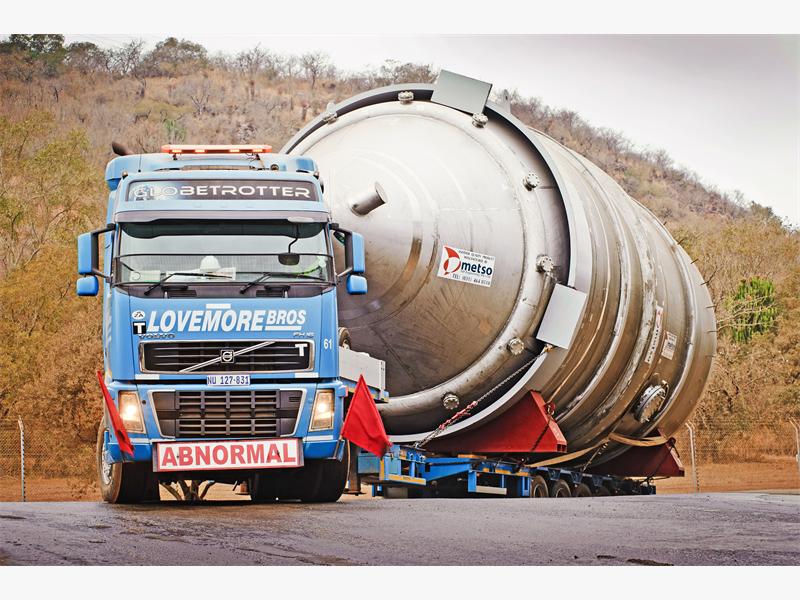
Transported by Lovemore Bros, these digestors left Durban on the back of three low-bed trucks. Because of the size of these digesters, it took them almost two weeks to do the trip.
They took up most of both lanes and for this reason the convoy had to be escorted all the way and the route had to be planned very carefully. Eskom along with Telkom, SAPS and the local traffic department of each town along the route, were on board to ensure road safety, and to take down and put up power and telephone lines.
The clearing height of the freight (7,5 metres), forced them to travel via Nelshoogte and Kaapsehoop and not the ZASM tunnel in Waterval Boven.
A project of this magnitude comes with many challenges, and the greatest one for this particular project was to keep to the deadline. This project would normally be executed over a longer time period. As a result there was much more emphasis on selecting and modifying methods and design. During the civil construction phase, a very tight schedule had to be met. In this period at least 1 500 concrete piles were installed to secure the building foundations. These foundations used 1 380 tons of reinforcing steel and 14 000 cubic metres of concrete.
A further 710 tons of structural steel was erected to complete the building works.