Treaty brings end to bloodiest war in history
15 million soldiers and civilians died in the Great War
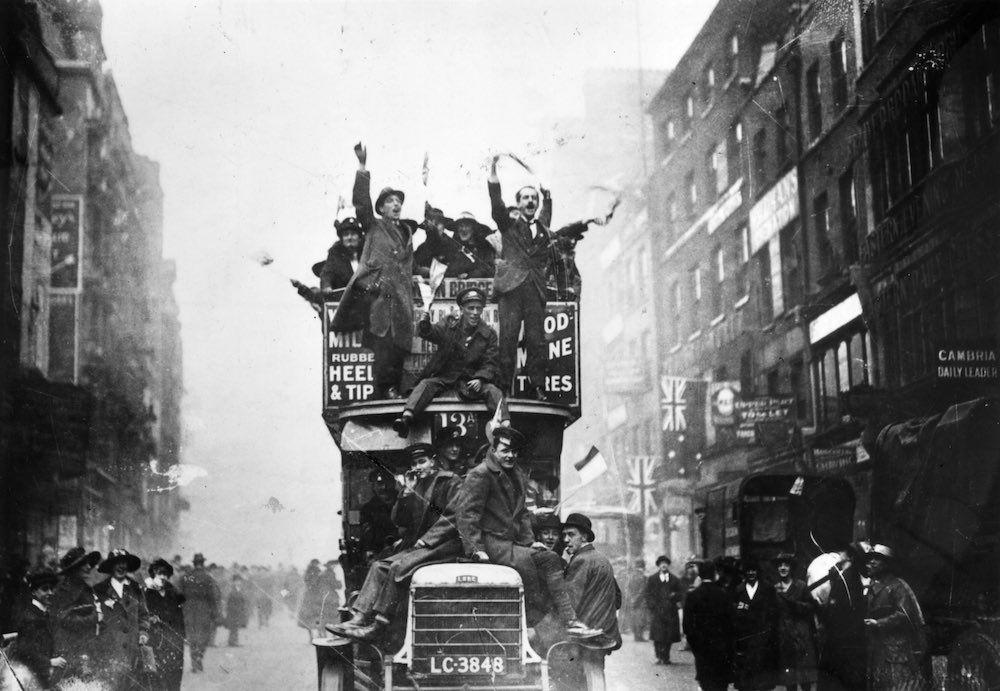
Sunday will mark the 100th anniversary of the armistice ending what was then known as the Great War. It was, at the time, the bloodiest war in the history of mankind. The armistice, signed at 11:00 on November 11, 1918 (the 11th hour of the 11th day of the 11th month) ended fighting on land, sea and air in World War I between the Allies and Germany.
Previous armistices had eliminated Bulgaria, the Ottoman Empire and the Austro-Hungarian Empire from the war.
Also known as the Armistice of Compiègne, after the place where it was signed, it marked a victory for the Allies and a complete defeat for Germany, although not formally a surrender.
The actual terms, largely written by the Allied supreme commander, Marshal Ferdinand Foch, included the cessation of hostilities, the withdrawal of German forces to behind the Rhine, Allied occupation of the Rhineland and bridgeheads further east, the preservation of infrastructure, the surrender of aircraft, warships, and military materiel, the release of Allied prisoners of war and interned civilians, and eventual reparations. No release of German prisoners and no relaxation of the naval blockade of Germany was agreed to.
Although the armistice ended the fighting, it needed to be prolonged three times until the Treaty of Versailles, which was signed on June 28, 1919, took effect on January 10, 1920.
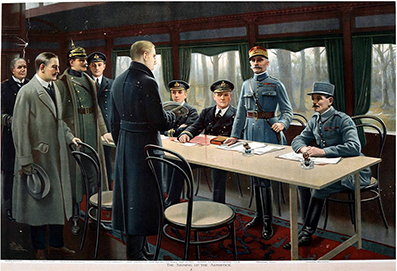
The Armistice was the result of a hurried and desperate process. The German delegation headed by Matthias Erzberger crossed the front line in five cars and was escorted for ten hours across the devastated war zone of Northern France, arriving on the morning of November 8. They were then taken to the secret destination aboard Ferdinand Foch’s private train parked in a railway siding in the forest of Compiègne.
Foch appeared only twice in the three days of negotiations. On the first day, to ask the German delegation what they wanted, and on the last day, to see to the signatures.
The Germans were handed the list of Allied demands and given 72 hours to agree. The German delegation discussed the Allied terms not with Foch, but with other French and Allied officers.
https://www.citizen.co.za/lowvelder/458639/honouring-war-dead-legendary-lowvelders-idea/
The Armistice amounted to complete German demilitarisation, with few promises made by the Allies in return. The naval blockade of Germany was not completely lifted until complete peace terms could be agreed upon. There was no question of negotiation. The Germans were able to correct a few impossible demands, extend the schedule for the withdrawal and register their formal protest at the harshness of Allied terms. But they were in no position to refuse to sign.
On Sunday November 10 they were shown newspapers from Paris to inform them that the Kaiser had abdicated. That same day, Chancellor Ebert instructed Erzberger to sign.
https://www.citizen.co.za/lowvelder/458672/fascinating-facts-armistice/
The cabinet had earlier received a message from Hindenburg, requesting that the armistice be signed even if the Allied conditions could not be improved on. The Armistice was agreed upon at 05:00 on November 11, to come into effect at 11:00 Paris time (noon German time). Signatures were made between 05:12. and 05:20, Paris time.
Source: Wikipedia