Water crisis: Supply cut of 20% – More water restrictions imposed
The severe drought and low water level of the Flag Boshielo Dam, one of the city’s major sources of water, necessitated drastic intervention by the Department of Water and Sanitation that has resulted in a reduction of 20% of the water provided to Lepelle Northern Water for distribution to the city. According to information reflected …
The severe drought and low water level of the Flag Boshielo Dam, one of the city’s major sources of water, necessitated drastic intervention by the Department of Water and Sanitation that has resulted in a reduction of 20% of the water provided to Lepelle Northern Water for distribution to the city.
According to information reflected on the department’s website, the dam’s level was at 20,2% at the end of last week, while the average level of dams in the province is at a worrisome 46,9%. The Glen Alpine, Mutshedzi and Nsami dams are respectively at 1,4, 4,5 and 8.1% of capacity while the Luphephe, Nzhelele and Tzaneen dams are at 13,9, 16,7 and 18,4% respectively.
The South African Weather Service indicated on its website that the rainfall for Polokwane for the month ending on 1 October was only 2mm, opposed to the norm of 7mm for the same period during other years.
Matshidiso Mothapo, acting Communications and Marketing Manager of Polokwane Municipality, said in a media release that shortages of water may be experienced later this week as a result of the reduction in supply. “The reduction will be automatically lifted and or intensified as and when the situation improves or worsens. The restrictions will affect all areas in Polokwane. This is a reduction of supply on top of a reduction that was implemented from July 2016 resulting in the production at the Olifantspoort and Ebenezer plants to go down drastically and supply to Polokwane to drop as well. Now with these restrictions in place, it would be difficult for the reservoirs to recover to comfortable levels. Should the reservoirs continue to decline, the municipality will consider rationing or rotation of supply,” Mothapo said.
According to Mothapo, watering of gardens and cleaning pavements with hoses have been identified as the primary consumer of water in residential areas.
“Watering of gardens is prohibited and the public is advised to use water for human consumption and domestic use only. If the consumers continue to disregard these warnings the systems would collapse resulting in shortages,” Mothapo added and warned that the municipality will continue to enforce current water restrictions by issuing R1 000 spot fines to anyone who is found watering gardens. “Those who have own boreholes are requested to use water sparingly because the municipality also depends on underground water tables to augment supply to other residents,” Mothapo said.

Mothapo also explained that the municipality will among others continue with the reduction of flow to low catchment areas and throttling of the system to avoid reservoir levels to reduce drastically.
Hoërskool Pietersburg responded to the situation by deciding that watering of all its sport fields and gardens will be terminated with immediate effect.
On Monday Mothapo reported that the levels of the new 50 and 30 mega litre reservoirs were at 38% and 27% respectively, while the level of the Potgieter Avenue reservoir was at 80% of capacity. The Seshego reservoir was at 32%. The level of the old 30 mega litre reservoir was 27%. The flow from Ebenezer Dam and the Olifantspoort plant was 172 and 144 litres per second respectively.
Capricorn District Municipality (CDM) has also reduced the supply of potable water by 30% for domestic usage and by 55% and 100% for mining usage and agriculture respectively in Lepelle Nkumpi and surrounding areas such as Zebediela and parts of Mphahlele.
“The restrictions are with immediate effect and the effect will be seen with decreased water pressure until the target is achieved. The restrictions will automatically be lifted as and when the situation improves and we therefore appeal to households in affected areas to limit water usage to immediate household needs such as drinking, cooking and bathing. If these restrictions are not adhered to, dams and reservoirs will run dry and households will experience severe water shortages,” Moffat Senyatsi, Media Liaison Officer of CDM said in a media release that was issued last week.
Matters related to water including misuse can be reported to the municipality on 015 290 2376/2457/2458 or 2001.
Story: BARRY VILJOEN
>>barryv.observer@gmail.com
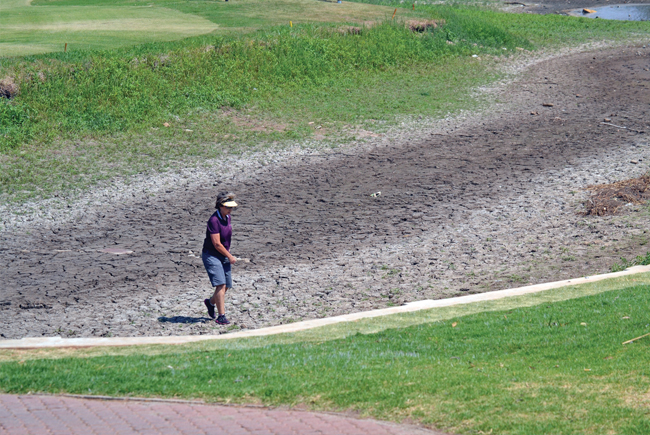
Featured photo: The effect of the drought can be seen at the Polokwane Golf Club where water from boreholes are used.