FEATURE: Hope springs eternal at Thuthukani
The 'Sponsor a Child' project will enable one to help one of these children stay in school for a mere R150 per month.
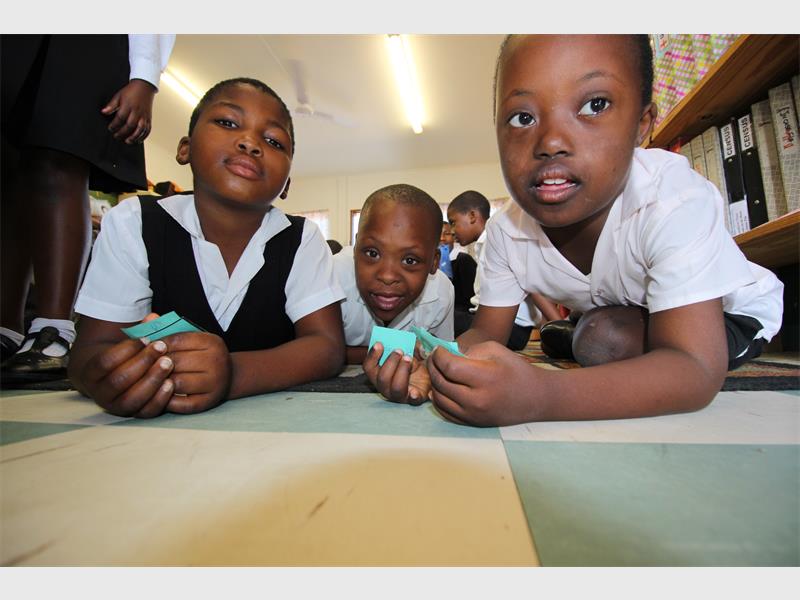
IN 1981 a small seed of hope was planted for Zululand children with disabilities.
This seed eventually grew into a flowering tree, standing tall and casting a welcoming shade for those in need to shelter.
Unbent by the Zululand heat, unwavering in purpose and undeterred by any form of obstacles, Thuthukani Special School has, and still is, looking after those who many would think are beyond hope.
Thuthukani is a place where dreams literally come true, where nightmares are banished, where the seed of hope is passed on and personal battles are fought and overcome.
It is indeed, by all accounts, a special place for very special people.

A need arises
In 1974 Jo James and her husband Chris, an attorney, arrived in Empangeni from Pietermaritzburg.
Jo, a qualified social worker, soon found work at the Zululand Mental Health Society, eventually becoming Principal of Sonskyn Hoekie, a school that catered for white children who suffered from mental disabilities.
The James family welcomed two new additions, Katherine and James, between 1979 and 1981.
Jo spent some time at home before duty called again, and Zululand Mental Health employed her as the Director in charge of the black social workers.
Seated comfortably on a couch with a cup of tea, Jo recounted the days gone by with a stoic determination one only sees from people who offer up their lives to help others.
‘It was during this time that my social workers would come and tell me the most shocking stories of mistreatment of mentally challenged black children,’ she said.
‘There were simply no facilities to cater for these children. Back in those days, there was a huge stigma about mental illness, and it was misunderstood. Some of these children would be left at home alone as their parents had to work.
‘I realised that there was a real need for these children.’

Turning point
Jo threw caution to the wind and started up a school for children in the garage of her Hillview home.
‘We started with four kids. Within a month we had 20. A few months later there were 50 kids with one teacher.’
‘If ever there was a turning point it was then,’ she said.
‘I didn’t have the space to accommodate the children, and I could very easily have given up then and there.’
Jo however, did nothing of the sort.
Instead, she approached the municipality and secured a house in Tanner Road that she rented.
‘We stayed in that three bedroom, single bathroom house for a few years. The school grew and soon we had more teachers and more children of all ages.’
But once again, the school had to expand.
‘I was very fortunate. I had started to look for land a local farmer Owen Johnson came to my rescue. He gave me as much land as I needed.’
At the same time, government realised they would need to be seen investing in black education.
Thuthukani was identified as one of the beneficiaries, and construction of the new school building took off.
It was not all smooth sailing, and Jo remembers some of the resistance she encountered.
‘You must remember we were still very much in the years of Apartheid. Some residents refused point blank to allow mentally challenged black children near them.
‘I think the most rewarding moment during those difficult times was the night we had our first ever concert.
‘It was an incredible success. We taught our kids ballroom dancing and on the spur of the moment all our guests joined in, some of them even dancing with the kids.
‘It was a profound moment. I saw real participation, and without the buy-in from the community, Thuthukani would never have become a reality.’
It was through these hardships and racial stereotyping that Thuthukani Special School, the very first inter-racial school for the mentally challenged, was born.
Jo served on the governing body of the school up until 2013 when she and her husband moved back to Pietermaritzburg.

Life skills
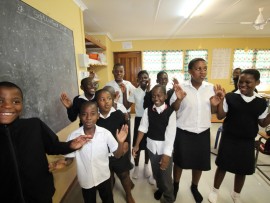
Today the school caters for 360 learners, all with varying levels of mental disabilities.
The waiting list stands at 120 children who have been fully assessed and certified as needing to be taken in.
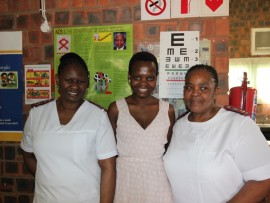
A staff complement of 53 Department of Education staff, 15 members of the governing body and 23 volunteers are needed to run the school.
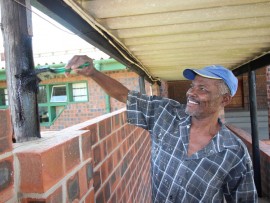
This ranges from teachers, teachers’ assistants, cleaners and groundsmen.
The current success of the school can only be attributed to the dedicated staff under the leadership of Principal Martie Combrink.
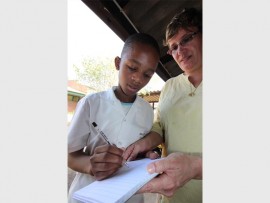
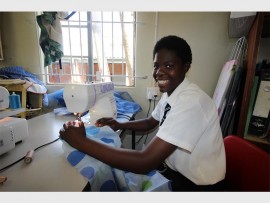
With initiative and lots of love, the teachers take the children through their first steps of education, right through to teaching them valuable life skills they need to survive in a world that is often difficult to cope with, even for those without disabilities.
An adult skills workshop, made possible by local businessman Peter Bannock, also employs mentally disabled adults who work in facilities on the school grounds to earn a salary in a safe working environment.
It is a place of tangible peace and passion. Having spent a morning at the school, this journalist can attest to the love and attention every member of staff gives to each and every learner.
They celebrate successes, encourage and discipline, working everyday without fail to ensure these children are given every opportunity to lead a life not confined by their challenges
The stark reality however, is that this wonderland is almost always staring financial difficulty in the face.
Understandably, it costs the school an enormous amount of money to cater for the children.
‘Many people do not realise that of our 360 learners, only 14% of the parents can afford the school fees of R150 per month,’ said Tanya Gervin, Occupational Therapist and PRO for the school.
We only have R1.13 per child for a meal per day as per department guidelines. It really is difficult.’

How can you help?
Thuthukani has initiated a campaign, among other fund-raising efforts, to help the school keep the doors open.
The ‘Sponsor a Child’ project will enable one to help one of these children stay in school for a mere R150 per month.
‘The money will go straight into ensuring we can provide every child with the necessary books, stationary and clothing,’ said Gervin.
‘If you think about it, it really is not a lot – but it can make a massive difference to the children.’
Tanya can be contacted on 035 7920080 or 081 5916965, alternatively email to info@thuthukani.org.za.
Despite these difficulties, staff at the school do not show any sign of relenting in their endless drive to better the lives of these children, some who do not have the ability to even dress themselves.