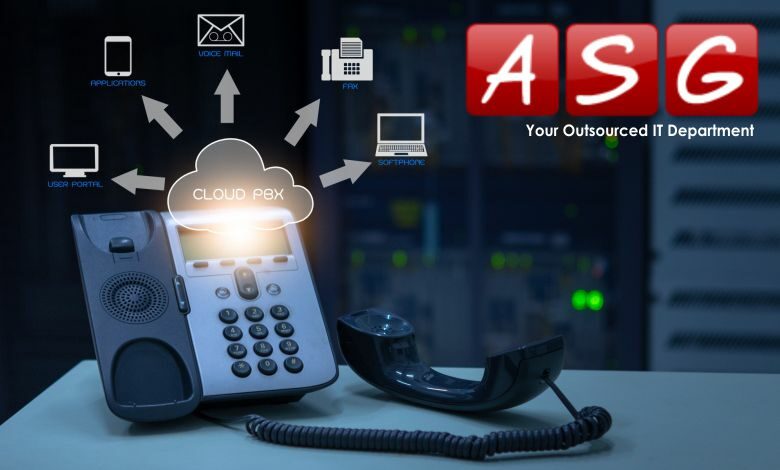
When most people hear a reference made to “The Cloud,” their thoughts typically go to cloud computing and cloud storage. This is a subset of innovation whereby infrastructure is constructed by utilising application-based software to manage data across several servers located in various places.
In addition, it enables individuals to conduct jobs and access organisational information through the internet, without the requirement for gear and databases to be hosted in their workplaces.
Cloud-hosted PBX phone networks have grown in popularity over the last several years. The possibility to add a comprehensive phone system with all the features and tools that you could want without installing or maintaining any equipment is very tempting to many small companies.
However, having a phone system that is completely reliant on the strength of an internet connection may not be appropriate for certain organizations. Before businesses decide whether they want to switch their traditional PBX system to a cloud-based PBX system, it is critical to understand what a cloud PBX system is, how it works, and how it might benefit your organization.
How does Cloud PBX Work?
When you use a cloud PBX service, your phone system is hosted by the service provider, who is also responsible for providing you with phone service. Any calls, signals, and features are handled by a server at the provider’s physical location, which is connected to a router and sent via the internet so that employees and customers can be connected no matter where they are based. In other words, employees can ‘be in the office’ while working remotely.
Phone system communications services, such as call waiting and voicemail, are all handled by the phone system’s PBX (phone system’s central processing unit). A call flow is a set of characteristics and rules that you may attach to a certain phone number in your system.
Traditional vs Hosted (Cloud) PBX
To understand how a Cloud-hosted PBX differs from the traditional system, a side-by-side comparison is necessary and can be viewed as follows:
| Traditional PBX Systems | Cloud-hosted PBX |
| Advanced user tools and equipment is necessary, there is a real-time call management | No hardware is required, all operations are managed by the cloud, scalable solutions, complete portability, and flexibility guaranteed |
| High maintenance requirements | Low maintenance |
| Call quality and reliability is extremely high | Average to good call quality and reliability – dependent on internet connection |
| There are extremely high set-up costs involved | The set-up costs are extremely low |
| There is a limited number of lines, which means low scalability | Lines can be upgraded easily where, when, and as needed hassle-free |
| Must be uninstalled and re-installed if the business relocates | Office moves are simple and all that is needed is to pack up the phone and connect once the broadband system is set up in the new location |
| Requires extensive technical support such as IT managers | Offers great features without constant technical support available on-site, remote maintenance can be done |
Benefits of Cloud PBX
- The set-up time with Cloud-hosted PBX is low and much faster
- The business can easily add new users and they are available immediately
- There is device flexibility and users can easily connect using their smartphones, desktop PCs, or VoIP phones
- Cloud-based PBX does not require as many hardware resources
- Well-known as a feature-rich solution
- Lower set-up, maintenance, and operational costs
- Indefinitely scalable solutions offered
You might also be interested in: How to get your home office in working order