Robertsham student returns from China inspired by supercomputing challenge
Wits student returns from China Supercomputer Challenge inspired.
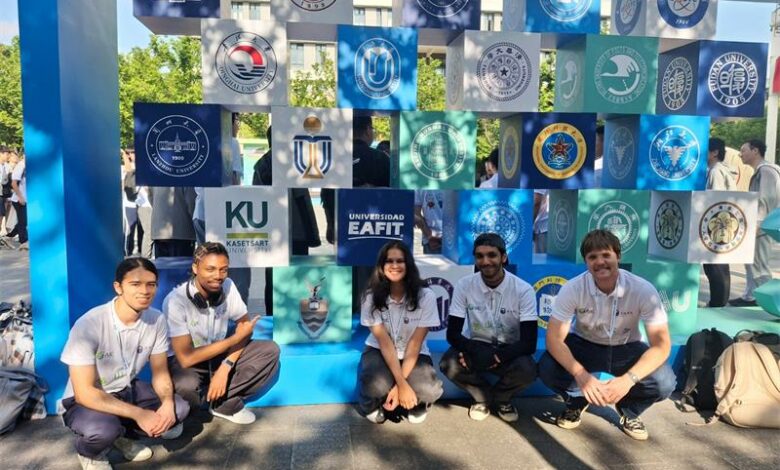
Mubeen Dewan, a third-year computer science student at the University of the Witwatersrand, returned from China proud of his participation in the 2026 ASC Student Supercomputer Challenge.
The event took place over five days.
The Robertsham resident returned to South Africa on May 22 after competing at Wuxi University, where the international challenge was held.
Speaking to the Southern Courier/Comaro Chronicle, Dewan reflected on his experience in China, sharing insights into the technical demands of the competition, teamwork and collaboration, learning opportunities, cultural experiences, and the impact the event will have on his future in technology and research.
• What was the toughest part of optimising the ASC benchmark applications on the cluster you were given?
“On a macro level, the toughest part was definitely balancing the time constraint with the risk of optimisation, deciding whether to lock in a slower baseline or risk profiling for a better score.
“However, underneath that time pressure, the actual technical bottleneck varied by application. For instance, power tuning was our biggest hurdle. We spent hours balancing the speed at which we could run our application with the 5000W power limit. Because these technical optimisations were so finicky and time-consuming to validate, our strategy became a strict trade-off game.”

• How did your team split the workload, and what was your role during the onsite finals in China?
“Going into the competition, we had a loose structure for who was in charge of which portion of application optimisation. But during the competition, we made sure everyone was always on the same page, so if need be, you could offer a second perspective to someone, and nobody would be left completely lost. I was in charge of a portion of the setup of the cluster that we built, dealing with the networking and one of the application benchmarks, ‘QiboTN’ – a quantum computing simulation platform.”
• How did the hardware and software stack at ASC compare to what you use in your computer science labs at the university? Did you get hands-on with anything you hadn’t touched before? What was it? Please elaborate.
Compared to the practice cluster that we had set up back home in South Africa, the hardware we were given was similar in some aspects but introduced some major changes in architecture.
“We were aware of these changes going into the competition, so we weren’t completely blind, but we still lacked access to test these new aspects back home.
“Mainly, this cluster had four graphics processing units (GPUs), which we don’t have access to at our university’s high-performance computing (HPC) lab.
“GPUs are notoriously expensive and difficult to get a hold of for practice, let alone for actual commercial use, but they offer an entirely new way to compute problems and are always sought after.
“Another piece of hardware that we were introduced to was Infiniband networking. InfiniBand is the high-performance counterpart to Ethernet cabling, enabling extremely fast (hundreds of GB/s) data transfer within the cluster.
“In South Africa, InfiniBand is almost entirely found in research facilities rather than commercial environments, so it was really fascinating to get hands-on access and learn to use it effectively. I was actually responsible for setting up the InfiniBand software on the cluster, and considering I had never used it before, I think we did a great job figuring it out on the first day.”

• Besides the challenge, what stood out about how tech and student teams operate in China vs South Africa? Any difference in preparation style, debugging approach, or how mentors interact with students?
“It was fascinating to see how other teams approached the preparation phase. For us, preparations involved extensive research into the theory behind the applications, followed by testing installation and optimisation ideas on our practice cluster.
“In contrast, some of the veteran teams immediately began rewriting entire applications from scratch in other programming languages. It was definitely a shock to see that level of divergence in strategy, but after talking with them, we realised it was a deep tactical insight they had developed after competing in ASC for several years in a row.
“Another point that really stood out to us was the attitude the competition took toward AI programming agents. Instead of restricting them, the organisers openly encouraged teams to use AI tools to our advantage to discover more optimisation techniques within the strict time limit. It was a refreshingly progressive approach that felt less like a rigid academic test and more like a real-world look at the future of complex problem solving.”
• Now that you’ve worked on real HPC workloads under time and power constraints, what’s changed about how you think about algorithms and systems design for your final year projects and beyond?
“Diving deep into the code of these scientific applications has given me a much stronger foundation for large-scale, complex problem solving. HPC is truly the backbone of any research-based computational field, whether it’s medicine, physics, engineering, or biology, and experiencing that first-hand has completely changed how I approach finding answers.

“Moving into my final year projects and future research, I no longer just think about whether an algorithm works, but how it scales and behaves under real-world constraints. I’ve never been more motivated to contribute my skills to scientific discovery than I am today!
After this trip, Dewan’s experience not only sharpened his technical and problem-solving skills but also opened his eyes to the future of high-performance computing and artificial intelligence.
He believes the exposure gained in China will inspire more South African students to pursue innovation, research and global collaboration in the rapidly evolving world of technology.