Ekurhuleni a better place 20 years on
The mayor paid homage to the stalwarts who sacrified their lives for the democracy which now enters its 20th year

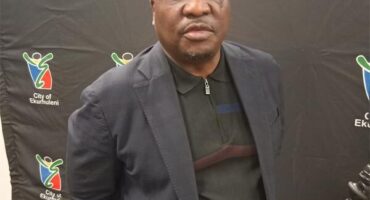
EKURHULENI mayor, Clr Mondli Gungubele, painted a picturesque scene of a growing and bustling city during his state of the city address in Germiston last week Wednesday.
He aligned the metro’s growth and progress with that of the province, highlighting the areas in which Ekurhuleni outperformed Gauteng.
“We estimate the Gross Geographic Product of Ekurhuleni to be R204 billion, or 6.4% of national GDP. This amounts to an average growth rate of 10.5% from 2002, when our GGP was estimated at R74 billion.
“The 10.5% average growth since 2002 is slightly higher than the national average of 10.4%. In the same period our unemployment rate was on a steady decline, from 35% in 2002 to 28.1% in 2012,” he said.
He said although there was a significant percentage of growth, they were looking to reduce the unemployment rate further. To this end, the metro has put several programmes in place to ensure this number keeps declining.
Gungubele said the city was committed to surpassing its goal to create 20 000 jobs during the current financial year. The metro has in the meantime, through various initiatives, created the following jobs:
1 100 young people were placed within EMM and external companies through the youth work readiness programme.
120 jobs were created in leak repairs to 2 900 indigent households and 21 schools in Tsakane, Langaville and Geluksdal. It is envisaged that by December 2015, 43 000 leaks to indigent properties in the same areas shall be repaired, resulting in the creation of an additional 250 jobs.
20 graduates were recruited to pilot an e-Siyakhokha collection programme. It is envisaged that the e-Siyakhokha team will be expanded in future to cover all areas of the city.
400 environmental health practitioners were recruited by the department of health and social development.
173 jobs were created through six refuse collection cooperatives in informal settlements.
Not neglecting to invest on education and skills development, at least 1 000 people have been chosen to take part in the Recognition of Prior Learning Programme through two FET colleges as well as Indlela Trade and Testing Centre.
The metro has invested R6 million in this project.
To date, 69 bulk meters have been installed to informal settlements in order to ensure that the metro can account for the water supplied to each settlement,and monitor and mitigate leakages and wastage in areas where these occur.
Gungubele added that by June 2016 the metro would have installed more than 40 000 water meters – of these 8 400 have already been installed in various townships. To date over 17 000 old meters had been replaced and they anticipated to replace 90 000 more in the next two years.
The mayor also spoke about the metro’s commitment to sustainability and the various projects they would embark on to ensure this.
“We are on course to create environmental consciousness in our communities while empowering residents to take ownership of waste management and refuse removal responsibilities in the neighbourhoods where they live.”
In addition the metro had extended refuse collection to informal settlements by appointing six refuse collection cooperatives. The metro has also taken a decision to roll out wheelie bins to all formal households. So far almost 40 000 have been rolled out and it is expected that the project will be completed by 2016.
As a means to standardise, the waste removal timetable has been changed by keeping the days of the removal service constant. This means that despite there being a public holiday on a collection day, refuse removal will continue regardless.
Gungubele said energy had always been a contentious subject within a majority of areas in the metro.
“Energy is one of the key interventions of this government. The programme has seen us work towards eradicating electricity backlogs, subject to limitations of available resources.
“More than 10 500 households that did not have electricity last year, had been electrified. Next in line to enjoy the benefits of electrification are the communities of Esselen Park extension,” he said.
Residents in informal settlements will receive solar lighting and high mast lighting around the settlements. To this end over 30 000 homes in informal settlements have become beneficiaries of solar lighting panels.
As part of urban renewal that is still in the pipeline, Tembisa will undergo a facelift in an urban renewal project which National Treasury has committed R8-million to in the current financial year and a further R50-million in the next.
Prior to rolling out the BRT system, the city first has to ensure that the infrastructure enables the bus system to run. Phase 1 of the plan starts from Tembisa to Vosloorus via Kempton Park and OR Tambo International Airport.
Construction has already started in certain areas. Rev RTJ Namane Road in Tembisa and Pretoria Road in Kempton Park have seen the commencement of the implementation of pedestrian walkways and cyclist paths as these are feeder routes to the system.
Meanwhile the metro has extended municipal bus routes and added additional routes for commuters travelling from Katlehong, Vosloorus and Reiger Park to Rhodesfield to catch the Gautrain.
Gungubele also reflected on the work that had been done on roads and storm water infrastructure.
“As of December 2013, we had constructed 63.5km of new roads and 23km of new storm water systems. This adds to the 168km of new roads constructed since 2011. In addition to these, we have further constructed 6.7km of new pedestrian walkways and graded 87.3km of roads in informal settlements,” he said
He highlighted the limitations of drainage in the city, attributing it to the legacy of the initial design. A proposal will be put forward to deal with the impact of flooding in the city.
“After the recent heavy rains, which left a trail of destruction on our roads, we are paying special attention to the resulting potholes,” he added.
Gungubele said finances were important in ensuring control of funding and revenue generation activities. The metro received an unqualified audit for the fourth consecutive year.
“We still aspire towards a clean audit during the 2013/2014 audit cycle. In addition, we have retained our credit rating, which rates us at the highest level of the metros in our country,” he said.
In the previous financial year, the collection rate was 92 per cent, lower than the set 93 per cent target. One of the key issues going forward is to address efficiency in the billing and collection system.
“With some residents sometimes querying their accounts, you will be glad to know that as from June 2015, those who still have reason to doubt their accounts will be able to pursue their complaints with the soon to be established Municipal Ombudsman, who will be able to provide independent assessment and determination of the facts of their appeal,” he said.
Gungubele reiterated that South Africa and Ekurhuleni were a far cry from what it was 20 years ago. The dawn of democracy in April 1994 enabled all South Africans to enjoy a country that was no longer politically unstable, racially segregated and economically depressed.
“A lot more still needs to be done though, particularly to defeat the country’s triple burden of unemployment, poverty and inequality,” he concluded.