
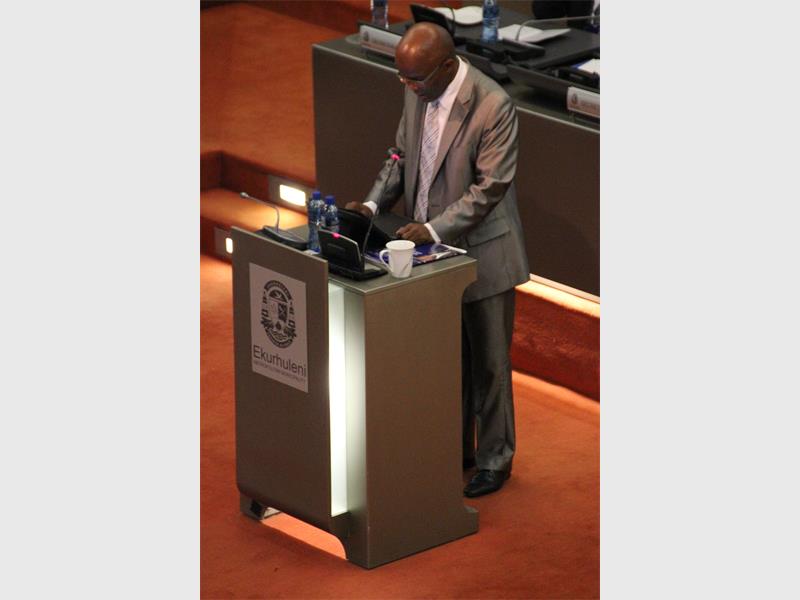
ONE of the mayor’s goals for Ekurhuleni when coming into office in 2011 was to improve service delivery to those less privileged.
Speaking at Ekurhuleni’s 2015 State of the City Address on March 25, Clr Mondli Gungubele said as a result of these goals, the mayor’s office adopted a three-dimensional value beam, one of them being to maintain the high standards of quality services already there and in the same breadth improving the services of those in less affluent communities.
One of these missions was to establish a fire fighting reserve force to assist in informal settlements, where fires are rife during winter. The metro had also committed to introduce a community-based peace corps in each of its 101 wards for safety purposes.
“We have walked the talk. A fire-fighting reserve force of 600 members has been established and they have been instrumental in the reduction of fires in informal settlements. We have also employed an additional 170 firefighter and emergency care practitioners to increase capacity.”
The metro has also recruited, trained and placed 1 010 peace corps (10 per ward) in identified hot spots dealing with scholar patrols, traffic control and foot patrols.
Since 2011, the city has spent R46.8 million in the construction of new fire stations and disaster management satellite offices, including the one launched in Isando last year. By June 2016, all previously disadvantaged communities will have fully functional fire stations.
The city has since 2011 also improved its provision of emergency services by procuring 69 new ambulances – 48 of these purchased by the metro in 2013 and 2014 and the rest coming from provincial government.
Nine fire engines and one disaster bus were also added to the emergency services family, which all contributed to shorter response times for emergency calls.
“Emergency calls responded to within 15 minutes increased from 15.78% to 58.49% and those responded to within an hour is now at 100% from 4.44%.”
Access to flushed toilets increased by 3.5% and clean water inside dwellings by 14,1 %. Access to electricity increased by 7% and access to weekly refuse removal grew by 0,5%.
The municipality has extended access to clean water to all people, including those living in informal settlements. This includes the 27 119 additional households provided with minimum water supply during the past three years. In addition, the quality of our water has continued to improve, maintaining the blue-drop status for the past three years.
“I can say with unwavering pride that our water remains the best water to drink in the country to date. This must be attributed to the metro’s boldness to invest around R12 million on water quality management each year.”
But the city is still one of the main contributors to the county’s water loss woes of R7 billion a year, that’s why the metro is making efforts towards dealing with water loss, including repairing leaks at 10 551 properties, replacing and upgrading 106km of water pipes and replacing 15km of sewer pipes.
The metro is also looking into diversifying the mix of its water sources by exploring the options of reclamation and re-use of treated effluent (liquid waste or sewage) from its ERWAT waste water treatment works, rainwater harvesting, ground water and the use of neutralised or purified acid mine drainage water.
However, the presence of heavy metals, pharmaceutical active and endocrine disrupting compounds (ECD’s) in waste water effluent remains a major cause of concern that needs to be considered and thoroughly researched.
The issue of electricity continues to be problematic with regards to the shortage of power throughout the country, which has led to the implementation of massive load shedding.
“The present power situation is not good for the economy of the country and especially not for a city like ours, which thrives on manufacturing. Our energy department has installed 138 518 energy efficient lights in all council buildings, saving the city R11.2 million a year.”
The metro is also making efforts to introduce renewable energy sources and as such have commissioned the Biomas Power Plant at Simmer and Jack Landfill Site to generate electrical energy using landfill gas.
One mega-watt of power can be generated from the landfill site and transmitted to the Wychwood Substation in Germiston, thus relieving the pressure on the national grid. A 200kVA Leeuwpan Dam solar plant has also been completed at the OR. Tambo Cultural Precinct in Wattville. This is the first PV plant fully owned by local government in the country.
“The metro’s commitment to providing quality and sustainable services to our residents cannot be doubted as proven by our investment of R1.14 billion into our electricity infrastructure programme since 2011.”