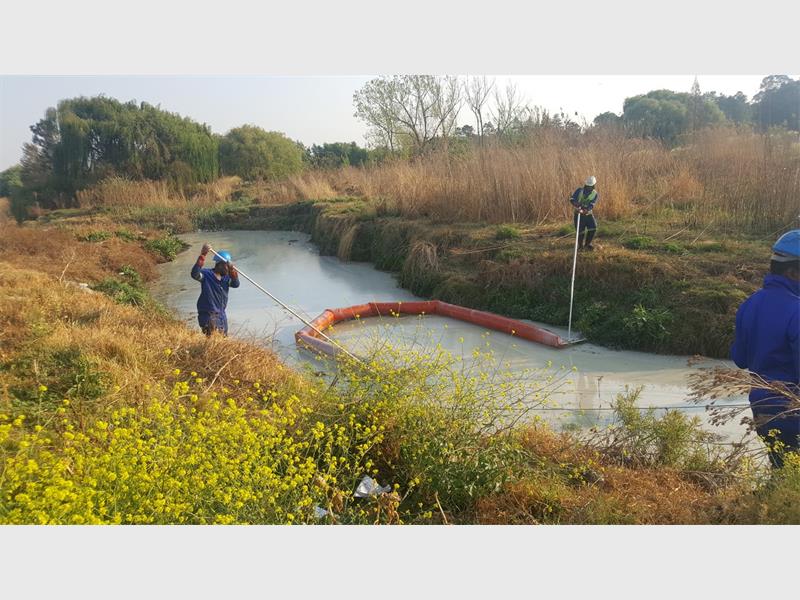
THE metro is keeping a close eye on the clean-up of a major oil spill into the Swartspruit, following a fire at an Isando warehouse on September 8.
Ekurhuleni Metro Municipality spokesman, Themba Gadebe, said a report on the incident was only expected in 14 days.
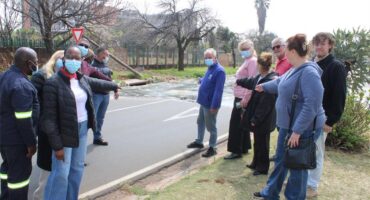
“Residents are requested to avoid contact with the polluted section of the river and to take care when passing the Drizit base of operations at the corner of CR Swart Drive and Kelvin Street near Festival Mall.
“Should anyone find any wild birds or other animals that may have been affected by this incident, they are requested to report this to the Drizit 24-hour toll-free number on 0800 202 202,” said Gadebe.

“The City of Ekurhuleni will continue to monitor the clean-up operation and will ensure that the company rehabilitates the affected environment to its original condition,” Gadebe said.
GUD Holding divisional director – group legal and human resources manager, Anthony Trickey, said it was still premature to give a full report on the extent of the oil spillage in the Swartspruit as a result of a fire at their distribution warehouse.
The fire at the premises of GUD Holdings resulted in the discharge of significant amounts of lubricating oils into the storm water system, contaminating about a 7km stretch of the Swartspruit.
Also read:
• Swartspruit oil spill: it’s too early to determine the extent
• Warehouse fire causes huge oil spill in Swartspruit
• WATCH: Isando factory goes up in flames overnight
Trickey said they were working closely with the Gauteng Department of Agriculture and Rural Development, directorate: environmental compliance monitoring and the City of Ekurhuleni, environmental resource management department on resolving the matter.
Hazmat spill response company, Drizit Environmental, called upon by GUD and GUD’s insurance company, has been on site at the polluted section of the spruit between Isando and the CR Swart bridge opposite Festival Mall.
“We are doing everything possible to address the spillage and will release a statement once the clean-up and containment is complete,” said Trickey.

Trickey said experts called upon included an aquatic scientist. They would be responsible for the following: conduct an ecological assessment of the site aquatic and wetland, derive an impact of the spill, conduct soil and water pollution assessments, make recommendations regarding pollution mitigation and rehabilitation from an ecological and soil chemistry perspective and monitor pollution plume and cleanup progress.
“We are taking full responsibility for the oil spillage but we have requested that water samples previously taken be examined to determine the extent of water pollution that existed prior to the oil contamination,” he said.
Gadebe said GUD Holdings, as the owner and in charge of the oil, was ultimately responsible for any contamination and the clean-up of the polluted environment.
“EMM has issued correspondence to the company reminding them of their responsibility in terms of section 28 and section 30 of the National Environmental Management Act (NEMA) to rectify the pollution and rehabilitate the affected environment,” he said.
What are the implications of the contamination?
In general terms, the contamination can have a deleterious impact on water quality, flora and fauna of the river system. In addition, the oil has contaminated the storm water infrastructure (ie drains) and would have to be flushed from the system.
The exact impact on the environment can only be determined by a specialist study.