Being at the top … exhilirating!
He climbed for the Caring4Girls initiative that supports needy girls with sanitary towels
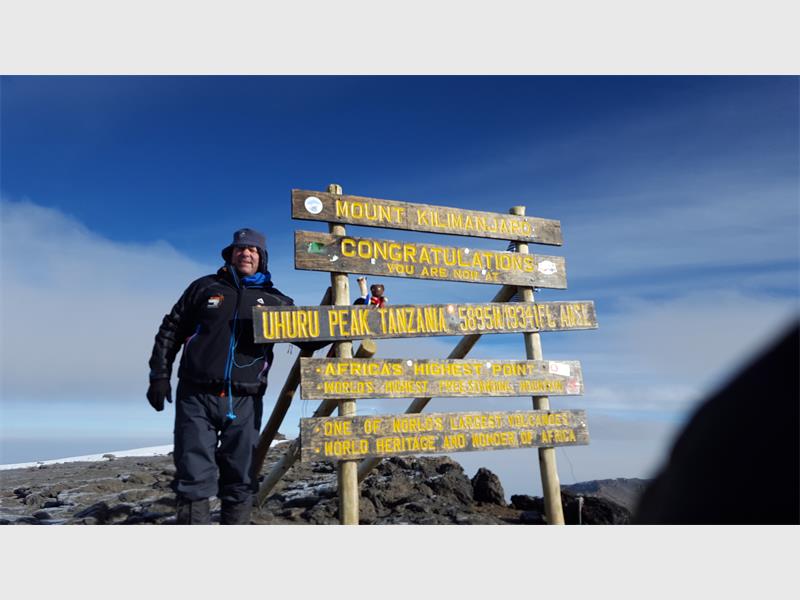
LOCAL resident and adventurer Albie Bester climbed Mount Kilimanjaro as part of the Trek4Mandela initiative in July.
He was joined by six of his SEACOM employers, who supported the Caring4Girls initiative, and was part of 42 climbers.
The Trek4Mandela expedition to Kilimanjaro was established in 2012 to create awareness of the plight of underprivileged girls in rural and poor schools during their menstrual cycles.
“My employer, SEACOM, adopted Aurora Girls High in Soweto and we will supply each of the 1 200 girls with sanitary products for a year,” said Bester.

The climb to the top of Kilimanjaro took the group five days to complete and they reached the summit on July 18, just in time to celebrate Nelson Mandela’s birthday.
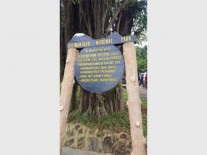
“We started the climb on July 14 at the Marangu Gate, which is 1 860m above sea level,” he added. ”We climbed to Mandara hut, which is situated at 2 715m, with a hike distance of 8km. The hike took us through a rain forest and lasted around seven hours. This was a very scenic and pleasant hike.
”On day two we climbed to Horombo hut (3 705m). The trail passes through a short stretch of rain forest and then emerges into the transition from rain forest to moorland.
”In the moorland, we got the chance to see some of Kilimanjaro’s most spectacular plants, such as the endemic giant lobelia, which grows up to 3m in height, and the giant groundsel (Senecia Kilimanjari), which can reach heights of 5m.

”After about another six hours we reached the Horombo hut, where we got a hot bowl of washing water, dinner and a well-deserved night’s rest in the wood cabins.
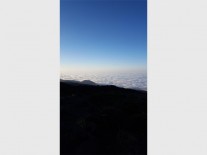
”The view from Horombo hut is incredible since we were a couple of hundred meters above the clouds.
”Day three was an acclimatisation day, which we spent at Horombo, with a short 7km hike to the Zebra Rocks and back. This short hike assists in the acclimatisation process.
”At this altitude we started experiencing some symptoms of mountain sickness (altitude sickness). People are effected differently and I experienced shortness of breath and headaches. Some of our team members also experience nausea, diarrhoea and fatigue. The best counter against mountain sickness is to drink lots of water.
”On day four we trekked to Kibo hut (4 730m), or base camp. The 9,6km and six-hour hike took us through the Alpine desert region. Kibo hut is a stone-built block house, which has bunk beds for 60 climbers. When we arrived at Kibo at around 2pm, the wind was strong and it was freezing cold outside.

”After a very early dinner we started preparations for the summit trek, which would commence at 11pm that night. Since the temperature at the summit was way below freezing, we had to store liquids in containers other than water bottles, which would freeze, leaving you without fluids. We took coffee or hot chocolate in flasks and water in our back pack reservoirs.
”For sustenance, we had a variety of dried fruits, sweets and chocolates.
“We went to bed around 8pm with alarms set for 10pm. It was very difficult to fall asleep as our nerves were getting the better of us. It was also at that time that Gugu Zulu fell ill and had to be rushed down the mountain.
”Day five started at 10pm on the night of July 17. With up to six layers of clothing to keep us warm, the first of three groups set off into the night. This was where the going really got tough.
”The first section of the trail consists of a rocky path to the Hans Meyer Cave (5 150m). The path then zigzags up to Gillman’s Point (5 681m), 4km from Kibu hut. Gillman’s Point is located on the crater rim. This section is very steep with a lot of loose stone and sand and required a great deal of physical and mental effort. This was probably the most demanding section of the entire route.
”Doing the Kili shuffle we moved very slowly up the mountain. As we reached Gillman’s Point at 5.10am, on Madiba’s birthday, the sun was peaking over the horizon. We were the first people on Africa to see that sunrise and that sight will always remain with me.

”From Gillman’s Point we trekked to Stella Point, another 500m along the rim of the crater. Here we encountered snow and the temperature dropped to minus 20 Celsius. The water in our water bottles froze and so did the water in the pipe from the back pack reservoir. The guava roll I took with me became a piece of rock and I could not get a single bite off.
”From Stella Point it was another 1,5km to Uhuru Peak. By this time we were extremely tired from the seven hours of trekking, the extreme cold and the very thin air we were breathing. On the way to Uhuru Peak we got a closer view of the majestic glaciers that were left on Kili from over 10 000 years ago.
”By this time the bigger group had split up into much smaller groups and my group of four, plus a guide, reached Uhuru Peak (5 895m) at 7.25am. Standing at the highest point on the African continent was an exhilarating feeling and made me very proud to be a South African.

”We spent around 10 minutes taking photographs and then turned back to begin the four-hour trek back to Kibo hut. After a short rest at Kibo we gathered all our gear we left behind for the ascent and headed down to Horombo hut (three hours) for our overnight. The return to Horombo hut was completed in a blur of tiredness and satisfaction that the job was done.
”Day five turned out to be a total of 16 hours of trekking and even longer for some of the slower climbers. That night the hard bunk beds felt like down feather mattresses.
”Day six consisted of a six-hour trek back to the Marangu Gate, with a quick lunch at Mandara hut.
”Back at the hotel it took me almost three hours to get myself clean from all the mud, sweat and dust. That evening we tested some of Tanzania’s brews and the climbers who summited received certificates.
”The following morning, we flew back from Kilimanjaro Airport to the Tanzanian capital Dar Es Salaam, and from there to Johannesburg,” Bester documented.
He said climbing Kilimanjaro was on his bucket list for so long and the fact that it was for such a worthy cause, made it even more special.
“As a husband and father of a daughter I can appreciate the challenges many schoolgirls are faced with if they don’t have access to sanitary products.”
Bester also enjoys painting, gym and spending time with his wife, son and daughter, in nature.
He said he would climb mount Kilimanjaro again only if his family would to do it with him.