
Did the rain turn your pool grey? Here’s how to get it blue again
The Kempton Express asked a pool-care expert what could be behind the phenomenon and how residents can get their pools blue again.
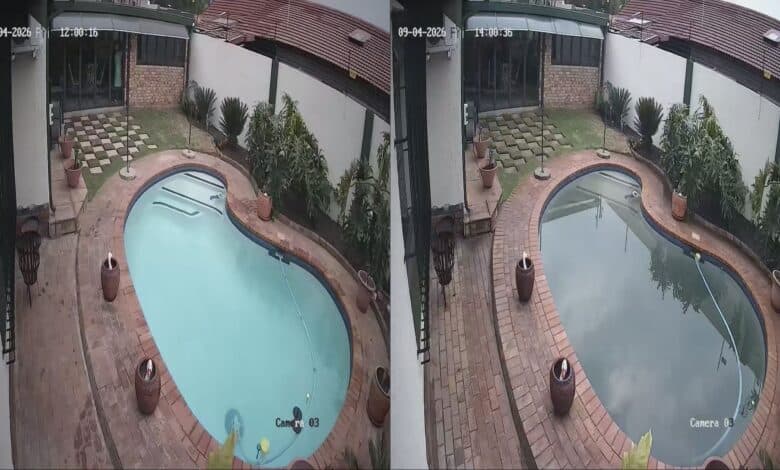
Residents whose swimming pools took on a rather alarming shade of grey after Friday’s heavy rain may be wondering whether their pools have officially entered their villain era.
Several residents reported their once-blue pools turning grey and even black following the downpour, prompting the Kempton Express to ask a pool-care expert what could be behind the unusual colour and, more importantly, how residents can get their pools blue again.
According to Quinton Gillispie, our resident swimming pool expert from Pool Action, heavy rainfall can significantly affect swimming-pool water chemistry.
Rain can dilute chlorine and other chemicals already in the pool, while stormwater can introduce dust, soil, organic matter, and other contaminants.
A dark black/grey, green or brown appearance can have several possible causes, including severe contamination, algae growth, suspended dirt and organic material, or metals reacting after the water chemistry changes.
The important thing is not to judge the treatment by the colour alone.
“Diagnosing the problem before treating it” is Pool Action’s approach, with residents advised to test their water first rather than reaching for every chemical on the shelf.
Step one: Don’t jump in
“If your pool has suddenly turned grey, extremely dark, cloudy or otherwise abnormal, we recommend keeping everyone out of the water until it has been properly treated, circulated and tested,” said Gillispie.
Residents should first remove large debris and test the water before adding chemicals.
At a minimum, testing should include pH, free chlorine and total alkalinity, while stabiliser (cyanuric acid/CYA) should also be checked for outdoor pools. Calcium hardness may be important, particularly for Marbelite pools.
Pool Action advises that pH should ideally be around 7.2 to 7.6, free chlorine around 1 to 3 parts per million (ppm) during routine operation, and total alkalinity around 80 to 120 ppm.
So, what chemicals should you use?
“Unfortunately, there is no magic bottle that will turn every grey pool blue.”
“The appropriate treatment depends on what the water test reveals,” said Gillispie.
Depending on the results, treatment may include a pH increaser or reducer, an alkalinity adjuster, chlorine or sanitiser, shock treatment and stabiliser (cyanuric acid).
Other treatments, including metal removers, flocculants and algaecides, may also be appropriate depending on the cause of the discolouration.
A shock treatment, for example, may be needed if testing indicates an algae or contamination problem. However, Pool Action’s Gillispie cautions against automatically shocking every grey pool without first testing the water.
The quantity and type of chlorine required will depend on factors including the pool’s volume, existing chlorine level, pH, stabiliser level, surface and the specific product being used.
And there is one golden rule: chlorine and acid must never be mixed.
“Residents should follow the manufacturer’s dosing and safety instructions, wear appropriate protective equipment and keep chemicals safely away from children and pets,” said Gillispie.
Don’t forget the filter
It’s not all about chemicals.
“Before treatment, residents should remove debris, brush the pool and ensure the filtration system is clean and functioning properly.”
Pool Action recommends cleaning or backwashing and rinsing the filter where required, as well as allowing sufficient circulation.
“If a flocculant is used, suspended particles can settle to the bottom of the pool and may then need to be manually vacuumed out using the appropriate waste setting,” said Gillispie.
He added that a clarifier can assist the filtration system in removing very fine suspended particles, while an algaecide may help where algae is identified as the problem.
“More chemicals do not necessarily mean a faster recovery.”
“Incorrect or excessive dosing can create an unsafe swimming environment and may damage pool surfaces or equipment,” warned Gillispie.
How long before the pool is blue again?
“That depends.”
A relatively minor rain-related problem may improve significantly after the correct treatment and filtration, while a severely contaminated or algae-filled pool could require several treatment and filtration cycles.
Gillispie said residents should not rush to drain their pools either. Many severely discoloured pools can be recovered through correct treatment, cleaning and filtration.
“Draining can also present risks depending on the pool’s construction, groundwater conditions and surface type, particularly with fibreglass and Marbelite pools.”
The Pool Action recipe for getting back to blue
Pool Action follows a simple process:
- Test: Establish the current condition of the water.
- Balance: Correct alkalinity and pH so treatment can work effectively.
- Brush and clean: Remove debris and loosen algae or contaminants from pool surfaces.
- Sanitise/shock: Apply the appropriate treatment according to the test results, pool volume and pool surface.
- Filter and circulate: Give the filtration system enough time to remove contaminants.
- Backwash and rinse: A dirty filter cannot effectively clean dirty water.
- Vacuum: Remove material that has settled on the pool floor where necessary.
- Re-test: Check the water again and make further adjustments if required.
- Only swim when safe: A pool looking blue does not necessarily mean its water is chemically safe.
Even blue pools should be checked after heavy rain
The rain can affect more than just the pools that have dramatically changed colour.
A pool can still look perfectly blue while its chemical balance has been altered.
Pool Action recommends that residents test their water after significant rainfall, even if it looks clear.
Owners should remove leaves and debris, check the water level, test the chemistry, correct pH and alkalinity where necessary, check chlorine levels, brush the pool and inspect the pump and filtration system.
A pool that repeatedly changes colour after rain may also have an underlying circulation or filtration issue that needs attention.
So, if your pool has gone from blue to black, don’t panic and definitely don’t start pouring every chemical you own into it.
Test. Balance. Clean. Treat. Filter. Re-test.
And hopefully, that backyard swimming pool will be back to blue soon.
Need help?
Pool Action can assist residents with diagnosing pool-water problems and advising on appropriate treatment.
Pool Action offers free in-store water testing and advice.
They are open Saturday from 08:00 to 14:00, Sunday from 09:00 to 12:00, and Monday to Friday from 08:00 to 18:00

Pool Action
33 Bergeend Street, Birch Acres/Norkem Park, Kempton Park, 1631
Tel: (011) 976-3701
Email: sales@poolaction.co.za