
How to treat your baby’s reflux
The number of babies diagnosed with acid reflux appears to be on the rise, with around 25% of all infants experiencing it to some degree.
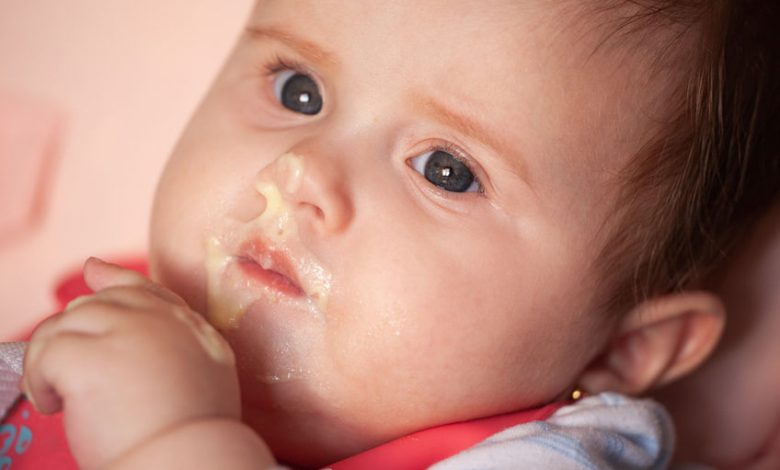
Despite popular belief, both breastfed and formula-fed babies can get reflux. Reflux has nothing to do with the type of milk you feed your baby. It happens because the valve between the stomach and the oesophagus doesn’t close effectively.
There’s no specific age when your baby’s reflux will disappear. As a baby with reflux gets older, the valve between the stomach and oesophagus gets stronger and the reflux slowly gets better. In most cases, reflux will disappear within a year.
We take a look at this common condition.
Gastroesophageal reflux
When we eat and swallow, the oesophagus (food pipe) automatically contracts to push food down into the stomach. At the same time, a valve, known as the lower oesophageal sphincter (LES), relaxes to allow the food to pass through. Normally, the LES closes to prevent food and stomach acids from flowing back up into the oesophagus. With reflux, also called gastroesophageal reflux (GOR), the ring doesn’t close properly, or remains open, causing a backflow of acids from the stomach into the oesophagus. This results in heartburn and discomfort.
In babies, reflux is fairly common as the LES valve is still weak and may not close properly. This is why babies typically spit up or burp after eating. In some instances, this isn’t painful. In other cases, the ingested milk mixes with stomach acids and irritates the inner lining of the oesophagus when it travels back up, resulting in pain and inflammation.
At her baby clinic, author and childcare expert Ann Richardson has seen and treated many babies with reflux. “I often sit across from tired moms who start by telling me that their babies are only content, and will only sleep for long periods, if they’re upright on the shoulder, in a chair, or carried in a pouch,” she says. “They’ll also mention that their little ones spit up often, or seem to be very uncomfortable and niggly during, or straight after, feeds.”
9 Signs your baby may have reflux
- Cries a lot at night
- Has slow weight gain
- Swallows and gags more than normal
- Sleeps better when she lies on her tummy
- Catnaps during the day and won’t settle easily
- Has recurring hiccups and ‘wet’ sounding burps
- Suffers from congestion or appears to have a cold
- Has bad or sour-smelling breath
- Possetts frequently and/or has frequent projectile vomiting.
How to treat your baby’s reflux
Although reflux can be hard to manage, take comfort in knowing that it will improve with time. The following tips may help you cope:
- Keep your baby upright after a feed and handle her gently (avoid vigorous winding).
- Don’t worry if you have to hold your baby in the upright position to sleep – you can’t spoil her at this young age. Assist her in any way to achieve sleep – even if it means holding her.
- Try to put her into her bed when she’s comfortable, but don’t be in too much of a rush.
- If your little one vomits often, she may need her milk to be thickened. This is easy to do if she’s being formula-fed. There are special anti-reflux formulas available. Ask your clinic sister to recommend one for you to try, or to advise you on alternate methods of thickening your baby’s milk to prevent regurgitation.
- Give your baby smaller feeds more often, to burp her more frequently during and after feeds, and to avoid clothing or nappies that are tight around her tummy.