UPDATE: Earthquakes in our area dates back to 1908
Both earthquakes that was felt in our area is now confirmed and the Council of Geoscience stated that seismic events here dates back to 1908.
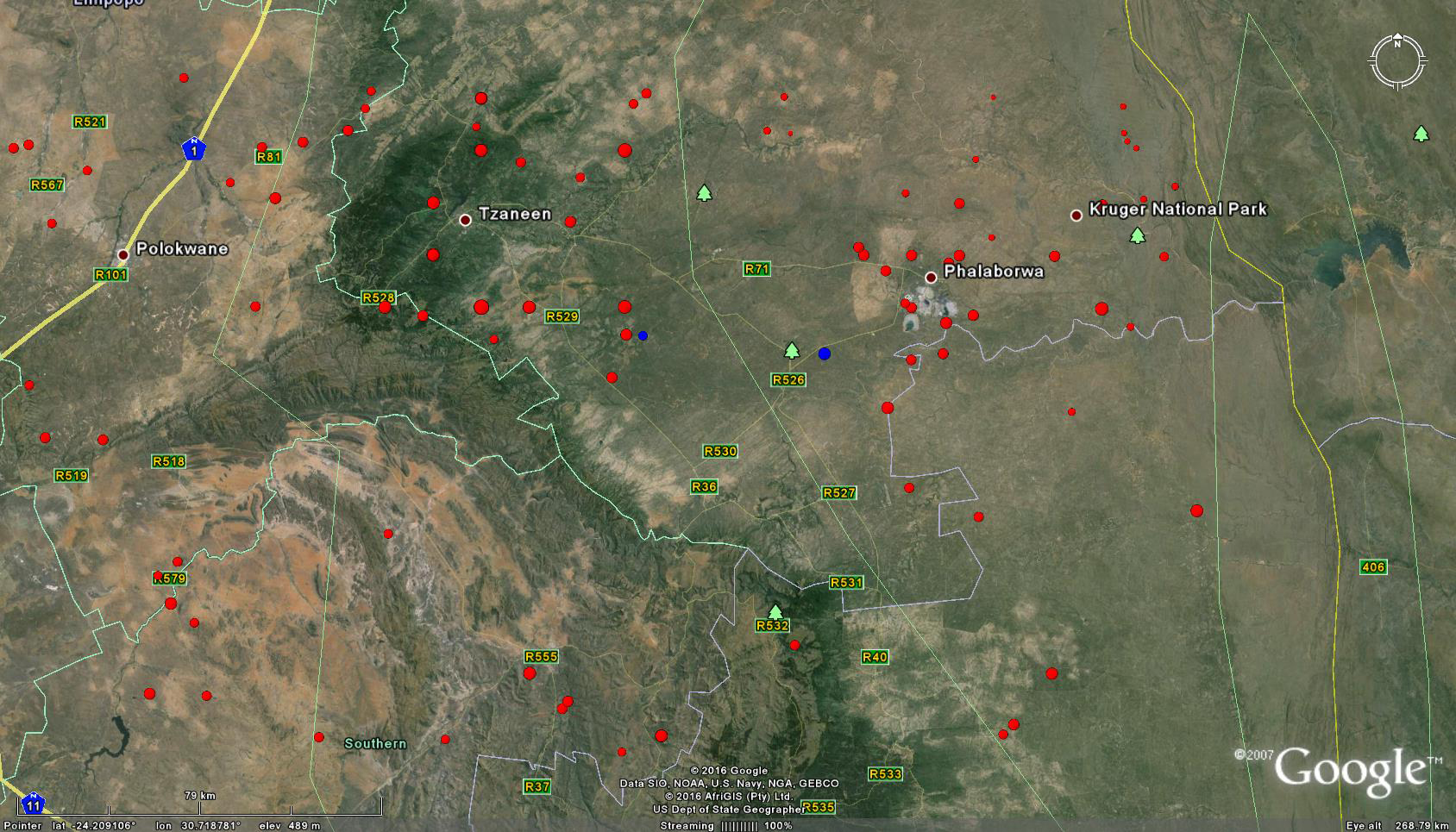
Ian Sanders, media representative of the Council for Geoscience, confirmed both events, but told the Herald that both earthquakes were relatively minor trembles.
Two relatively minor earthquakes took place between last Wednesday and this past Sunday.
The first quake’s epicentre was in the Leydsdorp area, with the tremors felt as far as Tzaneen and Modjadjiskloof, while the second one took place in the Phalaborwa area, with the tremors felt al the way in Tzaneen and Hoedspruit.
Although this area rarely experiences seismic events, it must be mentioned that there have been approximately 100 seismic events in the area since 1908 (see photo map), of which the biggest one measured 5.0 on 10 November 1940.
According to Sanders, Wednesday’s earthquake took place at 02:37 during the early hours of the morning at a depth of 5km, registering 2.0 on the Richter scale.
The region where it occurred, was in the Leydsdorp area, with a location quality error estimate of longitude +- 3.2km and latitude +- 2.6km, The depth was fixed by location software.
Sunday’s 12 June’s earthquake took place at 05:39 in the Phalaborwa area at a depth of 5km, registering a magnitude of 3.4 on the Richter scale.
The region where it occurred was in the Phalaborwa area, with a location quality error estimate of longitude +-3.2km and latitude +-4.4km.
The depth was fixed by Location software.
25 Stations were used in the epicentral solution.
Earthquakes are usually caused when underground rock breaks along a fault line.
This sudden release of energy, causes the seismic waves that make the ground shake.
When two blocks of rock or two plates are rubbing against each other, they stick a little.
They don’t just slide smoothly; the rocks catch on each other.
The rocks are still pushing against each other, but not moving.
After a while, the rocks break because of all the pressure that’s built up.
When the rocks break, the earthquake occurs.
During the earthquake and afterwards, the plates or blocks of rock start moving, and they continue to move until they get stuck again.
The spot underground where the rock breaks is called the focus of the earthquake.
The place right above the focus (on top of the ground) is called the epicentre of the earthquake.
Also read:
Light earthquake felt in and around Tzaneen