
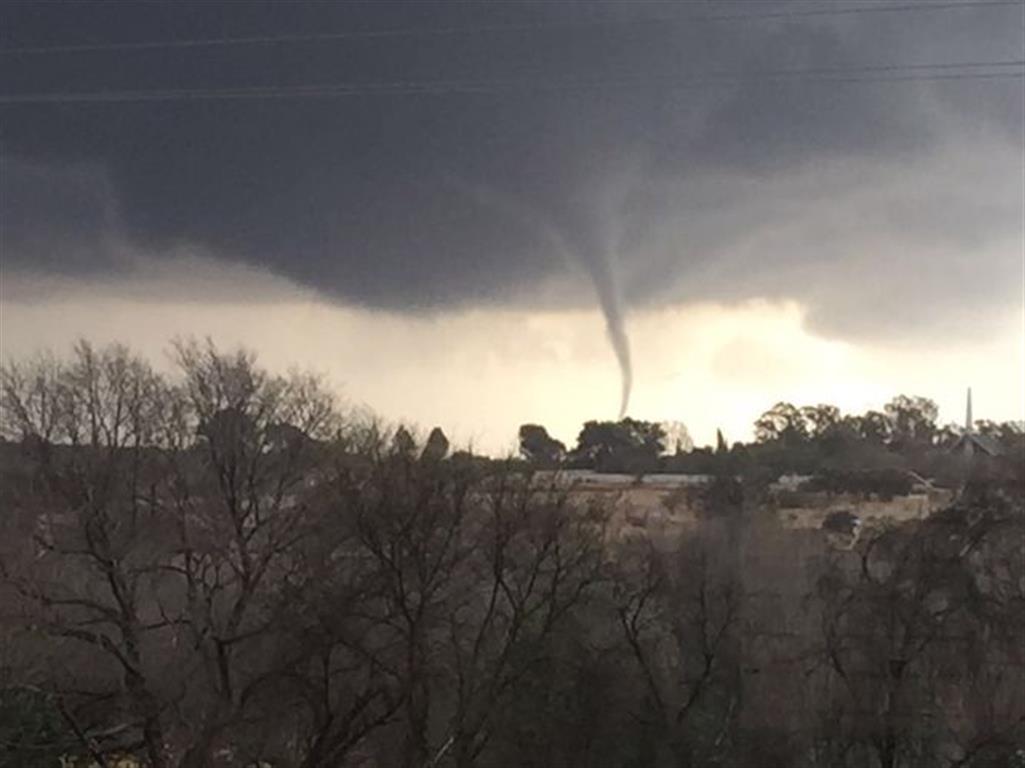
The tornado that swept through Robin Park in Randfontein on Monday, 25 July has left residents questioning the origin and cause of this extreme weather condition.
Although no serious injuries were reported, various billboards and roofs of houses and businesses suffered slight damage. The suspected tornado at the Phumlani Mall in Thembisa was however, a different story, as 17 people sustained minor injuries after being hit by flying debris.
According to the South African Weather Service tornadoes are formed when cold air drops from the atmosphere to the ground and warm air rises from the ground. The large column of warm air that is formed as a result of this motion moves parallel to the ground in a circular motion.
To better understand this concept, imagine an empty toilet paper cylinder rolling across the surface of a table. This is exactly what the start of a tornado looks like. It is not yet known why the winds form a spiral, but recent theories suggest that the cause is two winds blowing in the same direction at different altitudes and different speeds. It is believed that this causes air to rotate horizontally.
The wind causes the undersides of the clouds to form a funnel. If there is a sudden updraft of wind, the twisting column of air is tightened and the wind speeds become greater.
The twister then moves from its horizontal position on the ground to an upright position, touching the clouds above. In other words, the toilet roll is suddenly flicked into an upright position. A tornado is then formed. The hail or rain in the clouds above push the funnel downwards, causing the tornado to ground.
Small-scale tornadoes, like the one which touched down in Randfontein, only last between seven and ten minutes, and generally have wind speeds of less than 177km/h.
Strangely enough, American tornadoes generally occur in May and June. No-one really knows yet why the tornado that swept through Randfontein came in late July.

Do you perhaps have more information pertaining to this story? Email us at randfonteinherald@caxton.co.za (remember to include your contact details) or phone us on 011 693 3671.
Also read:
Throwback Thursday: Freak weather way back when
On the road in wet weather, be cautious
For free daily local news on the West Rand, also visit our sister newspaper websites Roodepoort Record, Krugersdorp News and Get It Joburg West Magazine
Remember to visit our Facebook, Twitter and Instagram pages to let your voice be heard!