South Africa to experience its third year of La Nina phenomenon
Late summer will feel the worst of La Nina with lower than normal high temperatures and higher rainfall.
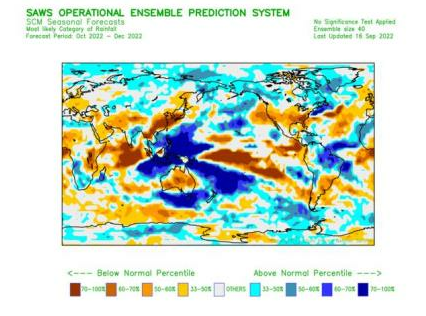
Despite the current heatwave conditions throughout the country, weather experts predict that South Africa is in for the third year of rainy conditions this coming summer, thanks to the La Nina phenomenon.
“Our forecasts in August and in September have shown above-normal rainfall for the summer rainfall areas (where La Nina is relevant),” said South African Weather Service (SAWS) expert Cobus Olivier.
“The latest forecast in September suggests cooler temperatures over large parts of the country during summer.”
La Nina typically means wetter weather and higher temperatures.
La Nina (Spanish for “the girl”) and El Nino (the boy) are the cool and warm phases of a predictable ocean-atmosphere interaction that is referred to as the El Nino-Southern Oscillation (ENSO).
The pattern shifts back and forth every two to seven years and brings with it some predictable weather changes in temperature and precipitation.
La Nina is the cool phase of ENSO, but this does not necessarily mean cooler temperatures can be expected. It referred to cooler-than-average temperatures in the Pacific Ocean, which causes a shift in weather patterns globally.
According to Olivier, forecasts indicate that the weather pattern will remain in this state for the rest of 2022 and early 2023.
Late summer will feel the worst of La Nina with lower-than-normal high temperatures and higher rainfall. After a delayed start to the rainfall season, November to January will see above-normal rainfall.
Previously, floods and high temperatures have wreaked havoc across South Africa.
“As we expect the whole of the summer season to receive above-normal rainfall, the increased chances of flooding will remain for the whole summer season,” Olivier said.
“It is, unfortunately, not possible to forecast specific flooding events during the season in a seasonal forecast; we can only advise the public that the chances of flooding are increased during this summer season.”
The flooding in KZN earlier this year claimed the lives of 448 South Africans while displacing about 40 000 others.
In February, the Tshwane metro also struggled with flooding in Mamelodi at Soul City and Eerste Fabrieke where at least one man drowned and hundreds were displaced.
Roads and neighbourhoods in other areas across the city were also affected.
ALSO READ: Heatwave conditions predicted to continue this week
Do you have more information about the story?
Please send us an email to editorial@rekord.co.za or phone us on 083 625 4114.
For free breaking and community news, visit Rekord’s websites: Rekord East
For more news and interesting articles, like Rekord on Facebook, follow us on Twitter or Instagram