Landlord dumps evicted family’s belongings, claims they were squatting in front of his house in Secunda
The municipal spokesman said their law enforcement officers do not participate in evictions in private properties.

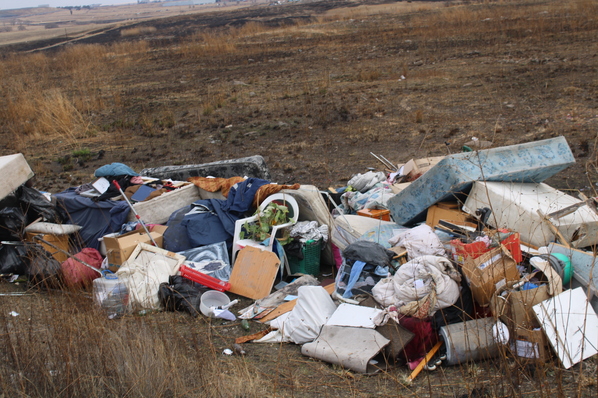
The McDonald family’s belongings were transported and dumped next to the Secunda dumping site in the presence of the Secunda Police.
According to Dylan Laubscher, a family member, they were not served with an eviction order.
The family was apparently stunned when their belongings were loaded onto a tipper truck and a bakkie and then taken to the dumping site.
“We were renting a house from an eMbalenhle businessman for two years, when the Covid-19 pandemic hit.
“Some of us lost our jobs and were unable to pay rent,” said Laubscher.
“The owner first kicked us out and we stayed outside his yard, then he decided to treat us this way. Why did he have to throw our property next to the dumping site?
“Some of our things broke when it was thrown from the truck and bakkie. That was inhumane.
“We are human beings. Why could we not be treated with dignity?
“The police even threatened me with pepper spray while we were being forced out,” said Laubscher.
William Kgomo, the house owner, said the family had been renting the house, failed for months to pay their rent.
He applied for a court order to remove them from his house.
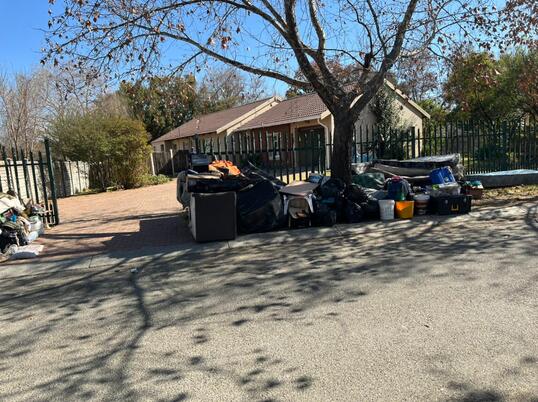
Kgomo said after receiving court’s eviction order, the family were removed from the house but they decided to stay on the sidewalk outside the palisades where they squatted for months.
“I am paying the bank a monthly instalment on the house and also rates and taxes to the municipality.
The people were also vandalising my house.
“After being evicted from the house, they blocked my palisades and gate. I was forced to report them to the Govan Mbeki Municipality because they were contravening the municipal by-laws.
“Neighbours were also complaining that the McDonald family were making noise day and night, and that they were urinating everywhere,” claimed Kgomo.
He said the neighbours were also concerned for their children’s safety.
“The municipal law enforcers and the police assisted us in removing them off the sidewalk in front of my house,” said Kgomo.
Donald Green, acting communications manager for the municipality, said the compliance and law enforcement officers responded to a complaint by aggrieved residents.
According to Green, residents complained about people who were causing a nuisance in the neighbourhood.
He said the police were already on the scene when the municipal law enforcement officers arrived.
Green also said residents further raised concerns about drug abuse, uncontrollable noise and the use of vulgar language directed to the residents (including children).
“While the police and our law enforcers were still at the location, the transport purportedly arranged by the landlord, arrived and their belongings were freely loaded onto the truck by those who were involved.
“The truck left for a destination unknown to municipal officials.
“It should be indicated that the municipality law-enforcement officers do not participate in evictions from private properties,” said Green.
Secunda Police Station commander, Col Herold Mashile, said the police were not part of the removal of the property to the dumping site.
They did, however, respond to a complaint of people who were being a nuisance in the neighbourhood.
Mashile said police went to the scene to prevent a fight between the residents.
“If anyone involved in this wants to open a criminal case, he or she is welcome at our police station. “The police are not part of what has happened, our role is to combat crime,” said Mashile.
According to the Rental Housing Act, disputes such as this are handled by the housing Tribunal for free and has the authority to deal with complaints or problems between tenants and landlords.
Such problems include:
• Non-payment of rentals.
• Failure to refund deposit.
• Invasion of a tenant’s privacy (including family members and visitors).
• Unlawful seizure of tenant’s goods.
• Discrimination by landlord against prospective tenants.
• The changing of locks.
• Lack of maintenance and repairs.
• Illegal evictions.
• Illegal lockout or illegal disconnection of services.
• Damage to property.
• Demolition and conversion.
• Forced entry.
• House rules.
• Intimidation.
• Issuing of receipts.
• Municipal services.
• Nuisance.
• Overcrowding and health matters.
It applies to all dwellings used for residential housing purposes, irrespective of who the owner or landlord is, that includes any house, hostel room, hut, shack, flat, apartment, room, outbuilding, garage or similar structure a landlord leases to a tenant to live in.
According to this act, a landlord has the right to:
• Prompt regular payment of all rental and other charges in terms of the lease.
• Recover unpaid rental and other amount that are due after obtaining a ruling from the tribunal or a court order.
• Terminate the lease on grounds that do not constitute an unfair practice and is specified in the lease.
• Upon termination of lease, receive the property back in good state and repossess the property after an order has been obtained.
• Claim compensation for damages caused to the property