Media Freedom Festival highlights growing threats to free expression in South Africa
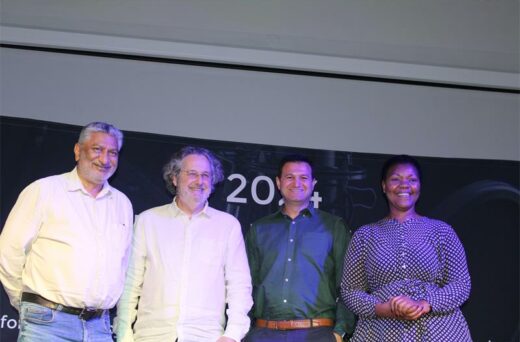
Ismail Mohamed, Anton Harber, Dario Milo, and Phathiswa Magopeni discussed the state of free expression in SA at the Media Monitoring Africa's Media Freedom Festival at the Goethe-Institut South Africa in Parkwood
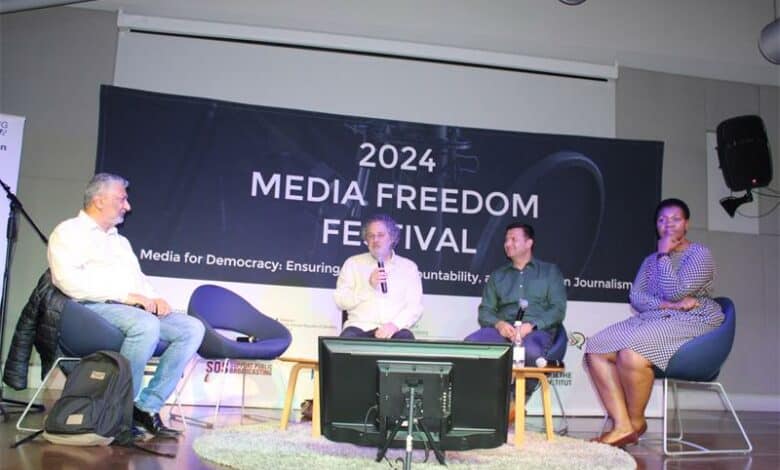
Media Monitoring Africa’s Media Freedom Festival returned on October 15 at the Goethe-Institut South Africa in Parkwood with a panel discussion on free expression.
In 2024, the Campaign for Free Expression released a report on the state of free expression in South Africa, highlighting serious and worrying threats.
Read more: 2024 marks 30 years of media freedom, whats next for the future?
The report: A Need for Vigilance: The State of Free Expression in South Africa 2024, was compiled by freelance writer and editor, Alan Finaly.
The following key observations were made:
• Trends in threats that prevent journalists from reporting freely while out on assignment have continued, with incidents involving the police, political parties, and public reports. The gendered nature of many attacks on journalists was also highlighted, with the worrying observation that fewer women now occupy senior positions in the news industry.
• The new draft of surveillance legislation shows the ongoing desire of the state to extend its surveillance capabilities without proper oversight.
• Questions have been raised about the public broadcaster’s independence after state security vetted its head of news, and it refused to air an advert by the main political opposition party during the elections. A new SABC Bill also undermines the broadcaster’s news head’s editorial authority.
• There was at least one politically motivated assassination on average every two weeks in the run-up to the elections. These targeted killings, together with violent protests that disrupted electoral processes in several communities, meant that many South Africans were likely to have voted in a context of intimidation and fear.
• Online attacks on journalists during the elections were considered a greater threat to media freedom than the serious but isolated incidents journalists faced while reporting in the field.
• Public protest has shown the depth of solidarity shared with the Palestinian cause amongst many South Africans. However, the Israeli-Palestinian conflict has also resulted in incidents of censorship in the country, including at the public broadcaster.
• The analysis of reporting on protests also suggests that when police intervene in protests there remains a reasonable chance that the rights of protestors and bystanders will be infringed. This is in line with the findings of our previous review.
• The period shows ongoing use of the courts by some businesses to try to silence reporting and other forms of public exposure of their operations through litigation known as Strategic Legal Proceeding Against Public Participation (SLAAP). Both incidents reported in the period involved foreign companies.
• Meanwhile, a struggling media industry faces a serious sustainability crisis through the loss of advertising revenue to big technology platforms, with important implications for the resilience of free media in South Africa, democracy, and freedom of expression.
SABC board member Phatiswa Magopeni highlighted that threats to journalists’ freedom stem from both external and internal pressures within newsrooms. She pointed out that media owners’ interests influence editorial decisions, especially in coverage of geopolitical issues like the Russia-Ukraine and Israel-Palestine conflicts. Magopeni also noted that financial pressures lead to self-censorship, with newsrooms avoiding stories that might jeopardize advertising and sponsorship.
Media lawyer Dario Milo weighed in and said he believed we should be lobbying for SLAAP to be legislated. “There was a breakthrough two years ago in the Mineral Sands Resources Ltd and Others v Reddell case which was a classic setup for a SLAAP, where a large multinational foreign corporate was suing for defamation against activists who required pro-bono legal assistance and could not defend themselves in terms of the cost of litigation. We acted with our pro-bono department, defended the activists, and argued that the common law should recognise the case as an anti-SLAAP defense as an abusive process.”
Milo added that SLAAP is an attempt by a powerful corporation or politicians to stifle public participation or criticism, which was abusive because it is weaponizing the law to teach someone a lesson.
“I would use Zuma and his litigation against the media as an example because, in my view, there was no intention for him to take the matters further but to hang it over the heads of the media to teach them a lesson.”
University of KwaZulu-Natal’s Centre of Arts director Ismail Mohamed analysed how the creative industry changed over the years after the implementation of certain amendments.
“In 1996, when the arts and culture white paper was adopted through a broad-based public consultation basis with the cultural and creative industries, it signalled an element of hope and indicated how the funding of the arts would be directed, and how art organisations would be governed, but that was not a hope that lasted long.”
Mohamed explained that the 2003 amendment to the Cultural Institutions Act removed the public’s right to nominate council members for cultural institutions, transferring this power to the Minister of Arts and Culture. “This is a high level of interference because it no longer leaves control in the hands of the council, but instead the Minister has direct influence over decisions,” he said, adding that institutions like the Market Theatre, known for its history of free expression, is now governed by state approval.
Follow us on our Facebook, X, Instagram and TikTok pages. Join our WhatsApp group for any story ideas you may have.
Related article: Voices for change: media freedom festival champions journalistic integrity