Green Coast status for Leisure Bay and Mpenjati-Trafalgar
The fact that the South Coast now has two certified ‘Green Coast’ beaches in addition to its nine Blue Flag beaches should multiply its appeal to discerning tourists and become great marketing tools for its chain of resort towns and multiple tourist establishments.
The South Coast has joined the Western and Eastern Cape as a region with internationally recognised ‘Green Coast’ destinations, after Leisure Bay Conservancy and the Mpenjati-Trafalgar Marine Reserve were awarded Green Coast status recently.
The announcement was made when the Wildlife and Environmental Society of South Africa (WESSA) unveiled its latest Blue Flag and Green Coast sites, which honour excellence in coastal management, environmental education and sustainable tourism.
Mike Denison, WESSA’s senior manager for the Coastal Programme, said the Green Coast awards were created alongside the well-known Blue Flag programme to recognise natural, less-developed stretches of coastline that maintain environmental integrity.
“The Green Coast certification rewards conservation excellence where communities are custodians of their coastline,” he explained.
LEISURE BAY
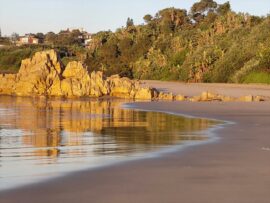
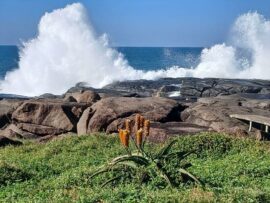
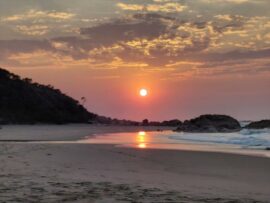
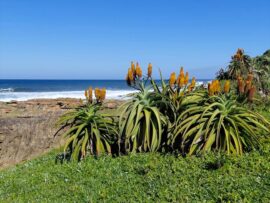
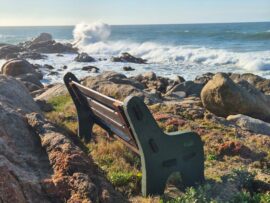
Leisure Bay’s four-kilometre stretch of unspoilt coastline features sandy beaches interspersed with estuaries, rocky outcrops and dense coastal bush. A coastal path runs its full length, linking rocky shores, wetlands, coastal dunes and wildflower-rich fields.
The area also carries a fascinating maritime history, with several shipwrecks recorded along this extension of the Wild Coast: the Sao Jao (1552), the Ivy (1878) and the Nightingale, which ran aground at the Thongazi River mouth in 1993.
Leisure Bay’s active conservancy plays a continuous role in protecting its environment. Volunteers clear beaches after storms, remove alien invasive plants and maintain the coastal paths. They also focus on public awareness, using posters and bright red ribbons to help holidaymakers identify invasive species.
One of the conservancy’s most ambitious projects has been the three-year clearing of invasive inkberry (cestrum) from a large inner section of the Admiralty Reserve’s dune forest. Since discovering the infestation, volunteers and employees have removed about 650 bags of inkberry – each weighing between five to eight kilograms – and have begun replanting the dune with indigenous species.
Conservancy chairperson Jenny Koen says this is the most significant conservation project the group has undertaken.
MPENJATI-TRAFALGAR
The Mpenjati-Trafalgar Marine Reserve includes three different marine protected areas. It comprises a portion of the ecologically important Protea Banks Marine Protected Area – home to seven shark species, deep reefs and three large submarine canyons – along with the Trafalgar Marine Reserve, Mpenjati Nature Reserve, Mpenjati Estuary and its catchment.
Mpenjati’s Yengele Forest, located on the dunes south of Trafalgar and adjoining the Mpenjati Estuary, is one of KwaZulu-Natal’s last and largest remaining coastal dune forests. It is rich in indigenous species, including protected red coastal and white milkwood trees.
Two established trails offer access through the forest: the 1.2km Impithi Trail, named for the blue duiker, and the 1.8km Yengele Trail.
HAVE YOUR SAY
Like the South Coast Herald’s Facebook page, follow us on Twitter and Instagram