Malaria safety tips
Monday (April 25) marked World Malaria Day, and it is in this light that ER24 spokesman, Chitra Bodisang, shares useful and very important information for everyone travelling to locations that are high-risk areas for malaria.
Information regarding areas that are considered to be high risk can be obtained from any reputable source.
However, malaria is mostly widespread in parts of several African countries, as well as parts of South Africa.
What is malaria?
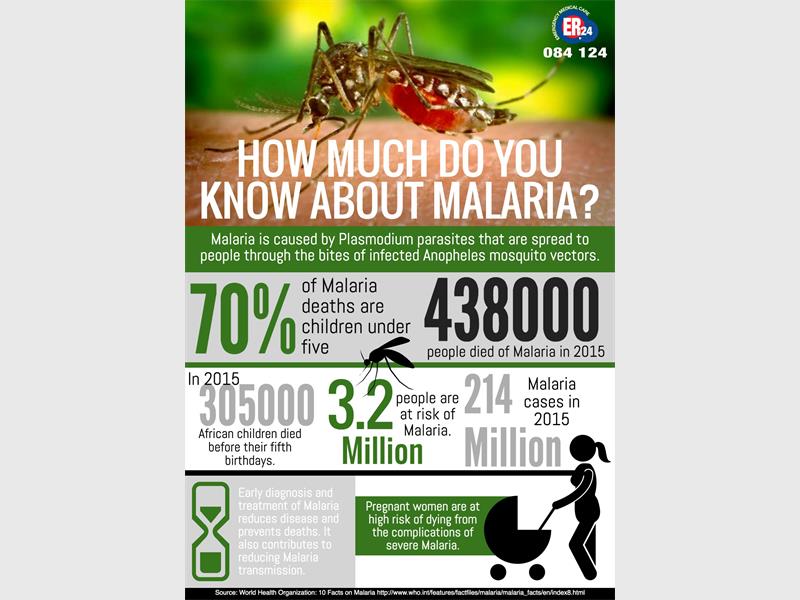
Malaria is a life-threatening disease caused by a parasite called plasmodium.
It is through the female Anopheles mosquito that the illness is transmitted to people.
What are the symptoms?
Symptoms can present themselves from as early as one week after infection, to as late as one year after.
These symptoms include:
- Fever
- Chills
- Fatigue
- Joint pain
- Dizziness
- Vomiting
“Should you experience some or all of the above symptoms, you should visit a doctor immediately”, says Chitra.
This is even if any prophylactic medication has been taken, as the risk of having contracted malaria is still very high.
The treating doctor must be advised of your travel.
The health implications of malaria
Malaria can cause serious health problems, some of which can be fatal, such as damage to the kidneys and heart.
It is therefore vital that any course of medication taken during this time is completed to avoid further complications, or even death.
Prevention is better than cure
To reduce the chances of contracting malaria, it is better to take the necessary precautions when travelling to high-risk malaria areas.
Some precautions include:
- Visiting a medical professional or travel clinic prior to your departure, in order to obtain the necessary prophylactic medication.
- Pack long-sleeved shirts or blouses to wear at your travel destination. These must be worn especially at dusk and dawn, when mosquito activity is at its highest.
- Packing insect repellents and mosquito nets.
- Making sure that, at your destination, main doors and windows are always closed between dusk and dawn.
“Should you come across a medical emergency, please contact ER24 on 084 124,” said Chitra.