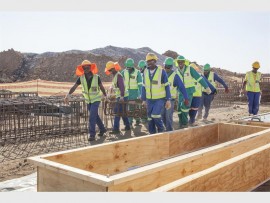
Gibela construction will be completed in November 2017
The Gibela train manufacturing construction at Dunnottar is well on track.
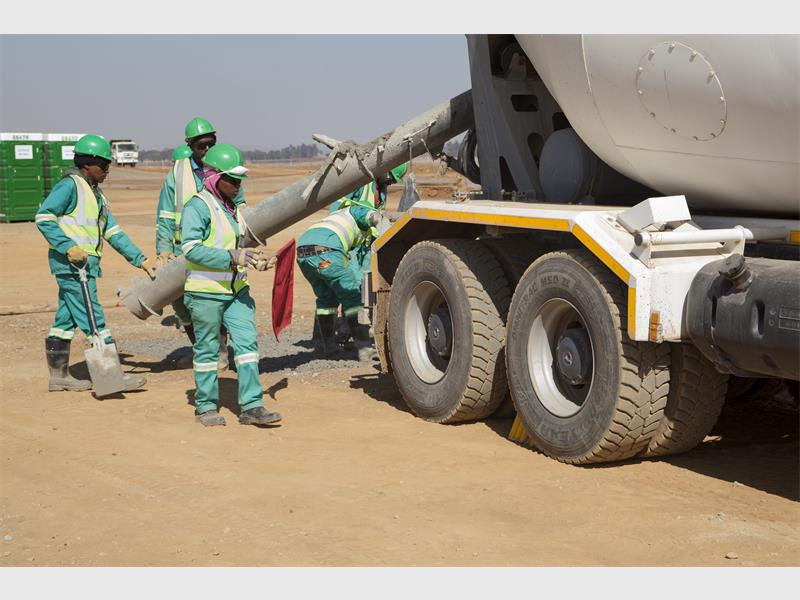
Seven months since site mobilisation for the construction of its sprawling, R1-billion train manufacturing complex at Dunnottar, Gibela has made dramatic progress.
“Indeed, the dream of developing a world-class train manufacturing plant in the industrial heartland of Ekurhuleni is fast becoming a reality as we work hard towards physically transforming this greenfield site into one of the busiest train manufacturing plants in the world in just more than a year now,” says Marc Granger Gibela’s chief executive officer.
The complex is 78 hectares (780 000m2) of which 51 hectares (510 000m2) is the total build area for the factory.
However, only 33 hectares (330 000m2) will be developed.
The remaining land is made up of an environmentally sensitive wetland the preservation of which necessitated the building of a dam as part of the design and lay-out of the plant.
Twenty-seven hectares (270 000 m2) are reserved for the uBumbano Rail Park which will house suppliers of equipment and components required for the new trains.
“Of the seven packages making up the overall construction programme for the complex, two are currently in progress under the execution of Trencon,” says Granger.
Package one was awarded for site clearance and earthworks in January and in May, Gibela’s partners were awarded package two comprised of construction works for the five main buildings.
Within three months after package two was awarded the following has been done:
• Concrete bases have been cast in the building where the body shells of the coaches will be assembled.
• The erection of the stub columns is nearing completion in preparation for structural steel.
• Concrete bases are being laid and the macro-pool area, the working platform that enables access on all sides of the train, is being excavated in the testing and coupling which is a process of connecting the coaches together into one train building.
• Strip footings, which link the walls of the buildings upon erection, have been compacted for the filming building in which the livery of the train is applied.
• Foundation slabs for the training centre and the access pit excavated.
Critical to the construction programme for the plant is care for both people involved and the environment affected hence adherence to the exacting, internationally applied environment, health and safety (EHS) standards of Gibela’s majority shareholder, Alstom, is paramount.
“Thanks to our constant EHS training, audits and inspections, instilling safety as a way of working at our construction site – we have not lost a single day due to injury since the start of construction work seven months ago,” says Vuyiswa Tlomatsane, construction programme director at Gibela.
More than 400 people have already been employed during the first two construction packages.
The current team on site consist of 220 residents of Ekurhuleni and 155 coming from Nigel, Springs, Brakpan and neighbouring areas.
Tlomatsane says the team is set to increase significantly over the next few months as construction advances in several additional phases.
The training centre will be the first building to be completed in order to prioritise the training of South African artisans and operators in readiness for when local train manufacturing operations start.
“The centre will supply trained people to the broader South African railway sector in years ahead,” he says.
Construction and all the buildings on site will be completed by November 2017, when full-scale building and assembling of the first of the 580 South African-made trains for delivery to Prasa will begin.