Semaphore signalling originates from 1840
The historic semaphore railway signalling system needs to be remembered for its important role prior to computerised systems.
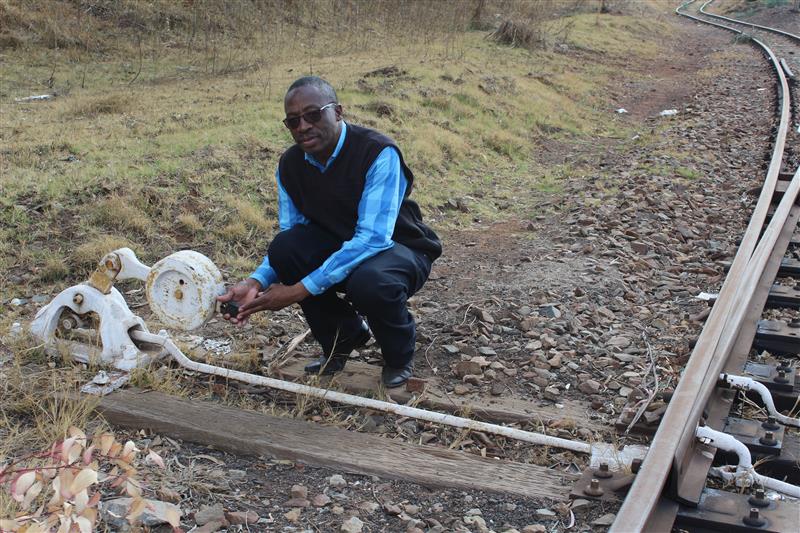
A railway semaphore signalling system, known to be one of the few left in the world, is still visible at Daggafontein Station.
Semaphore is one of the earliest forms of fixed railway signals and was patented in the early 1840s by Joseph Stevens.
This is a telegraphy system used to convey information at a distance by means of visual signals, with hand-held flags, rods, disks, paddles, or occasionally bare or gloved hands.
These signals display their different indications to train drivers by changes in the angle of inclination of a pivoted ‘arm’.
According to Joel Maja from Transnet Freight Rail, the purpose of the system is to ensure no other train is allowed to enter the single line section until the previous one has left the section completely.
“The system is delivering a wooden token to the next manned station, which is either Springs or Nigel, depending in which direction the train travels,” he says.
Currently, Transnet is not using this wooden token.
Maja says the instruments at the stations where these semaphore signals are visible have been vandalised, together with the signalling equipment they operate.
“We are currently using telegraph orders, which is a paper token and has the same purpose as the wooden one,” he says.
The system does need maintenance, and normally this gets done through highly qualified signalling technicians.
“However, seeing that we are utilizing telegraph orders to control the passenger trains and shunt trains traversing the section, not much maintenance is needed, except on the rail itself,” he says.
Transnet has plans to consolidate the section into a Visual Display Unit (VDU) warrant, a computer screen with the drawings of the section layout on it, which will be controlled from Sentrarand in Benoni.
The computerised system is similar to what is being used to control colour light signalling.
“This will happen soon in the new financial year and we are already busy with this project, says Maja.
The VDU warrant system at Sentrarand is currently being used to control the Trichardt lines and Hawerklip and Leeupan mines, together with Geduld station, where Transnet serves Sappi.
The Nigel section will be added as a third system.
“It is a highly advanced system which was recently rolled out to all Track Warrant radio systems in the country,” says Maja.
However, the news that the semaphore system is not being used any more is sad for railway fanatic Peter Denton.
“It is sad that another part of history is being put aside for new technology.
“This is a part of history that should be placed in a museum and not left to be vandalised,” he says.