From room-sized computers to laptops: A pioneer’s journey
From bug fixes to intricate programming, Priscilla was a pioneer of the digital revolution.
Scrolling through our phones, staying connected has never been easier. Whether it’s doom-scrolling on social media, managing our finances, or composing emails on the move, access to digital platforms has broken boundaries, giving us the freedom to live our lives, knowing a fully capable personal computer is resting in the palm of our hand.
It may therefore be difficult to comprehend that these endless possibilities could not have been possible without the tireless work done by the pioneers of computer programming.
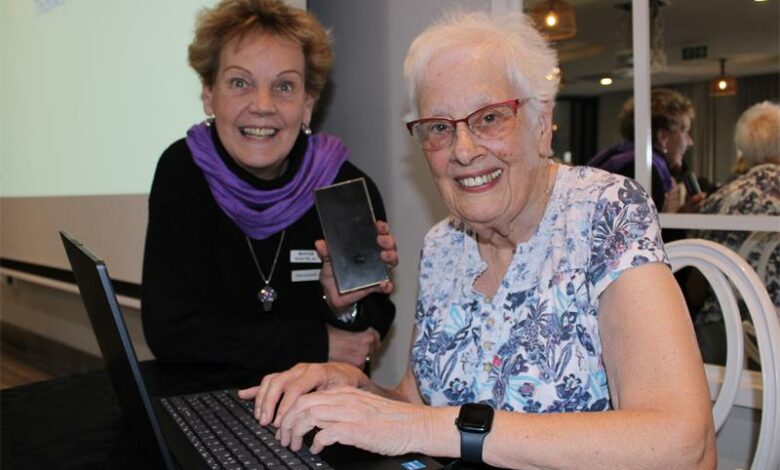
On April 23, Priscilla Fuller, a member of the Garlands Ladies Luncheon Club, took a seat behind her laptop to share her life story as one of the country’s first female computer programmers.
The first computer was introduced in South Africa in 1960, with the concept of a completely digitised world, unheard of at the time.
In 1963, following an argument with her mother, Priscilla stowed her sheet music away and instead underwent an aptitude test at the International Computer Tabulators (ICT).
“The day-long test proved quite fun as it required prospective applicants to complete a series of puzzles, something that appealed to me,” she said
“The company clearly stated that it was looking for male candidates over the age of 30 to join its programming team. As a bona fide woman of only 19, I was, however, hired and underwent a five-week training course which included more logic tests, all of which I loved.”
Starting her career, Priscilla recalls being introduced to the ICT1500, a beast that filled an entire room, complete with its own specialised air-conditioning unit.
“This monstrosity was supposed to revolutionise how we did things, but it required a team of programmers to manually write code, punch cards and feed it into a humming machine.”
With only seven computers throughout Johannesburg, Priscilla was part of the team creating operating systems for Stewart and Lloyds, Pfizer, and the Johannesburg Stock Exchange (JSE).
“I was soon moved over to the National Cash Registers (NCR) division, where I again was one of only a few women to undergo the three-month training programme,” she said.
“Making use of Nedbank’s computer, we spent numerous nights and weekends fine-tuning our systems. Very few people understood the complexity of our work and were dumbstruck to see women working on such intricate machines.”
Expanding her horizons, Priscilla travelled to the United Kingdom to further her career. At 23, she found herself in Vancouver, where she worked for a decade.
“The development of disc drivers, the predecessor of the floppy disc, revolutionised how we worked. Now we could save our programmes on these drivers and effortlessly transfer them between devices,” she said.
“By the 1970’s, microchips had become the rage, computers were shrinking, and prices were dropping, thus making it more accessible to the wider public.”
Returning to South Africa in 1977, courses in computer programming were widely offered, and work environments were becoming computerised.
Of her five-decade-long career, the Benoni resident said one of her crowning achievements was her role in creating an accounting system for various government departments, a system that was retired in 2010 but whose pioneering foundations still underpin new systems.
She toiled tirelessly to prepare for the turn of the millennium and the feared Y2K bug, which threatened systems’ capability to automatically switch over.
Retiring at 69, Priscilla has by no means unplugged from her ongoing interest in programming. In 2025, at the age of 81, she completed a Python coding course. The reason?
She wants to try her hand at writing games.
“My home computing system is one of great pride. I want to attempt coding a game for personal enjoyment,” she said with a giggle.
“I suppose once a programmer, always a programmer.”
The Garlands meet monthly at the Katse Room, at Ebotse. Guests are always welcome. For more information or bookings, email club president Margie Kostelac at margie.h@mweb.co.za