
Make your vote count this Election Day
With the municipal and national elections just around the corner it is time you educate yourself on the voting process.
With the municipal and national elections just around the corner it is time you educate yourself on the voting process.
On July 10, members of the IEC sought to educate voters by hosting a church youth mass voter education event.
The event covered the need to know basics of voter registration as well as the do’s and don’ts come Election Day.
So where can you vote? First off you must have pre-registered as a voter in South Africa in order to vote. To confirm that your name is on the voters’ roll, and to find out which voting station you’re registered at, please check your voter registration status online at https://www.elections.org.za/content/For-voters/My-voter-registration-details, SMS your ID number to 32810, or check on our mobile app.
With the national and provincial elections you will need to vote at the voting station where you’re registered to vote.
However, if you’re outside your voting district on Election Day, you may vote at another voting station in South Africa. If you’re outside the province where you’re registered, you’ll only be able to vote in the national election and not the provincial election. You may be required to provide proof of registration (application sticker pasted in your ID when you applied for registration) if the zip-zip scanner is unable to verify your registration. You’ll also have to complete a form (VEC 4) at the voting station.

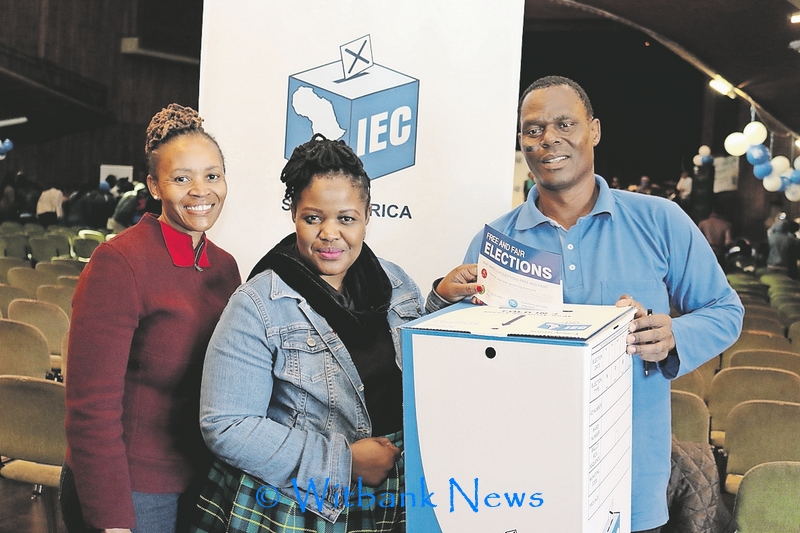
The IEC hosted a church youth mass voter educational event at the Witbank Civic Theatre, here are from left Dudu Mabuza (Municipal Outreach Coordinator), Lerato Charity Sehlakgoe (IEC regional communications officer) and Victor Kekana (Provincial Outreach Assistant Manager).
As for the municipal elections and by-elections you can only vote at the voting station where you are registered. Check your voter registration status to find out where your voting station is.
Voting is as easy as one, two, three. Start by finding your correct voting station by ensuring that you have the address for the correct voting station for the voting district in which you are registered. Most voting stations are located in community buildings like local schools, churches or community centres. Where buildings are not available, voting stations are set up in tents in parks or other open land. In some sparsely-populated rural areas we use specially adapted vehicles as mobile voting stations. Every voting station has large clear signs outside marking it as a voting station.
Use the Voting Station Finder to find your correct station (https://maps.elections.org.za/vsfinder/).
Present your valid identification document to the door controller at the entrance of the voting station, the door controller will check that you have a valid identification document (green bar-coded ID book, smart-card ID or temporary ID certificate), will scan this document, and present you with a slip that confirms that you are a registered voter. The door controller will also tell you when it is your turn to enter the station and will advise where to go once inside the voting station.
Once inside the voting station you will proceed to the voters’ roll table where election officials will take your ID and check for your name and identity number on the segment of the national common voters’ roll for that voting district. Your name will then be crossed off – this is a manual mechanism for ensuring that voters only vote once. An election official will then ink your left thumb nail.
An election official will then hand you your ballot papers. Each ballot paper has a unique number and you must make sure that there is a stamp at the back of your ballot papers to verify that they were issued to you on that Election Day. For national and provincial elections voters generally receive two ballot papers (one for the national and one for the provincial election), whereas for municipal elections voters in metros and local councils receive two ballot papers (one for a ward councillor and one for a political party as part of the public relations section of the election). Voters in areas which form part of a district council receive a third ballot paper for the district council election.
Once your identification documents have been stamped find an empty voting booth and make your ‘X’.
Here you will place your X in the box next to the political party and/or candidate of your choice. To avoid a spoilt ballot, ensure that you make only one mark on each ballot paper and that your mark is clear. If you make a mistake call an election official and they will provide you with a new ballot paper.
When you are finished, fold your ballot papers in half and leave the voting booth. Just a reminder, you are not allowed to photograph your marked ballot paper, as it is against the law.
When you are ready go cast your vote into the respective ballot box.
Remember that political party representatives and independent observers (both national and international) are present throughout the voting and counting process to observe the process and to ensure it is free and fair.