Human error leads to train collision
The trains were authorised to travel on the same line resulting in the collision.
By Melissa Hart
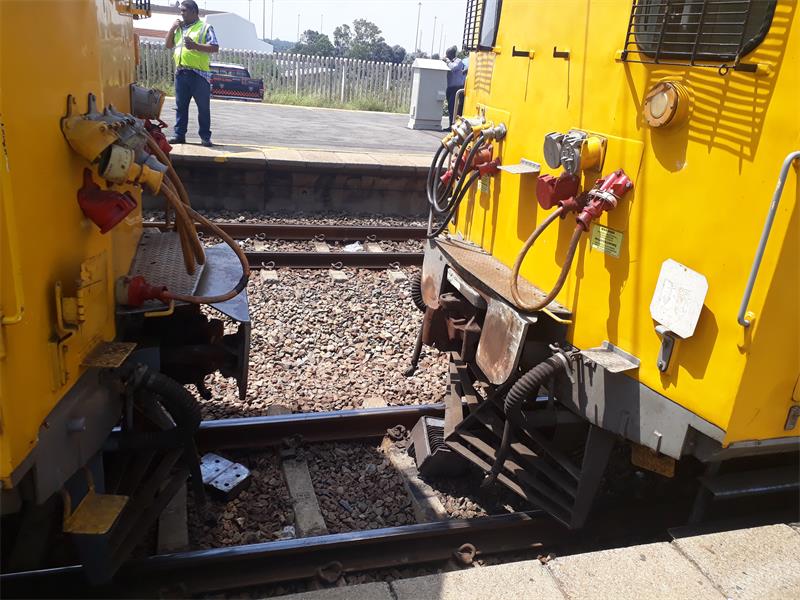
A collision involving two Metrorail trains at the Geldenhuys Train Station rocked the community, last Tuesday.
The collision came just days after a Prasa long-distance passenger train collided with a truck at a level crossing in Kroonstad, leaving many passengers injured and 19 dead.
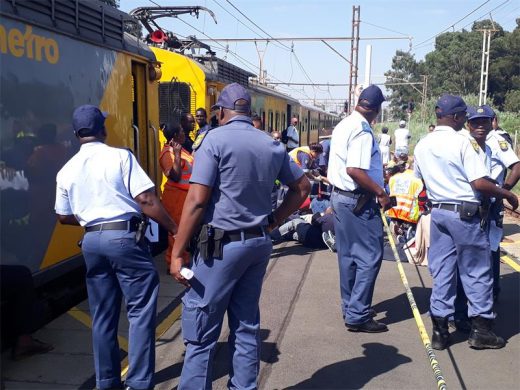
Ekurhuleni Disaster Management and Emergency Services members, along with paramedics from other services, attended the scene of the train collision in Germiston.
Eric Maloka, media liaison for the metro, told the GCN the collision occurred at about 7.45am.
“Apparently both trains were travelling from Johannesburg towards Springs on the same line,” Maloka said.
“According to a Metrorail representative, one train was stationary as it had a fault, and the train driver was attending to that when the other train was also authorised to travel on the same line.”
He added that emergency personnel counted 226 patients with minor to moderate injuries.
All patients were transported to various hospitals, including the Tambo Memorial, South Rand, Hillbrow and Life Roseacres hospitals.
“The scene was officially handed over to Metrorail at approximately 9.52am for them to start with their investigation,” Maloka said.
Russel Meiring, ER24 spokesperson, said ER24 paramedics arrived at the scene to find scores of commuters walking around.
Upon closer inspection, paramedics found that one of the carriages had derailed but had not overturned.
A triage area was set up to assess the patients.
“Over 200 people were assessed and found to have sustained injuries ranging from minor to moderate.
“Fortunately, no fatalities were found at the scene,” said Meiring.
In a statement later that day Gauteng Metrorail said a board of inquiry had been instituted to determine the root cause of the collision.
Metrorail also set up a walk-in centre at 30 Wolmarans Street, Umjantshi House in Braamfontein, Johannesburg for commuters who were involved in the accident to receive assistance.
The Railway Safety Regulator (RSR) then issued the Passenger Rail Agency of South Africa (Prasa) with a prohibition directive in terms of Section 36 of the National Railway Safety Regulator Act 16 of 2002 as amended (“the RSR Act”), for operating under conditions which are a threat or might be a threat to safe railway operations.
On June 19, last year, following the train collision at Elandsfontein, the RSR issued Prasa with a prohibition directive.
Prasa was subsequently instructed to cease operating trains in the Prasa Gauteng Region under abnormal working conditions.
In response to the directive, Prasa issued correspondence to the RSR undertaking to ensure safe train operations during degraded conditions.
However, on the morning of January 9, two Metrorail trains were involved in a rear-end collision at the Geldenhuys Station.
This accident convinced the RSR that Prasa does not have the means to prevent accidents from happening during degraded mode when manual authorisations are undertaken.
Prasa was, therefore, prohibited from manually authorising trains until such a time that normal train services are restored or until such a time when Prasa can provide the RSR with a comprehensive and convincing action plan for all affected areas in all the provinces where Metrorail trains operate.
The prohibition applied with immediate effect and will be in force nationally.
Failure to comply with the directive is an offence in terms of Section 45 of Act 16 of 2002 as amended and will result in criminal charges and/or a penalty being imposed in terms of the Penalty Fee Regulations 2011 as amended.
On Wednesday, the Department of Transport, the Rail Safety Regulator (RSR) and Prasa were locked in meetings to deal with the prohibition directive suspending the use of manual authorisation during degraded conditions.
The meeting was meant to highlight the huge impact of the prohibition directive on train operations across Gauteng, KwaZulu-Natal and the Western Cape provincial services.
Approximately 2.6 million passenger trips will be affected across the three provinces with Gauteng alone undertaking 1.5 million passenger trips per day.
The order will effectively push all those passenger numbers onto road-based public transportation.
Traffic volumes will also increase thus stretching the demand for road-based movement.
In the Western Cape, Metrorail has more than 40 per cent of the public transport market share and undertakes 650 000 passenger trips per day and KwaZulu-Natal undertakes 475 000 passenger trips (running 12 car train configuration).
All these trips will also be affected.
In a statement, Prasa said the use of manual authorisation by Metrorail is not by design but arises out of the ongoing attack on the rail infrastructure by thieves who continue to damage the signal infrastructure by stealing cables and signalling equipment.
The scourge of cable theft and the continued support of that theft by clandestine industries continues to cost Prasa and government millions of Rand that could be used to upgrade passenger rail and create job opportunities.
Should the prohibition directive hold, Metrorail can expect a huge backlash from the public that might result in trains being set on fire or vandalised.
Millions of passengers who have bought tickets, which are the only tickets they can afford, will be severely affected while Metrorail will be unable to provide alternative transportation or refunds due to the sheer scale of the number of passengers.
Prasa respects the authority of the Rail Safety Regulator in terms of its powers, according to the Section 36 National Railway Safety Regulator Act 16 of 2002 notwithstanding that RSR should have still given notice before issuing a prohibition.
The meeting agreed that Prasa will submit corrective measures to the RSR that will ensure the safety of passengers during degraded conditions where manual authorisation is in operation.
The minister of transport, Joe Maswanganyi, has directed Prasa to fast-track its plans to modernise rail services in South Africa.
This includes expediting the process to replace all existing signalling interlocking, which consists mainly of obsolete mechanical and electro-mechanical systems, with electronic interlocking as the technology of choice.
“A budget of about R5.6-billion has been set aside for the signalling modernisation from 2015 to 2018, as we know that our rail network has previously been characterised by years of disinvestment.
“Cable theft remains one of the major challenges that keeps undermining our determination and efforts to provide a safe and secure railway experience for all South Africans,” said Minister Maswanganyi.
Minister Maswanganyi called on communities, civil society and businesses to work together with government to secure the railway network from all criminals who are hell-bent on vandalising the railway network system for economic benefits.