Municipal coalition instability severely delays Gauteng service delivery, academic studies show
Policy uncertainty is associated with unstable municipal coalitions in South Africa, particularly when changes in coalition composition affect long-term planning and operational decisions.
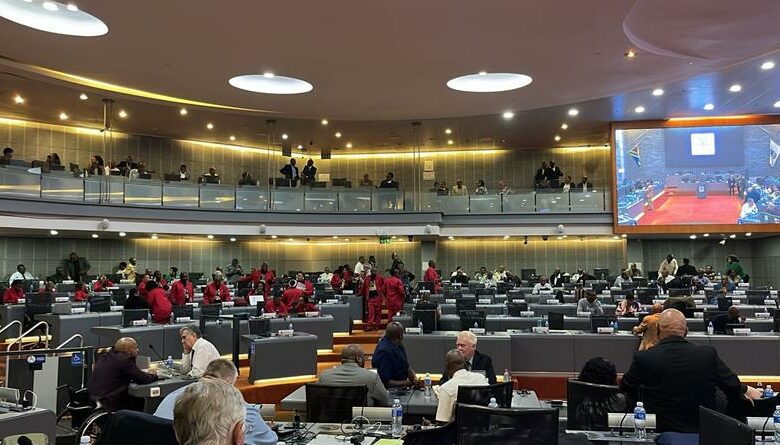
Coalition governments include multiple political parties that unite to govern because no single party has a majority in council after the election.
According to an academic article, ‘The influence of unstable coalition governments in Gauteng metropolitan municipalities’, written by Martin Pholoma, Stellah Lubinga, Tyanai Masiya and Onkgopotse Madumo and published in 2024, South Africa has seen an increase in coalition governments since the 2016 and 2021 local government elections.
According to Pieter Labuschagne, who wrote ‘South Africa, coalition and form of government: Semi-presidentialism’, published in 2018, one reason for the increase in coalitions across South African municipalities is the decline in support for the ruling African National Congress (ANC), which has opened the door to municipal coalitions.
ALSO READ: Ekurhuleni residents urged to apply for indigent relief on municipal bills
This decline created an opportunity for parties with less support to join forces and secure a majority in council.
With the increase in coalitions in Gauteng, reporter Kgothatso Madisa notes that unstable coalitions must find solid ground.
Deputy President Paul Mashatile highlighted in 2023 that municipalities and the Gauteng province have been in disarray following the 2016 and 2021 municipal elections.
Madisa further states that the three major metropolises — the City of Tshwane, the City of Johannesburg and the City of Ekurhuleni — clandestinely change mayors and executive committees, affecting municipal programmes and delaying budget approvals and general service delivery.
ALSO READ: City of Ekurhuleni reminds residents to apply for free basic municipal services
Eleftherios Mantzaris, who wrote ‘Coalition challenges in South African metropolitan municipalities’, published in 2022, supports Madisa’s view, saying coalition governments in metropolitan municipalities face issues when interacting with administrators at different bureaucratic levels.
Madisa argues that coalition governments in Gauteng’s three metros became unstable following the 2021 municipal elections, resulting in frequent changes in mayors and executive committees.
These changes negatively affected municipal administration and service delivery.
Reporting by Thabiso Goba titled ‘Tshwane council fails by one vote to pass adjustment budget’ in 2023 cites Tshwane’s failure to meet three deadlines for adopting its revised budget as an example of the consequences of coalition instability, with former executive mayor Cilliers Brink stating that the delays had implications for service delivery.
The instability is attributed partly to political parties prioritising their own policy objectives, which can contribute to coalition breakdowns.
Jason Felix, in an article titled ‘Frequent collapse of local government coalitions is deliberate, Mashatile tells national dialogue’, published in 2023, describes municipal coalitions as unstable and disruptive, noting that political shifts and competition between the ANC and the DA contributed to instability in Johannesburg, Tshwane and Ekurhuleni.
ALSO READ: New Ekurhuleni municipal tariffs come into effect
William Gumede, in ‘Policy Brief 46: Improving coalition governance’, published by Democracy Works in 2023, argues that dominant parties often fail to compromise sufficiently, leaving smaller coalition partners feeling excluded.
Susan Booysen, in ‘Multiparty democracy is in trouble in South Africa – Collapsing Coalitions are a sure sign’, published in 2022, similarly links coalition instability to intensified political competition between the ANC and the DA, with both parties seeking to maintain or expand their political influence.
Policy uncertainty is associated with unstable municipal coalitions in South Africa, particularly when changes in coalition composition affect long-term planning and operational decisions.
Kelvin Knowles, in ‘An analysis of emerging governing coalitions at the local level in South Africa with a specific focus on Johannesburg and Nelson Mandela Bay’, published in 2021, found that ideological differences between the DA and the EFF contributed to tensions in coalition governments in Johannesburg and Nelson Mandela Bay.
Disagreement over land reform and expropriation without compensation contributed to the EFF withdrawing its support from the coalitions.
ALSO READ: New Ekurhuleni municipal tariffs come into effect
Pierre de Vos notes in ‘The constitutional-legal dimensions of coalition politics and government in South Africa’, published in 2021, that during the 2016 to 2021 period, the EFF used its position as kingmaker in Johannesburg to secure concessions from the DA-led coalition, including converting outsourced personnel contracts to insourcing. The resulting increase in municipal staff was described as a rushed and politically driven decision that affected service delivery in some departments.
Onkgopotse Madumo, in ‘Collective decision-making: A critical function towards ensuring sustainable development in local government’, published in the journal African Renaissance in 2023, argues that because the EFF had not entered into a formal coalition agreement, it was not required to support the DA-led coalition’s initiatives fully. This contributed to uncertainty in municipal governance and administration.
Overall, the research shows that unstable coalitions make it difficult to implement municipal strategic and operational plans, policies, programmes, and initiatives because coalition parties have different policy priorities and objectives.
ALSO READ: Ekurhuleni municipal office hours adjusted for festive season: closures and key dates
Political instability in municipal coalition governments creates uncertainty about the duration of governments’ terms in office and reflects coalition partners’ inability or unwillingness to cooperate.
Felix argues that coalition collapses are sometimes deliberate and unrelated to the public good, while Booysen attributes some collapses to political leaders pursuing positions and municipal portfolios.
Ray Mwareya, in ‘South Africa: Johannesburg’s circus of eight mayors in two years’, published in The Africa Report in 2023, notes that Johannesburg appointed eight mayors within two years, with consequences for residents.
Frequent changes in mayors also lead to changes in mayoral committees, as incoming mayors introduce new visions and priorities.
Lylian Buti states in ‘The impacts of a coalition government on investment opportunities and socio-political development in Lesotho’, published in 2018, that instability in municipal coalitions disrupts continuity in policymaking and implementation.
ALSO READ: Gauteng Education settles outstanding municipal debts with Eskom, schools
Consequently, repeated changes in municipal leadership delay the achievement of departmental goals and hinder the implementation of municipal objectives.
Although coalitions do give political parties a means to govern through alliances and shared goals, significant challenges remain.
The question remains: who is ultimately in charge, who can keep another in power, who acts as the kingmaker, and who can survive without the other?
As seen throughout numerous election seasons, coalitions rise, fall, and fracture, leaving citizens and voters to hold those in power accountable.
In addition, the challenges associated with unstable municipal coalitions indicate a need for interventions to promote sustainable coalition governance.
Governments and municipalities need to develop legislation and policies to address coalition instability, promote political stability and democratic values, and improve municipal administration in Gauteng’s metropolitan municipalities.