Celebrating success: Local student beats all odds to become an actuarial science graduate
The Boksburg Advertiser recently caught up with Mbuso as he was revisiting his former high school.
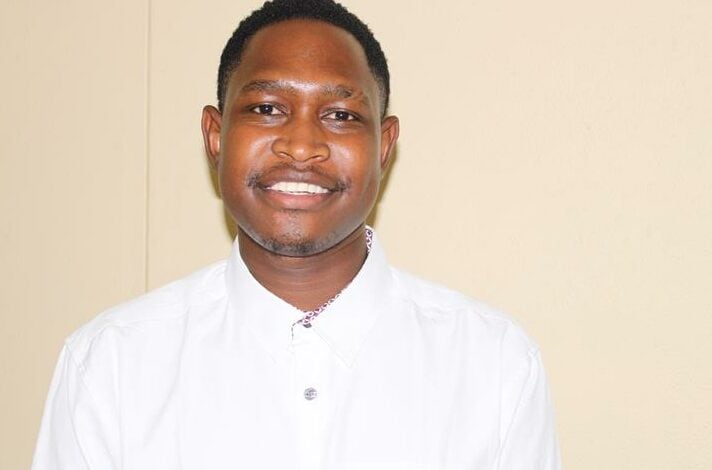
Teachers and management at Reiger Park High School are bursting with pride at one of their former students’ achievement.
The outspoken young man, Adrian Mbuso Mhlanga, who attended this school from grade 8-12, has recently served as an outstanding example that with hard work and dedication, learners can regardless of their humble background overcome barriers to achieve their goals.
Coming from this previously disadvantaged township school, at 23, Adrian qualified as an actuarial science graduate after recently conquering UJ’s BSc Actuarial Science qualification.
According to the statistics by the Actuarial Society of South Africa (ASSA), as of February 2024, South Africa has fewer than 2000 students who have already completed their undergraduate studies – while on the other hand, according to the University of Pretoria, the demand for actuarial professionals continues to grow.
Adrian attested to these reports, saying when he started the journey at UJ, there were about 150 students in the course, but each year, the group gradually decreased, and they were eventually below 20 students who made it to the final year.
Even among the students who made it through to the final exams, about six of them did not qualify to graduate.
Challenging
The Boksburg Advertiser recently caught up with Mbuso as he was revisiting his former high school.
He said mathematics has always been his favourite ‘game’, and used to score the highest marks in his high school exams.
After demonstrating high levels of mathematics skills, one of his high school’s top achievers, Ernest Molelle, advised him to take this course. But he warned him that it’s very difficult.
“I don’t want to lie, indeed, I found actuarial science to be a very challenging and draining field to pursue. The exams are tough, and a bit slack could result in failure.
“At some point, I got intimidated when I saw more fellow students, who I started the course with, falling behind and others giving up, as I thought I might become one of them.
“I wish someone had told me that I would need some sort of emotional intelligence. This is because I had to learn it the hard way throughout the course. Without that emotional intelligence, you can be destroyed as a student and end up dropping out with no will to go back to varsity.
“I’m happy that through hard work and dedication, I was able to take on the challenge and that’s what got me through here.”
Adrian said he doesn’t at any point believe that nailing the course meant that he is intelligent. He said it was through his consistent hard work, like having a 16-hour study session just to prepare for one exam.
“The workload is just a lot. You can write one exam based on four or five textbooks. So it requires you to be well prepared because talent alone is not enough. It’s the effort that you put to pull through to the end.”
Among the things that gave a boost to Adrian’s resolute optimism is that the rewards are big. The prospect of securing a job in a world where the job demand for actuarial skills exceeds supply is excellent.
He also wanted something that would push him to reach his limits and to prove that learners from Reiger Park Secondary School can also do it.
He and his fellow graduates have already been getting employment interviews from some of the large companies such as Deloitte, MTN, Absa, and others.
Moral compass
Adrian attributed his achievement to the school principal and the team of educators, whom he described as his compasses.
He said, beyond teaching at this quintile two school, they also instilled in him moral values that propelled him into discovering his abilities, guided his ethical decisions and behaviour and helped him to keep focus.
Adrian had passed matric with five distinctions, in mathematics, physical sciences, life sciences, geography and life orientation.
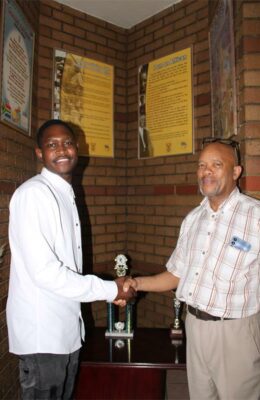
“The principal Raymond Tekana and all the teachers who taught me were always there for me, even when I was slightly slacking up. The principal would even phone me if I was not in class yet saying ‘Adrian, where are you, because we are waiting for you’.
“My teachers would constantly remind me that you know what you want and you have the potential to achieve it. All you need to do is to give it your all and not allow yourself to be distracted by anything else.
“So their advice, even when I was at varsity, motivated me to overcome a plethora of challenges. Without their support probably at university I would have at some point slacked up and subsequently failed.”
He also praised his mother Sikho and father Mbuso for their continuous support and constant monitoring of his academic performance and behaviour.
Advice for learners
The graduate urges youngsters, especially in previously disadvantaged schools, to take a leaf out of his and other top achievers’ books – and start investing most of their efforts in things that will bring them advantage in the future.
“I heard some learners blaming their schools for their failures. For me blaming your school it’s just an excuse. I’m a prime example that what matters is not the school that you attend, it’s your mindset and the effort you put that will lead to something great at the end.
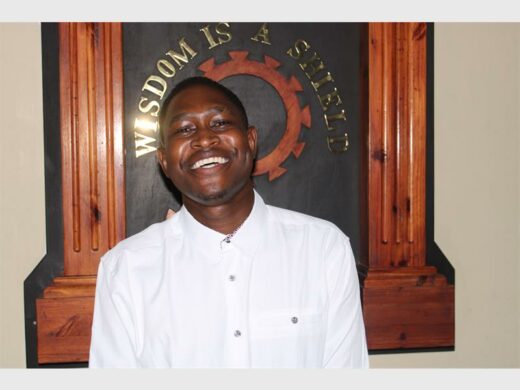
“I always ask myself as to why my high school used to make headlines for all the wrong reasons. The teachers are very good educators, they are qualified and know what they are doing to help learners realise their goals just like the private and former model C schools.
“I hope my story will help restore the lost hope, inspire and motivate youngster to work hard, and stop marking themselves down as hopeless academically because of the school they attend.
Special message
The message I want to share with learners is a quote by John H. Schaar, where he says “The future is not some place we are headed to, but one we are creating. The paths to it are not to be found, but made, and the activities of making it changes both the maker and the destination.”
“It means that what you choose to do today play a major part in shaping your destiny. As long as you put effort you can achieve anything you want.
“I remember in my years of attending high school, there were times where there were attempts to cajole me into wrong things that are presented as cool stuff or lifestyle.
“However, I knew what I wanted in life, and refused to allow bad influence to blind me to the fact that experimenting with such can derail your future. I think it’s important to have a good mindset.”
Parental monitoring
Adrian also called on parents to play their role instead of leaving everything in the hands of teachers to deal with their children’s misbehaviour.
“I think monitoring your child’s academic performance, behaviour and the people whom your child hangs out with is important to nip bad habits in the bud. Even the parents of privately educated children do a lot of supervision.
“I remember, when I slack a bit my parents would pick it up immediately and would straighten me out. They would tell me that they want me to be better than them.
“Do what you need to do to cement the prospects of your future.”
Adrian said he will in the next years be focusing on writing his board exams from the Actuarial Science Society of South Africa, while also working.
He also plans to do an honours degree in actuarial science.
Also Read: Top schools rewarded at RCS Rising Star tennis national finals