When we talk about international boxing greats and the biggest sportsmen in South African sporting history, the name Harold Volbrecht shouldn’t be out of that particular conversation.
A southpaw welterweight during his boxing days, Volbrecht is one of the most accomplished trainers and arguably the best boxer to ever come out of the country.
In a professional career that spanned between 1975 and 1989, Volbrecht won what was then the vacant South African welterweight title against Gert Craemer in 1976 at the Skilpad Hall showgrounds in Pretoria, today known as the Tshwane Events Centre.
He never lost the title until his retirement. Such sporting milestones can only be compared with the best global sportsmen the likes of basketball great Michael Jordan, who won the National Basketball Association (NBA) title six times in a row.
Volbrecht had a total of 20 SA welterweight title fights and 19 successful defenses in a decorated career.
Born in Bedfordview on October 10, 1956, Volbrecht grew up in Johannesburg where it did not take long for the boxing gods to spot him as one of their own. He stayed in the same street as late 60s pugilist Dave Rose and another boxing icon, Brian Mitchell, among other celebrities.
It all began at the Yeoville Boys Boxing Club (YBBC), as he explained to the Advertiser.
Volbrecht: I grew up in Troyeville and when you went to play at the park, you got bullied. I was about five years old and you got 10-year-old children that bully you. Near Jeppe Police Station, there used to be a four-story building and downstairs boxing was hosted, the second floor was wrestling, third floor was for karate and fourth was for weight-lifting.
So as little children, we used to run to the building to box, do some wrestling and we also learned karate. We played there and we learned everything. And then when one day when I got to the park, the older kids tried to bully me again and one of them got a surprise when I gave him carrots [a beating].
As time went by, I think I was six or seven years old, the trainers at the building said to me some wanted me to box and some wanted me to wrestle – I had to make a choice. I picked boxing. And then that’s where my career started.
From there I went to Jeppe Boys Club and to Ellis Park; from Ellis Park I went to Yeoville Boys Club (YBBC) which sported a lot of famous fighters. All the overseas guys came and trained there.
One day, fast forward to years later, they had a famous boxer that came to fight Jan Kies. And Jan is a southpaw. So I said to the trainer if I can spare with his boxer and he said just one round. He thought the guy would mop the floor with me, but I boxed and competed and the trainer was amazed.
One day my dad called to me saying ‘Hekkie’, as this was my nickname, ‘I think these guys are looking for the southpaw youngster that helped them with sparring when they fought Jan Kies.”
So I went straight to YBBC and when I walked in, the guy says you can spar again and I said yes. And after the last day of sparring, he gave me money. When I say R100 then that is a lot of money. I’ve never seen so much money in my life. To me, it was a lot of money. I said I don’t want money, I want experience. He insisted I keep it. That’s how I got to spar and mingle with a lot of professional fighters and getting involved with professional trainers.
Volbrecht later moved to Springs where he did his boxing at the Springs Amateur Club (SAC). It was there where his boxing path was paved.
Volbrecht: I met Gert ‘Hottie’ van Heerden through his father upon moving to Springs. I used to train twice a week at the SAC and twice a week with Hottie. He taught me everything that I wanted to know.
Not a lot of people know this but my amateur career is made up of over 300 amateur fights and my professional career 56 fights. My whole amateur career and my professional career combined I fought southpaw, but I wasn’t actually a southpaw. I wrote with my right hand but I was taught to box southpaw.
Road to professional career
In the late 60 as a youngster, Volbrecht was already winning novice championships. He had won the Eastern Transvaal championship and Transvaal championship. His local promise and success led him to the South African Championships where he won his first SA title in 1969.
Six years later in 1975, he won his last SA amateur title in Port Elizabeth before turning pro later that year.
Professional career
Volbrecht: In my sixth professional fight, I won the SA title. I was only 19 years old. I fought a guy called Gert Craemer. But I had to fight for that fight to happen. My trainer and father did not want me to fight Gert because they were scared he was too experienced for me. So I went to Johannesburg and went to convince Stan Christodoulou [international boxing judge and refer] to make the fight happen and not to listen to my father and trainer.
We fought in Pretoria at the Skilpad Hall. It was around that time that I found out that I’m not a six-round fighter but rather a 12-round fighter; and I won the SA title. Thereafter, I had a lot of promoters phone me offering me an eight-round fight against Joseph Lala. Everyone gave me a hard time and hard fight up to round number eight, but when it gets into championships rounds then that was my game. It suited me to longer the fight lasted and that’s why I still hold the record today for the most title defenses.
My last professional fight was in Sun City against a guy from Canada and I won. But by then already, I had started training the likes of Corrie Sanders and Brian Mitchell.
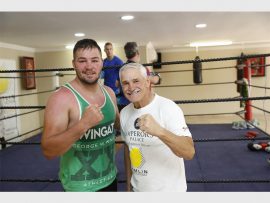
I was one of the lucky guys, I had a fantastic boxing career and I had a fantastic trainer career; and because of all that, I saw the whole world. There aren’t a lot of places in the world I’ve never been to because of boxing. That’s why in my heart I give back to boxing. There are a lot of things I do for boxing that a lot of people don’t even know about. I’m here in the gym all the time, from very early, to train the guys.
Retirement from the ring
Advertiser: How did you know it was time to retire?
Volbrecht: I was advised by other experienced boxers such as Willie Ludick and Arnold Taylor that when you get to 30 years old, then you are on your way down. I tell every boxer in the gym that you must try and win the world title before the age of 25. Tommy Oosthuizen won a world title at 21 because if you lose when young then you still have a chance to get back on your feet. When I turned 34 and had my last fight at Sun City, I called it a day. People remember me retiring as a winner. It was the same advice I got from Stan [Christodoulou].
Advertiser: What were the biggest challenges as a boxer?
Volbrecht: Experience and that’s what we need in this country. When I say experience, I’m not only speaking as a boxer, but as a trainer. My trainer back then, Willie Lock, and I went to fight Mark Breland in New York. And when we got there, the snow must’ve been about 15cm deep. I had to run to Central Park in the snow. I got so sick after about four days and we were there for three weeks. I couldn’t even speak. And that is experience. I asked for the fight to be postponed but they wouldn’t allow it. They obviously wanted the home boy to win, yet I was sick like a dog. And that is where I’ve learned as a trainer that if you go and fight in New York around March to April then you dealing with the weather. So rather go to California to train and then fly to New York. That is what my trainer should’ve done. They don’t tell you anything.
Advertiser: Which were your toughest opponents?
Volbrecht: I fought Pangaman Sakapani who had moved from junior welterweight to welterweight. We got Fight of the Month and then that same fight won the Fight of the Year award. We fought 12 rounds and yes, it was toe-to-toe. It was a hard fight, it was even rated internationally.
Joseph Lala also gave me a tough fight right up to round seven and then I took over.
Advertiser: What were your craziest moments in your career?
Volbrecht: I remember going down to Durban where Charlie Weir fought Freddy ‘Tap Tap’ Makhathini. Charlie and I were big friends so I drove down to Durban and on the way back, I rolled my car. I had 10 stitches at the back of my head and I too was busy preparing for a fight at Loftus Versveld at the time – to defend my title.
So I had 10 stitches on my head and two days later, I booked myself out of the hospital but Boxing South Africa found out about it. I insisted that I was perfect to fight so they took the stitches out and the fight went on. Gerrie Coetzee, Jimmy Abbott and Kallie Knoetze fought that night. I fought David Kambule.
Coming into the second round, Kambule accidentally hit me on the head and the cut opened. Now the blood is running down my back, into my white boots – so my white boots were no more white boots, they were red boots. The doctor wanted to stop the fight before I told him and I said, ‘Doctor please do not stop the fight!’ I thought if they stopped the fight, I was going to lose because of the cut and the fight went 12 rounds. That was also rated as one of the best fights. ‘Baby Lux’ [Kambule] was a good fighter, very good boxer. So I beat him that night, and I’m not lying to you there were 85 000 people that night at Loftus Versveld. The stadium was full of people, the whole rugby field was full of chairs and the ring was in the middle of the field. I put up a good fight. Gerrie Coetzee had a tough fight against John Tate. As I got out the ring, the first time my feet touched the ground was in the changing room. It was so nice – the people were throwing me around. It was very nice and that was one of my highlights of my career because of 85 000 people, who fights in front of 85 000 people?
Advertiser: Best fight you’ve watched?
Volbrecht: I was very sad when I heard that ‘Terror’ [Peter Mathebula] had passed away because we were friends and trained together. He had nice hand speed and became our first black world champion. He went overseas and won the world title and that was one of the best fights I’ve seen. I realised that when he was away from home, he was the best fighter, but when he was at home there were too many friends and too many distractions. There was a time where we stayed in the same room ahead of a tournament in Soweto. I remember this one night he was like, “Hey Harold, I’m quickly going to visit a friend.” I said tomorrow 6am we have to hit the road. I forced him to wake up and run the next morning and as we were on our way out, I noticed that he had smashed his car. He said a tree had gotten in front of him. And the guy he fought in Soweto was nowhere near as good as the guy he fought overseas for the world title but he lost. It’s because of lifestyle and friends.
Advertiser: How did you maintain discipline?
Volbrecht: My mother was quite strict and a better boxer than me. I did my matric in Brakpan Technical School. I played very good rugby and I was an all-round sportsman. I was three months in matric and I decided I had enough of school. In those days, when you were 16, you were considered an adult. I went to the principal and I said to him I’m quitting. He asked me if I was hit so hard that I couldn’t think straight anymore. I told him I had other plans.
I left school and I went to an industrial area in Brakpan in my school uniform. I went from factory to factory to factory looking for an apprentice job. So I go to this one factory and a guy looked at me and he says, “Didn’t I see you at the Springs town hall?” I said yes, I box there. I told him I love welding and I want to be a boilermaker. He put me in and employed me. While I was there, I met two guys that I know, they also came from Springs.
So I asked them if they could give me a lift to work every morning. So now, every morning when I went to work, I put on my school clothes because my mother didn’t know that I left school. After three months, my mother found out but you know what? At the end of the day, that was the best thing I ever did because after one year, I wrote my exams and I qualified as a boilermaker.
And then the same factory sent me to Alberton where they had started a new factory where I later became a fitter. So I have two traits: a qualified boilermaker and a fitter.
I then met a girl in Benoni and we started dating. I decided I want to leave home. So at 16, I left school and I got a job. You know what my salary was? R32 a week. I went looking for a place to stay, got there and said to the lady, I’m looking for a flat. She looks at me and says, “how old are you?” Now I’ve already made up my dates in my head – I’ve suddenly gone to 20. She told me it was R35 deposit. When I moved in, I paid the R35 for rent. But I had no furniture. So I went to a place called Beares for furniture and there was a guy there, his name was Ben Truter. He says to me, “Oh, aren’t you one of those guys I saw fight at the Springs town hall?” I confirmed and told him I’m moving into a flat across the road and I need furniture. He said, “But, how old are you?” I said 20. He said I looked very young for 20. So I signed for the furniture, I took a bedroom suit, a lounge suit and a washing machine – it all cost me R32 a month.
So I have everything: in my flat now doing my own thing. That is how I got disciplined.
Also Read: I’m ready for Roarke – Tristan
Also Read: Tommy Gun set to return to squared circle