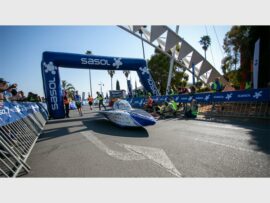
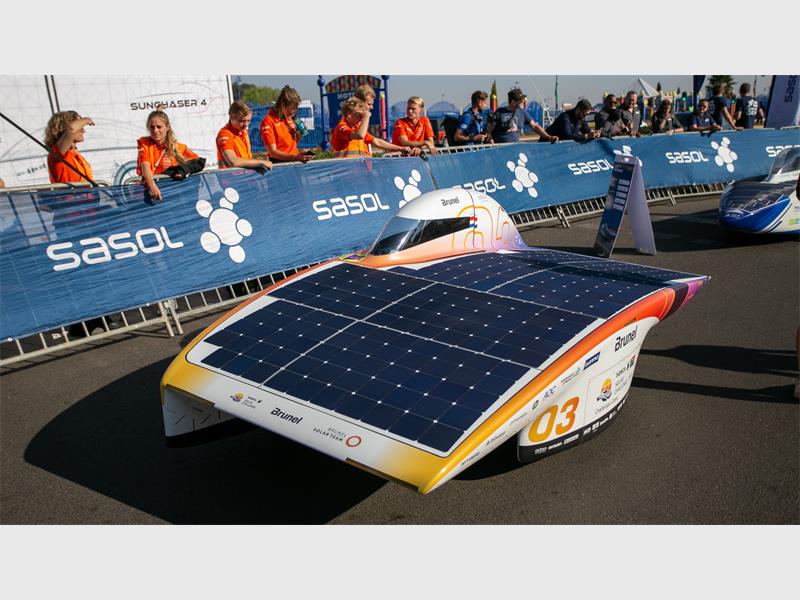
The 2022 Sasol Solar Challenge officially started last Friday at Carnival City with nine solar cars teams lined up at the start line by 07:45, getting ready to depart the venue for the eight-day-long endurance challenge.
The event officials, sponsors and guests including Belgium and Dutch embassy officials, gathered at the venue to wish the teams good luck.
Sasol, the title sponsor of the challenge, waved the flag at the start line to set off the solar cars as they were departing the venue.
Spectators from the Gauteng region and surroundings filled the venue to view the solar cars and support the teams as they took on Africa’s biggest solar challenge.
ALSO READ:
How to safely cancel a residential lease agreement
“We have been preparing for this event for four years now. It’s exciting to finally be back on the road and travelling through each town, driving awareness of renewable energy as well as science, technology, engineering and mathematics in young people,” said Robert Walker, owner and director of the Sasol Solar Challenge.
“Today was a great start of the event and we look forward to more exciting moments in the next seven days.”
Addressing the crowd at the start line, Charlotte Mokoena, executive vice-president of human resources and stakeholder relations at Sasol said: “All the teams competing in this year’s challenge exemplify some of the best hands-on learning in STEM (science, technology, engineering and mathematics) education.
“You are an inspiration to our youth to pursue careers in these fields. To all the young people here, I hope this experience ignites your passion and curiosity in science and technology.”
From Carnival City, the event will travel to Sasolburg alongside a range of popular attractions and South Africa’s major infrastructures including Sharpeville memorial, South African Airways Museum, Sedibeng Heineken brewery and the East Rand proprietary mines, before reaching its destination in Cape Town.
ALSO READ:
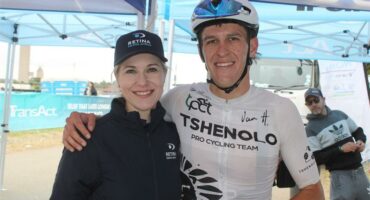
Pedal Power Association embarks on campaign to promote safety of riders
Day one of the challenge incorporated a school programme, which took place in Sasolburg during the first control stop of the event.
The programme was attended by roughly 800 learners from different schools in the area. Learners took turns in three stations at the venue to learn about solar technology, e-mobility and robotics in real life.
Each station, operated by Microbotics, a company that offers robotics, programming and electronic modules, presented toolkits that the learners used as practical examples of robotics and solar energy.
Some of the toolkits were provided by the Council for Scientific and Industrial Research. Among other modules, Microbotics offers robotics, programming and electronic modules.
Floris Niehaus, CEO of Microbotics, said: “Microbotics aims to simplify STEM education and make it interesting to young people. Our vision is to educate and train young people and teachers in programming, electronic and robotic skills by getting them to play with technology.
“We are grateful to the challenge for this opportunity to come here and engage with the school learners and through our demos, show them how different STEM and energy concepts work.”
Among other schools that attended the school programme was Lehutso Primary School.
The school principal said he was pleased to see the learners participate in initiatives that inspire them to pursue STEM education.
“We are grateful for such opportunities. Our learners have started working on energy solutions to address challenges that are faced by the community and the school itself.
“Their participation in this programme motivates and inspires them to develop even bigger energy and STEM solutions, and hopefully a solar car, which can compete in the challenge,” said Mpho Mofokeng, a school principal at Lehutso Primary School.
The Sasol Solar Challenge (previously known as the South African Solar Challenge) is in its 14th year. It is a biennial competition that strives to be the ultimate test of technology and innovation.
Engineering teams from around the world challenge each other to cover as much distance as possible as they travel on public roads from Gauteng to the Western Cape.
Local and international teams conceptualise, design and build solar-powered vehicles to drive across South Africa in the eight-day long event while competing against each other, demonstrating and showcasing their design, manufacturing, and strategy skills.
The challenge runs on public roads, sharing space with trucks and regular traffic, and passes through multiple small towns.
The challenge was inspired by the World Solar Challenge, which is now known as the Bridgestone World Solar Challenge, held in Australia since 1987.