East Rand war veteran shares dramatic flight story
“It was an interesting morning that put my training to the test.”
“The plane was damaged and flying was a challenge, but the 30-minute flight was just another day at the office.”
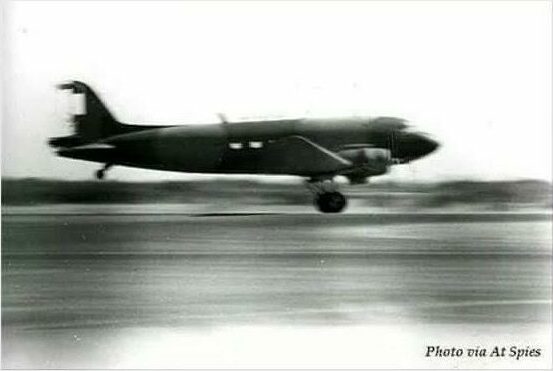
This is how retired South African Air Force (SAAF) pilot Colin Green described the faithful flight at the steer of a Dakota, which had been struck by a Soviet SAM-7 infrared missile on May 1, 1986.
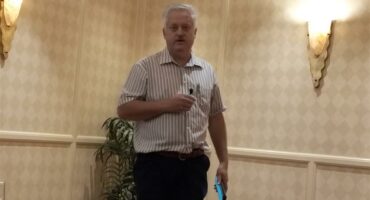
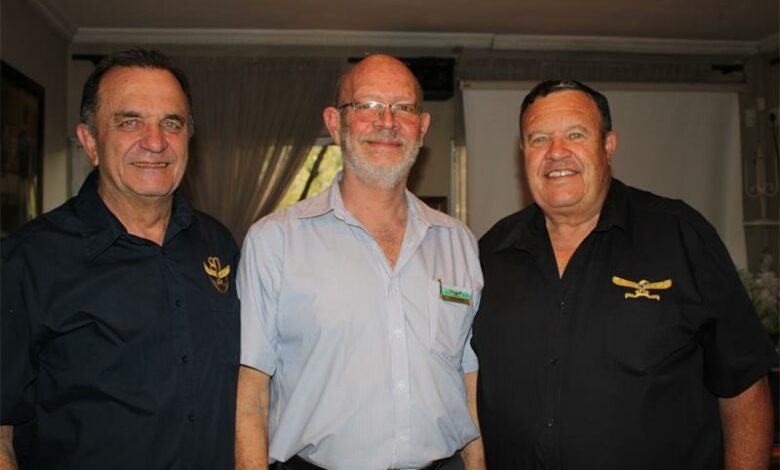
The former Christian Brothers College (CBC) alumnus shared his experience during the monthly South African Air Force Association (SAAFA) East Rand Branch’s chairman’s luncheon at Café@The Range, Kempton Park, on April 17.
Taking the podium, the Sunward Park resident quipped that he wanted to tell members and guests a ‘little tale,’ about an interesting flight he took to Ondangwa, in the former South West Africa.
Conscripted to the South African Military Police in 1980, Green had his aspirations set sky-high and, after numerous applications, was successfully enlisted to the air force.
Assigned to the flight school in Dunnotter, he got his wings flying Harvards.
“When we were not soaring above the clouds, we spent countless hours undergoing advanced physics training, something that was quite boring at the time but boded well when the unthinkable happened,” he said.
Green did a brief stint in Langebaan, Cape Town, undergoing training on flying jets, but a tug-of-war between G-force and his innards saw him join the 44 Squadron as a commander of a Dakota.
“It was during the height of the Border War, and we were based in Ondangwa, close to the Namibian border with Angola,” he explained.
“We would do routine ‘rumruns,’ delivering supplies to surrounding bases as well as transporting troops and patients.
“We flew in the attack envelope and therefore cruised at 10 000ft. I had flown the course on numerous occasions and didn’t suffer a single incident until that May.”
Attending a briefing, Green and co-pilot Mark Moses were instructed to collect seven military VIP’s, including the chiefs of the navy and army as well as generals, from Opuwo.
“As our esteemed passengers boarded the plane, I was momentarily blinded by the bling that chimed on their chests,” he said with a giggle.
“Our instructions were clear – to get the guests back to Ondangwa.”
Loud bang
Following the usual fight pattern, flying in a zig-zag pattern to avoid ground attacks, the conversations on the flight fell silent following a loud bang.
“We immediately checked the engines but observed no damage. However, the craft’s nose was barrelling up, the stick was out of control, and the rudder was unresponsive,” he said.
“Unaware that the tail was struck by a ground missile, my priority was to bring the craft under control and bring it in for a safe landing. That’s when those hours spent in the Dunnotter came streaming back.”
In an attempt to balance the Daks’ centre of gravity, Green instructed the passengers to move towards the cockpit and to sit as closely behind him on the craft’s floor.
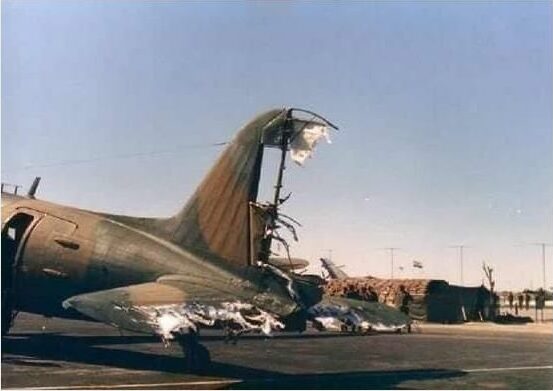
Stablising the nose, a Mayday was put out, and two military Puma helicopters were deployed to assist.
Lowering his altitude to 1 000ft and decreasing speed to 100 knots, the radio crackled into action.
“It was one of the Puma pilots, he asked whether I was enjoying my flight, to which I answered that I was happy with the progress,” he said, laughing.
“The pilot said as long as I am happy, he will not tell me what is wrong with the plane.”
Safely back on terra firma
Following the 30-minute flight and the Ondangwa landing strip coming into range, Green elected to let the plane’s landing gear down in an effort to further decrease its speed.
Positioning the nose to the centre line, he shut the engines down, landing the plane without risk of sparks, which could lead to a potentially deadly explosion.
“Greasing” the tarmac, the Dakota effortlessly touched down, its passengers and crew relieved to be safely back on terra firma.
“It was poetry in motion and had it not been for my training, the outcome could have been worse,” said Green.
Investigations later found that during a regular service at Rand Airport, Germiston, the tail suffered superficial paint damage during a Highveld hail storm.
“Repainting was hurriedly completed with the necessary deflective painting processes not being followed,” he said.
“As a result, with the Daks flying in an easterly direction, the sun created a reflection to which the missile locked, resulting in some highly placed individuals having a near-death experience.
“However, we landed safely and celebrated the touchdown appropriately.”
Final salute
In a letter addressed to Green, chief of the Navy, Vice Admiral C Snydercombe wrote: “Allow me to express my belated admiration of the calm confidence and professionalism you displayed. I shall never forget the 30 minutes prior to touchdown; it seemed like an eternity. Well done.”
Green was later awarded the Southern Cross Medal for his exceptional flying skills on that morning.
Two years later, Green made his final salute, retiring from the air force before joining the family business.
He may have hung up his wings, but to this day, aviation enthusiasts still talk about the tailless Daks, making a faultless landing.
SAAFA is a meeting ground for former aviators, South African Air Force members, anyone who worked within the aviation industry and aviation enthusiasts.
For more information, contact branch chairperson Roelf on 073 186 7761 or rossouwrj1@gmail.com