Abbotts College principal delivers important speech at UN
He spoke on early-childhood learning in South Africa and how the country is addressing the need for early-childhood development.
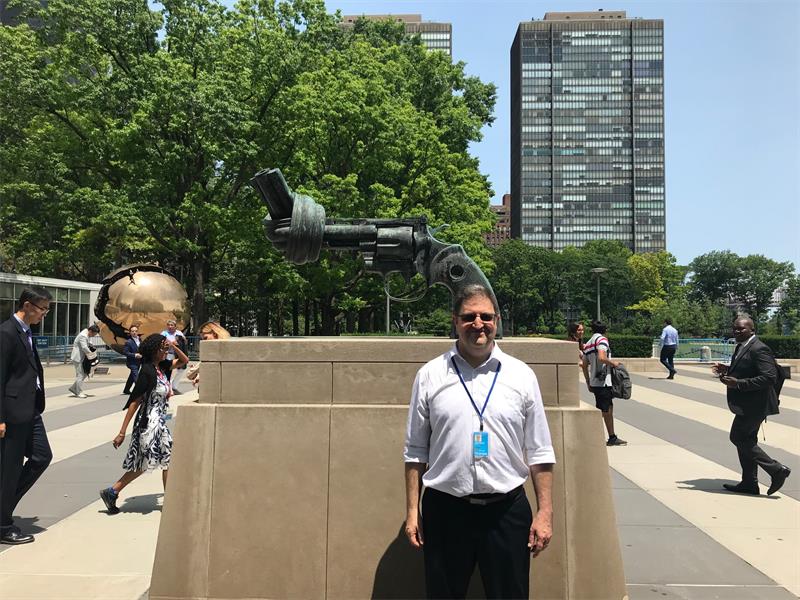
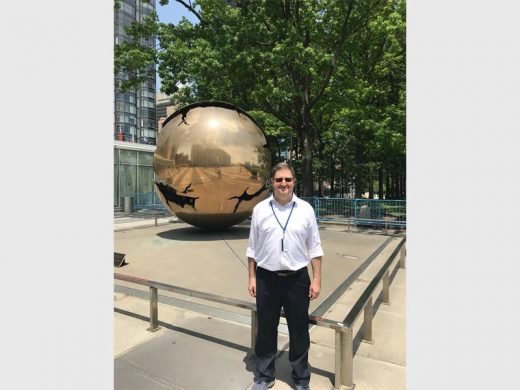
COLIN Northmore, principal of Abbotts College, recently returned from a trip to the United Nations where he spoke at a side event at the High-level Political Forum in New York.
Northmore went there to ask difficult questions, give counter-views or to agree with what the South African contingent was saying.
“That’s the idea behind inviting NGOs – you’re there as a conscience for your country, holding speakers accountable to what they are saying,” Northmore said.
He spoke on early-childhood learning in South Africa and how the country is addressing the need for early-childhood development.
One of the things that have been identified by the UN is that the best investment a country can make in education is in early childhood.
Another discussion point was how teaching refugee children has become a massive problem worldwide.
“South Africa does not have an encampment model, which most countries do have. If you want to provide education for children of refugees, all you have to do is build a school in the camp. South Africa does not have all the refugees in a camp. They are scattered all over South Africa and the schools that already exist have to be built into the solution to this problem,” said Northmore.
He pointed out that in the submission of educational goals that the South African government presented to the UN, the word ‘refugee’ appeared only once. The word ‘immigrant’ did not appear at all.
“When South Africa was reporting on its delivery of its goals, it did not even recognise the issue of immigrants and refugees in South Africa,” Northmore added.
He concluded his talk at the UN by saying, “As Chief Justice Arthur Chaskalson once said when ruling on capital punishment in our Constitutional Court, ‘It is only when we take care of the rights of the worst and the weakest among us that we can be sure that our rights will be protected.’ From this perspective the refugees are the weakest.
“There are people in the world who take the desire for us to bring about universal access to rights to all people in the world very seriously. Many say we are never going to meet the goal by 2030, which is the deadline. In South Africa we have made progress – there are communities that had no access to education, water and electricity that have access now. But the actual quality of our teaching and learning in our schools can arguably be said to have regressed,” Northmore said.
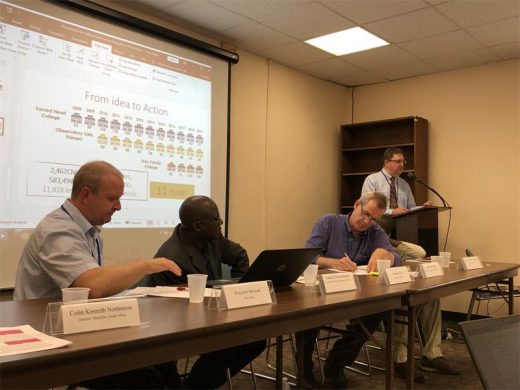
His experience at Sacred Heart and Abbotts College has been that there is a genuine desire on the part of the students to be part of the solution.
“They are not willing to accept it as a reality. They have a greater sense that the world doesn’t have to be like this and they can do something about it.
“Africa has the youngest population in the world with the greatest amount of adolescents in the world. Our responsibility is to engage the youth and encourage them to do and not simply accept. One of the biggest problems with education in our country is a lack of accountability. Students are disempowered and children are often still ruled by fear or treated as immature citizens,” Northmore added.
“Schools should be empowered to register undocumented children for access to educational and health services in our country, in their own right. If parents are illegally in the country that is between the state and the parent. It should not be the child who is punished,” he said.
Through funding that was provided by the sponsors for his UN trip, Northmore is planning an event where he will put a formal request to the government to create an advocacy platform for parents and schools that are experiencing this problem.
“That’s the next step forward,” Northmore said.
Colin Northmore’s UN speech
From Idea to Action – Tackling the problem of refugee education in South Africa.
Father Thomas, thank you and the Don Bosco network for this opportunity and thank you Eamonn and Misean Cara for making this possible.
To be clear, I do not speak with a mandate from South African civil society, but I hope to be the voice of tens of thousands of voiceless children in our country. Like many other parts of the world, Africa has seen a massive movement of people across the continent. It needs to be said again that nobody chooses to leave the comfort of the familiar for the dangers of the unknown and, especially, nobody chooses to expose their children to those dangers. I will not repeat the myriad of reasons for this movement. South Africa has been seen by hundreds of these thousands of displaced families as a place of hope.
South Africa has one of the most liberal and welcoming legal and policy frameworks in the world when it comes to the management of refugees and asylum seekers. We have a Constitution that aims to protect the dignity and rights of all individuals regardless of any factor that may set them apart from others, including country of origin, and this is especially true when it comes to the rights of children. There is a distinctive building that you see when you approach Johannesburg. It is called the Ponte and for many it is our Statue of Liberty and a symbol of arrival for migrants as they see it for the first time. Ironically, it was built during the apartheid era and is one of the most perfect examples of apartheid architecture still in existence. It is a perfect physical manifestation of the principles of apartheid. It is also a perfect physical manifestation of what awaits newly arrived migrants today as they face the new apartheid of our country.
If we had a way of successfully implementing the Constitution in our country, I would not be standing here today. Sadly, the reality for many children is that they are not able to access their right to an education. Xenophobia, poverty, language and, especially, bureaucracy prevent them from doing so.
I referred earlier to the South African laws and policies and, in relation to migrants, we are one of the few countries in the world to practise an integration model as opposed to an encampment one for dealing with refugees. The concept of integration is that you will avoid the issues that arise when you have large numbers of uneducated migrants and that their participation in economic activities brings enterprise and innovation, which results in their being a net gain to the GDP.
So, after that rather long-winded introduction, let me get to the point of what we believe to be one of the solutions to this problem. Last week in VNR, a presentation at the UN, it was stated that the commercialisation of education in a country leads to an entrenchment of the inequalities and the increase in the gap between the wealthy and the poor.
I would argue that you should measure commercial education not by the inequality that you presume to exist but by the equality it engenders in the community. I am not talking about outreach where the inequities are reinforced and where actors continue to believe that they can justify their privilege through acts of charity. I am talking about true social engagement that raises awareness of injustice and where genuine desire to bring about long-lasting change is engendered. This takes true courage from the parents and leadership of such schools and the result of this action can lead to an agency to bring about meaningful change in the world.
Three2Six is one example of this in practice. It came about when an expensive independent catholic school took the risk to do something about the children in its community who could not get into schools. These migrant children can attend school in the empty classrooms in the afternoon between 3pm and 6pm, hence the very creative name of the project.
Three2six is an afternoon bridging education programme for refugee and migrant children.
• English, mathematics and life skills are taught.
• Transport, nutritious meals, food parcels, uniforms, textbooks and stationery are provided.
• Financial support is given with school fees and uniform costs when they register into state schools.
• But more than this, we allow them to be children again!
We have five goals:
1. To provide basic primary education to displaced children who are denied access to education (with a particular focus on numeracy and English literacy)
2. To provide employment for refugee teachers to empower them to find permanent employment
3. To advocate for the rights of displaced children
4. To build the resilience and the social-emotional well-being of the children in the project.
5. To achieve a degree of sustainability through diversification of funding sources and the establishment of a strategic reserve.
I want to conclude by looking at recent developments in our attempt to achieve our third goal and to address the achievement of SDG 4.7 particularly, the inclusion of human rights education and the appreciation of cultural diversity into mainstream education.
We have been welcomed of late by the Department of Higher Education and by the minister Naledi Pandor and Michelle Mathey, the director of teacher education, to promote the use of the lesson plans we have developed in our Talking and Thinking about refugees resource book.
Through the agency of the department we have had meetings with the deans of schools and faculties of education at several universities and with trade union and basic-education representatives. The purpose of these meetings is to include our lesson plans into the pre-service and in-service training of South African teachers.
This resource is freely available and can be downloaded and adapted by teachers, and we would love to see it used in schools and translated into many languages in any country dealing with an influx of refugees and displaced communities
A final comment that I would make is that in the official 134-page South African VNR submission the word ‘refugee’ appears once in relation to goal 3 and the word ‘migrant’ does not appear at all. In the 60-page Civil Society report there is no reference to refugees and ‘migrant’ appears three times in relation to labour practices and policies.
As Chief Justice Arthur Chaskalson once said when ruling on capital punishment in our Constitutional Court: “It is only when we take care of the rights of the worst and the weakest among us that we can be sure that our rights will be protected.
Appendix 1 – SDG 4.7
4.7
By 2030, ensure that all learners acquire the knowledge and skills needed to promote sustainable development, including, among others, through education for sustainable development and sustainable lifestyles, human rights, gender equality, promotion of a culture of peace and non-violence, global citizenship and appreciation of cultural diversity and of culture’s contribution to sustainable development
4.7.1
Extent to which (i) global citizenship education and (ii) education for sustainable development, including gender equality and human rights, are mainstreamed at all levels in: (a) national education policies, (b) curricula, (c) teacher education and (d) student assessment
ALSO READ:
WATCH: Abbotts College principal invited to speak at the United Nations
For free daily local news in the south, visit our sister newspapers Alberton Record, Comaro Chronicle, Southern Courier and Get it Joburg South Magazine.
Remember to visit our Facebook, Twitter and Instagram pages. You can also email our offices on cvdwalt@caxton.co.za, juliem@caxton.co.za or luckyt@caxton.co.za
Get regular news updates sent directly to your inbox: Newsletter-Signup