
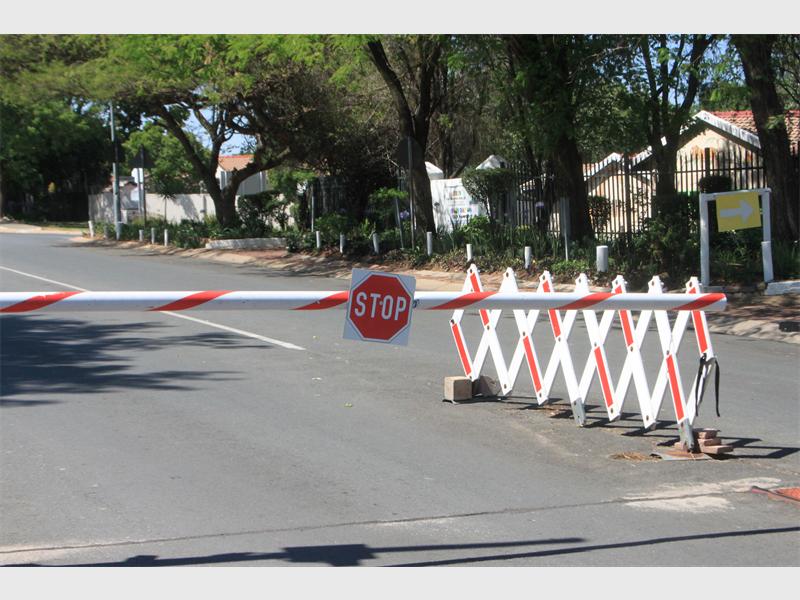
Road closures are by no means new, having been implemented some 15 to 20 years ago. They were constructed by a number of residents associations hoping to keep crime out of their suburbs. Over time as crime increased so did the number of road closures.
Presently there are in excess of 360 closures in the Gauteng region, many of them out of date or illegal.
Stephen Margo, who has been involved with many road closures over past years and who specialises in road closures, informs residents that the Johannesburg Roads Agency (JRA) in conjunction with the Johannesburg Metropolitan Police Department (JMPD) have now taken up the challenge of trying firstly to contact each closure and secondly to regulate all the closures around the city.
In the coming months, the 2014 Policy Document will be updated and improved upon and members of the community are encouraged to submit any suggestions or recommendations they may have which in turn may improve the policy. All submissions will be investigated by the council and will be carefully scrutinised for inclusion in the new policy.
Road closures must be renewed every two years, the onus being on the road closure committee to ensure that this is done timeously. This has not happened in the past but will be more strictly adhered to by council ensuring that all records are kept updated.
Out of date and illegal closures will soon receive letters from council giving them a specified time period to renew, update or legalise their closures. Failure to do so may lead to council removing the closures and fining residents or taking legal action against them.
The road closure policy is available on the council’s website. There are a number of forms which have to be completed as well as a number of items that also have to be included in the submission.
“The process is time-consuming and costly but well worth the effort as it does assist in keeping crime down in the suburb,” said Margo.
Unfortunately, there are a number of rules that many of the closures simply disobey. Should council receive complaints in this regard they will take action against the closure.
To mention a few of the rules:
- All roads are public roads and no one may be prevented from using them
- Security officers may not stop a vehicle and request a register to be filled in
- Security officers may not stop and search a vehicle
- No fees may be charged for access to the boomed area
- Security officers may not ask for personal information
- Security officers may not delay traffic
- No posts with push buttons or cameras may be mounted in the centre of the road as this narrows down the road making it difficult for emergency service vehicles to manoeuvre
- Security officers may only monitor the inflow or egress of traffic into and out of the boomed area
- Wherever a post is to be sunk into the street or sidewalk, a wayleave form must be completed by the applicant
- Pedestrian gates should be left open 24 hours a day, although in certain cases permission is granted for night closure between 8pm and 6am
- Any and all motor gates where permission is granted for closure at any time must be able to be opened immediately in cases of emergency
- In cases of new applications a traffic impact, study may be required, alternatively a traffic safety study
- Correct and sufficient signage is critical to all closures as well as a public liability policy, as immediately the council approves the closure, the residents become liable for any incident that may occur in the street
- At present no automatic gates or booms are allowed unless specific permission has been granted, although this may change when the policy is updated.
Other factors influencing a road closure are:
- Easy and quick access for all emergency services and armed response services
- Easy access to all council services, such as Telkom and the like
- A free flow of traffic in and out of the boomed area.
Anyone needing assistance or further information with regard to a road closure application or with the renewal of their road closure can contact Stephen on 011 465 8638 or 076 030 2342 or by email stephen@margo-security.co.za