
Burns are a common injury that can range in severity from minor discomfort to life-threatening emergencies.
The extent to which a burn will heal often depends on the quality of first aid received immediately after the injury.
Burn awareness week was observed from May 6 to 12.
“Whether it’s a minor burn caused, for instance, by a steaming cup of coffee or a more serious burn, there is little doubt that correct first aid can improve the outcome,” said Mr Gary Paul, the clinical head of Netcare 911’s coastal operations.
The following is some advice on what to do and not to do when faced with a burn injury.
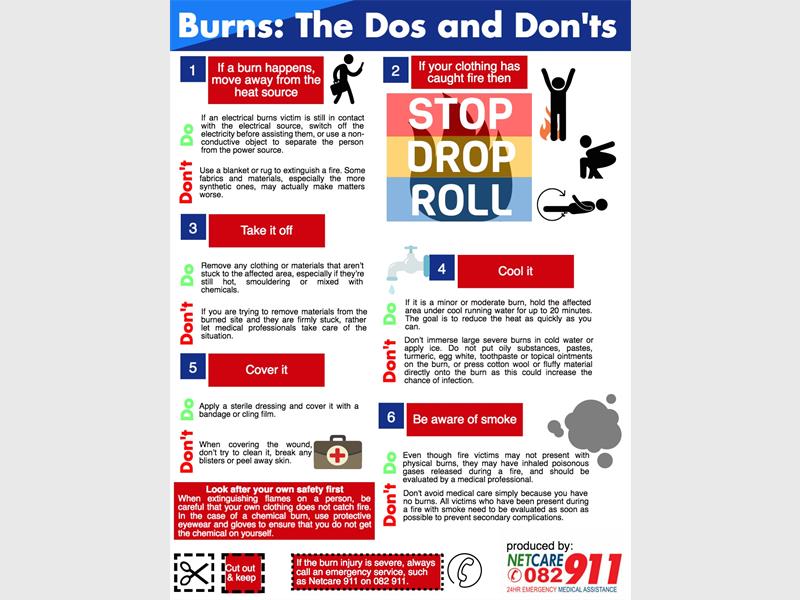
What to do:
Remain calm.
If there are flames, extinguish them.
Stop running, oxygen fuels flames.
Drop on a flat surface, cover your face with your hands.
Roll over and over until the flames are out.
Educate others about the stop, drop and roll technique.
Make sure the area is safe before you help someone. Look after yourself, you cannot help people if you are injured.
Cool the burn with cold water for at least 20 minutes
Call for help, an emergency provider and give them as much information as possible.
Wrap the burn victim in a clean sheet and either wait for medical assistance or take the individual to a medical facility, whichever may be quicker in the circumstance.
Avoid smoke inhalation, not only will the smoke contain poisonous gasses, it can also burn your lungs.
What not to do:
Don not put substances on the burn other than water. Even ice can further damage the tissue, however using too much cold water can lead to hypothermia.
Do not put oil pastes, turmeric, egg white, toothpaste, tropical ointments or fluffy material on the burn. These items can increase the risk of infection. Burn dressings from pharmacies maybe used.
Never peel off blistered or open skin as this can lead to further infection
Severity of burns
Don’t underestimate the severity of a burn. Rather consult a medical professional.
Superficial partial thickness (first degree burns) – these burns are painful and red. Sometimes blisters may form. However, they usually heal with little or no scarring.
Deep partial thickness (second degree burns) – severe pain, skin discolouration and blisters, often with scarring. Seek medical advice.
Deep thickness (third degree burns) – these burns cause deep damage to all three layers of the skin. They destroy hair follicles, blood vessels and nerve endings. The burn victim may also experience breathing difficulties and circulation problems. Seek immediate assistance from emergency medical services or a trauma facility equipped to deal with burn injuries.
Burn prevention tips:
Reduce the temperature of geysers; this reduces the chances of scalding injuries, which are among the most common types of household burns.
When filling a bath, never use the hot water tap on its own. Control the temperature.
Keep portable cooking devices, kettles and pans that can contain hot liquids out of reach of children.
Invest in at least two fire extinguishers.
Invest in smoke detectors.
Never use flammable liquids to start a braai or fire.
Take care around fires, hot liquids or cooking equipment when in use.
Do not sleep with electric blankets or heaters switched on.
Test the bath water for babies and children. It should be comfortably warm.
Store matches and lighters out of children’s reach.
Never overload electrical plug points, as this can increase the fire risk.
Never smoke in bed, near gas cylinders or other flammable substances. Always dispose of cigarette butts responsibly.