The DA is “appalled” at the poor sanitation conditions at Winnie Mandela and Madelakufa Extension Two informal settlements.
On July 11, the DA conducted an oversight inspection in Tembisa after Ekurhuleni mayor Clr Mzwandile Masina refuted claims that about R1.9-billion had been spent on chemical toilets in informal settlements in Ekurhuleni.
The mayor’s office released a statement in response to a toilet report published by AmaBhungane in Daily Maverick, outlining the interventions his administration had taken in improving sanitary services across the City. He said it was not R1.9-billion that was spent but rather R800-million. He said the tender was awarded in 2016, prior to him assuming office.
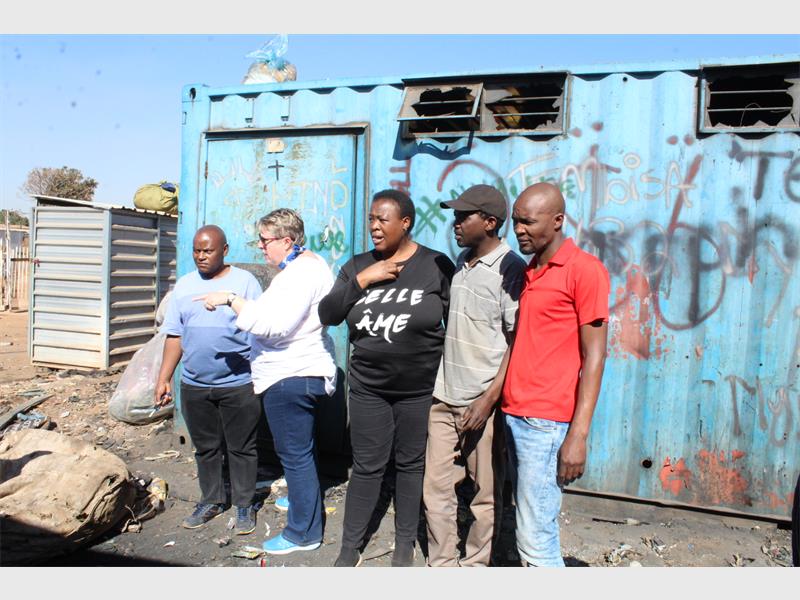
Residents of Winnie Mandela and Madelakufa expressed their disappointment to MPL Kate Lorimer, DA Gauteng shadow MEC for Human Settlements and Cooperative Governance and Traditional Affairs (COGTA), about their living conditions.
Lorimer said according to the AmaBhungane investigation, the metro has spent R1.9-b on these chemical toilets over the last three financial years from 2017 to 2019.

“It is shameful that the chemical toilets provided to residents of Winnie Mandela and Madelakufa Ext Two are not being regularly maintained,” the DA said in a statement.
Lorimer said she was going to report the tender to the Special Investigation Unit (SIU).
Lorimer suspects bribery in the tender, saying the 16 companies contracted for the project may have pocketed something for themselves, seeing as 1 000 toilets were supposed to be issued to each community, but only 530 toilets are available.
“Where are the rest? We walked into the settlement and saw that suddenly a new toilet had been delivered. It all seems a little bit too convenient in terms of timing. The issue arises and suddenly new toilets are being delivered.
“The question is, why are these toilets so expensive? You are looking at R19 000 and R26 000 per toilet per year.
“That is to purchase the toilet and to service the toilet supposedly twice a week, but we know that is not happening,” said Lorimer.
She said an audit of how many toilets have been delivered needs to be conducted to see if it is the same number (16 000 toilets in the first year, 30 000 in the second year and 39 000 toilets in the third year) as in Masina’s statement.
“We need to see if we are getting value for money. My feeling is that we are probably not,” explained Lorimer.

According to Thabang Mashiyane, spokesperson for the ANC in Ekurhuleni, the ANC caucus in Ekurhuleni welcomed the clarification provided by Masina in respect of the chemical toilets.
“Prior to the press briefing, the ANC caucus was taken into full confidence on what transpired with regard to the chemical toilet tender and its related services.
“We were satisfied that there were no procurement irregularities emanating from the supply-chain management process.
“We were also assured that measures are being put in place, particularly with regard to the standardisation of rates, as well as the system of monitoring the service,” said Mashiyane.
Sello Masokameng, a resident of Madelakufa Ext Two, said they experienced poor service delivery from the metro.
“We are requesting more toilets because we have 530 toilets used by more than 5 000 families and each toilet caters for over 30 families. We are not happy with the conditions of the toilets because there are not enough and they are not maintained.
“It is unhealthy. In summer, these unserviced toilets stink, which is not good for our health,” said Masokameng.
Another resident, Mpho Maba, said the metro must be held accountable and explain what happened to the rest of the toilets that were supposed to be distributed to Madelakufa Ext Two.
“We also want a reliable service provider that will maintain the toilets we already have. Our toilets look like they are not being used by human beings, but by animals. I want to assure South Africa that the toilets that were supposed to have been distributed to Madelakufa Ext Two were not delivered,” said Maba.
The community does not want the new proposed plastic toilets, saying they would cause health hazards in summer.