

Watch: Wildlife capturer’s son survives hippo boat flip near Hoedspruit
A seasoned wildlife capturer recounts split-second decisions that prevented serious injury when a protective cow capsized their boat during a relocation mission.
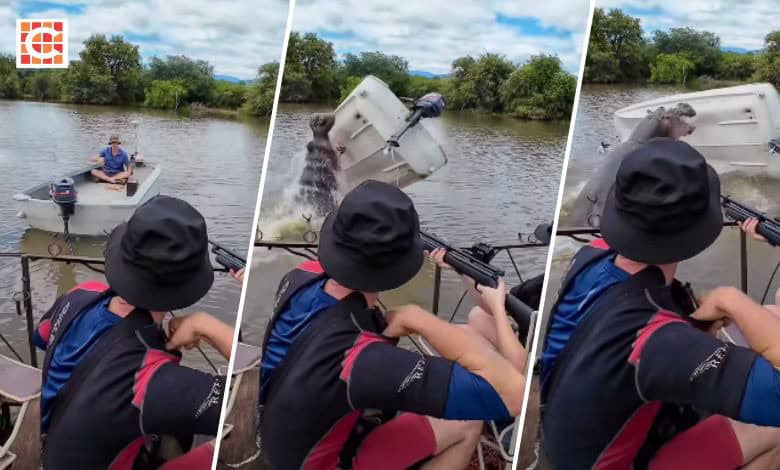
A father has shared the story of a terrifying incident in which one of his sons was flung from a small boat by a hippo.
In an exclusive interview with Caxton Network News following the incident last Tuesday, experienced wildlife capturer Andre Pienaar (54) explained what happened.
Andre, who owns Parawild Edu Capture and has more than three decades of experience in wildlife capture, says his youngest son, Zander (20), who is also the company’s team manager, kept his composure in what could be described as a horror encounter. The incident was filmed by Andre’s oldest son, Markus (23), who handles the company’s marketing.
“A thousand things were going through my head as a father and as someone who has never seen someone being killed during a wildlife capture,” he said.
He has, however, witnessed people sustaining ‘light injuries’ over the years.
A routine capture…
Andre explains that the day was supposed to be a routine capture. The operation had initially been scheduled for last Monday, but was postponed after the boat he arranged had engine trouble. A strong wind also contributed to the decision to delay the capture until last Tuesday.
Recent floods in Hoedspruit resulted in the Zandspruit River swelling and washing away fences. As a result, a hippo mother and calf ended up in a dam at Zandspruit Bush & Aero Estate near Hoedspruit.
Andre said the hippos’ owners, from an adjacent reserve, contacted him. Nature conservation officials and role-players from the Department of Forestry, Fisheries and the Environment were contacted to assist.
Two capture methods
Andre explains that there are two ways to catch a hippo.
The first is darting the animal. The second, a more passive method, involves placing two electric cables around a dam and luring the animal, with food, into a boma or kraal over time. This method takes between two and four weeks and involves night-vision equipment.
He says they translocate and relocate several hippos a year and that most operations are successful.
“Every capture and situation and animal’s personality is different,” he said.
In the past, hippos were darted at night when they were far from water because the medication used caused their muscles to relax, leaving them unable to control their breathing and putting them at risk of drowning. The newer medication, used for almost 20 years, allows them to dart animals while they are in water. The animal enters a sleep-like state but will float to the surface and continue breathing.
However, he stresses that darting in water remains dangerous and is used only when there are a few hippos in a dam or when it is the better option, such as after floods or when animals are in areas they do not belong.
Hippo flips boat
Last Tuesday, Andre and his team used a float, which he says offers protection from a hippo attack but is clumsy and difficult to navigate on water. He thus arranged an additional boat, which he had hoped would be bigger than the one they had to use.
The smaller boat was used to get Andre and the veterinarian on the float closer to the hippo. Only upon closer inspection did they realise that the hippo was a cow and that she had a calf. They could not determine the animals’ ages before the capture operation, as only their nostrils were visible above the water.
The mother and calf were positioned near a tree in the water.
“I wanted the smaller boat to get the float to about 20m from the tree so that we could drop anchor and wait patiently,” Andre explained.
He said one of the hippo’s patterns was to surface its nose every four to six minutes and show its entire head every 20 to 30 minutes to look around. The plan was to wait for an opportunity to dart her so that she would float and be pulled to shore with a rope. This option was chosen because the passive method costs more and takes longer.
Andre had a hunting rifle as a backup weapon, but carried his pistol to make him feel more at ease in case something went wrong.
As they approached the tree, he noticed bubbles under the water and realised the hippo cow was directly beneath the boat.
“Before we could react, she flipped the boat over.”
Split-second decisions
Zander was on the small boat when it was overturned. Andre says his instinct was to jump into the water to rescue his son. However, his experience had taught him that doing so would cause more chaos and panic, so he remained on the float.
From the higher vantage point, he had a better angle with his pistol should the situation escalate.
He pulled the overturned boat, still attached to the float, closer. Amid the chaos, Zander managed to climb on top of it. The hippo cow, with her calf nearby, then moved away.
“She was purring about 30m away as she made her displeasure known,” Andre said.
After recovering the boat from the water, drying the engine and allowing everyone to settle after the scare, the team proceeded with the longer, alternative capture method.
Andre said the veterinarian got a fright during the incident and was unable to take a shot.
What matters most, he said, is that everyone survived and that the hippo was not injured.
Two days later, true to their motto, the team carried out a similar operation at another dam with other animals.
“We have a saying that if we can’t catch the animal today, tomorrow we will be back, and do it easier, better and quicker,” he said.
While this video went viral, Andre said this type of risk is a part of wildlife capture work.
“This is a normal day in several wildlife capture operations.”
Watch the videos:
Zander explains the video:
Another angle:
@radarafrica An angry hippo overturned a safari boat at Kruger National Park, South Africa. Luckily, the boat was empty.
