
[WATCH] Push hard, push fast
After a scary life-threatening experience at the News' offices, we asked a team of paramedics to demonstrate CPR to us.
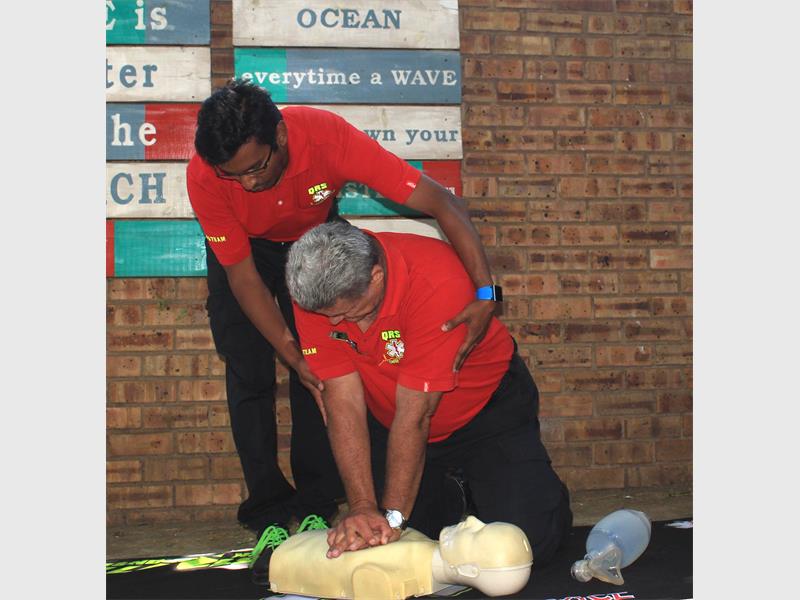
Caxton Joburg West recently experienced a very scary incident, when one of our staff members fainted and stopped breathing.
A short silence preceded havoc as everyone in the office tried to help in any way possible. However, no-one knew exactly how to react or what to do – and it only takes about four minutes for someone to start sustaining brain damage without oxygen or blood supply. Fortunately, we were able to get our colleague breathing again very quickly with the help of a team of paramedics, and today she is well and safe.
After our scare, we invited a team of Quick Response Service‘s (QRS) finest paramedics to visit the Caxton Joburg West branch to briefly demonstrate how any person can administer CPR to save another’s life.

The demonstration quickly turned into a fun exercise, as all who attended had a turn at pumping the chest of a demonstration doll named Frikkie.
Denver Ramnarain, an advanced life support paramedic, started the demonstration by explaining the three ‘Hs’ one needs to check on to determine whether or not a person needs CPR. He started by saying if you find a person who seems unconscious, you should first determinine if the object that caused the person to be unconscious is still on scene.
“This is called a hazard,” Denver said. “A hazard can be anything from a snake to an electric cable and so forth. You need to remove the hazard before moving to the patient, unless removing it will cause the patient to bleed out.”
Thereafter you determine whether the patient is conscious or not.

“Tap the patient hard on the shoulder (and I mean hard!) and say ‘Hello’ to them,” said Tony Wolfe, the QRS events manager. “If he/ she doesn’t respond you can move to the next step, which is to call for help”.
“Many people make the same mistake when they call the paramedics – they call very quickly, say a few words and hang up,” Tony said. “If you call someone, stay on the line, no matter what.” It is important to help paramedics with as much information regarding both the situation and the location of the scene.
Denver and Tony then demonstrated the three ‘H’ steps:
If the patient hasn’t responded, the next step is to start administering CPR. In the past CPR started with some mouth-to-mouth breathing – giving two breaths to the patient. However, this has fallen away, as it is more helpful to start with chest compressions to get blood circulating again.
The CPR procedure can be summarised in these steps:
1. Locate the end of the patient’s sternum (breast bone). That’s where the top of the diaphragm is. Once you’ve located the top of the diaphragm, measure two finger-widths above it, towards the patient’s face. That’s where you do chest compressions.
2. Put one of your hands on top of the other, with the backs of your hands facing up, and interlock your fingers.
3. Place the palm of the bottom hand on the spot you located in step one.
4. Straighten your arms, and lean forward, so that your shoulders are above your hands.
5. Start compressions by pushing the breast bone down about 5cm. Then raise your hands and arms until your palm is just far enough from the patient’s chest to slip a sheet of paper between your hands and the patient. One push and one lift is considered one chest compression. Chest compressions must be done at a rapid pace, about 120 a minute. Do 30 chest compressions, then give two rescue breaths, preferably using a mouthpiece or a resuscitator bag.
6. Before the rescue breaths, establish an airway by putting two fingers underneath the patients’ chin and lifting it. The head will tilt backwards too. Then, pinch the patient’s nose closed and blow firmly but not hard, into the patient’s mouth. The first breath must last about one second. Keep an eye on the person’s chest to see if it rises.
7. Give a second breath. You must do two breaths within 10 seconds and then continue to administer chest compressions.
8. Try to have someone on stand-by to take over from you – chest compressions are very tiring. Take turns doing chest compressions with that person. Whatever else you do, don’t stop giving CPR until the person is conscious or a paramedic arrives.
To do CPR on a baby (under one year of age), follow the same procedure; however instead of using your palms and arms to compress the chest, use two fingers:
1. Put your index and middle finger together and place them at the top of the diaphragm/bottom of the breast-bone. Move your fingers two finger-widths towards the baby’s face.
2. Then start pushing rapidly on the chest. You have to press the chest down about 2cm. Do 30 compressions. Then administer two rescue breaths. Blow softly into the baby’s mouth until the chest rises. Do two breaths within 10 seconds and continue with compressions.
Treat children of more than one year of age exactly as you would treat an adult.
When do you stop administering CPR?
• If the patient starts moving, he is conscious and doesn’t need CPR anymore.
• If a paramedic arrives on scene and takes over.
Watch as our editor, Janine Viljoen demonstrates how she would administer CPR to an unconscious patient:
Also Read:
Former Norie pupil dies in head on collision
Man critical after roll-over accident
Car rolls through complex wall