

The News recently went around town speaking to a few small business owners and workers about the re-establishment of the nationwide load-shedding programme.
They were asked how load-shedding affects their business, and the general consensus was rather more than just negative. Some Krugersdorpers felt that they were rightfully angry about it all.
Mandy Chinner currently manages a car-wash station near the Key West Shopping Centre, and noted that their job is a lot more work, since they can no longer clean the cars with pressure hoses, but have to wash everything by hand.
Hair salon owner, Loraine Holder, is lucky to have a generator in her shop for when the power goes out, but said, about the regular power surges that occur when electricity is restored to the area, “After a few days of having load-shedding, your equipment starts packing up. Then you wonder why, and you realise it’s because of load-shedding”.
Tyrone Jacoby of The Diner restaurant said they sometimes also incur damages to some very expensive equipment in the restaurant. Just recently a refrigerator’s motor was damaged, and will cost a few thousand rand to fix.
Tyrone also pointed out the security concerns of home-owners.
“Last night it wasn’t that busy, because who’s looking after the person’s home when he’s out? It’s all dark at home and people tend to stay home.”
When asked why load-shedding is necessary, everyone who was interviewed answered in near identical ways: “It’s not necessary”. Tyrone said, “It shouldn’t be necessary. There’s no proper maintenance to these systems. If you don’t service your car, it’s not going to run, is it?”.
The News found that the largest confusion surrounding load-shedding is centered on the implementation of the stages. For the most part, people could not explain how the stages work, or exactly how many there actually are.
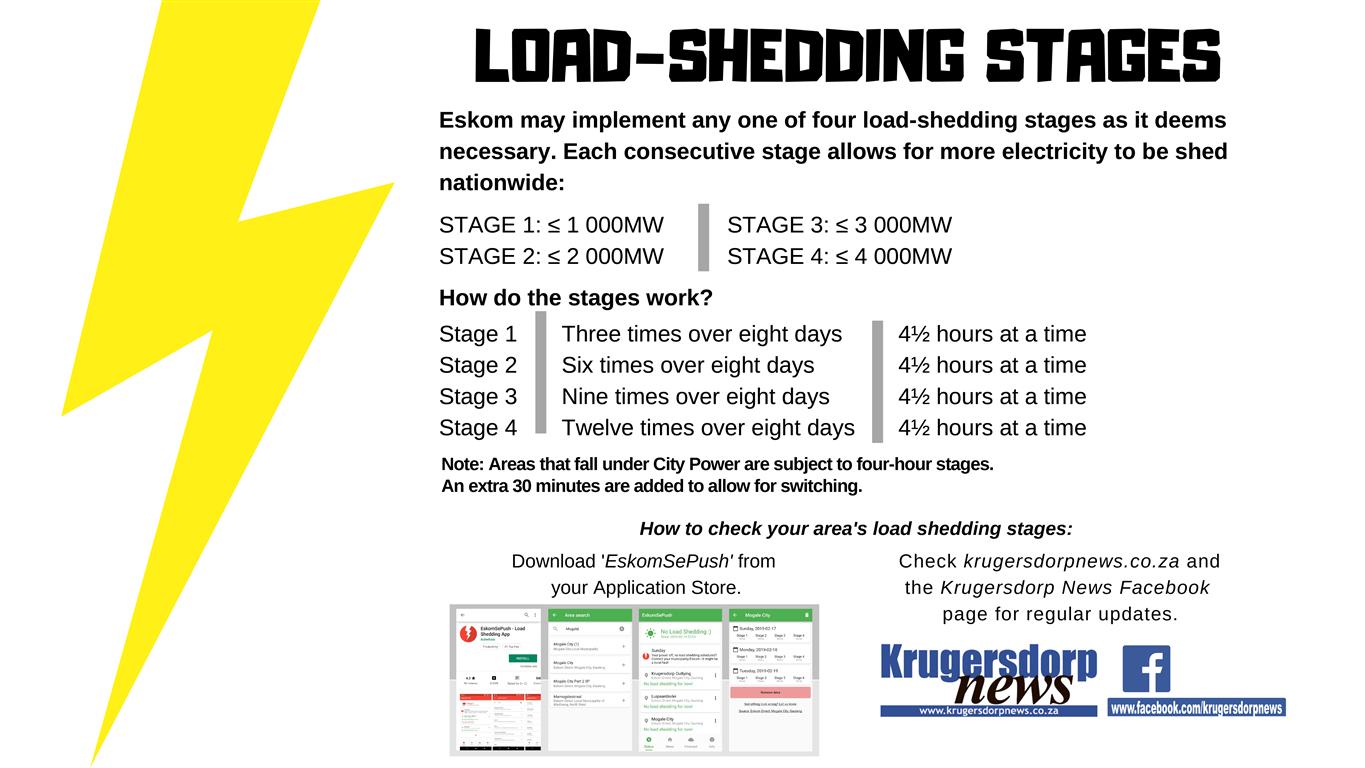
To explain it as simply as possible: each stage allows for a certain amount of electricity to be shed from the general supply. The higher the stage, the greater the quantity of electricity that needs to be shed, which means that load-shedding will be implemented more often at each level. To make it easier to understand, take a look at the infographic depicting how each stage works.
Watch more of the interviews here:
Do you perhaps have more information pertaining to this story? Email us at krugersdorpnews@caxton.co.za (remember to include your contact details) or phone us on 011 955 1130.
For free daily local news on the West Rand, also visit our sister newspaper websites
Remember to visit our Facebook, Twitter and Instagram pages to let your voice be heard!