What is it like flying a spotter?
Maritza Swanepoel, public relations officer for Letaba Fire Protection Association (LFPA) joined her colleague, Eksteen du Toit flying a spotter during a fire. Here she writes of her experience.
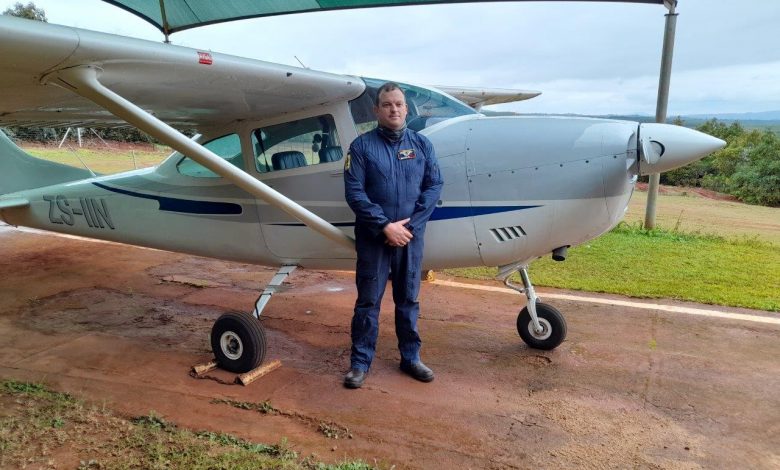
There are four pilots that do base standby at the Letaba Fire Protection Association’s base in Politsi.
They are fortunate enough to have their own crew room with an air conditioner and deck with a braai. They are here for the winter fire season starting from June 1 annually until the end of October.
Day in and day out they wait, seven days a week. Every day. All day. And then it happens. The dispatcher calls them over the PA system: “Pilots, pilots come to dispatch!” They quickly get changed into their flight suits and run up the stairs to the dispatch centre where the dispatcher gives them their head and bearing, fire name, incident commander, and radio channel to be used and off they go.
I jumped into the Cessna 182 Spotter, called Spotter 15. You must be strapped in a seatbelt in a very tiny space. Because it differs from your normal car seatbelt, the pilot strapped me tightly. I threw my arms in the air as I did not know what to do with them.
Then we go through the emergency procedures, like always. The start-up of the spotter takes about five minutes. Before taking off, the spotter pilot must activate the firefly which is an onboard camera that captures the fire live.
Also read: ‘Python deserves our respect,’ says snake lover
He also carries a Trackimo device in the plane which is a small GPS device for tracking movement. Once in the air, the spotter pilot immediately makes contact with dispatch, helicopter pilot and the incident commander on the ground.
Once overhead the fire, the spotter must locate the nearest dip site for the helicopter to collect water from. The spotter does the aerial command and control in the sky. He gets instructions from the incident commander on the ground and gives the message to the helicopter pilot.
Also read: How to pack a hiking backpack
On the control side, he controls where the drops should be placed, hold separation if there are two helicopters on the incident. Furthermore, he is also responsible for looking for hazards from above like electrical lines and widow-maker trees because he flies at about 1 000ft.
Flying in a circle with your head tilted 90 degrees the whole time and turbulence bouncing you up and down for hours until you are stood down, takes a toll on your body. And all the while the pilot is monitoring and communicating over three radio channels while keeping the plane in the air. That is concentration at its best!“