New signage on R40 to curb wildlife road collisions
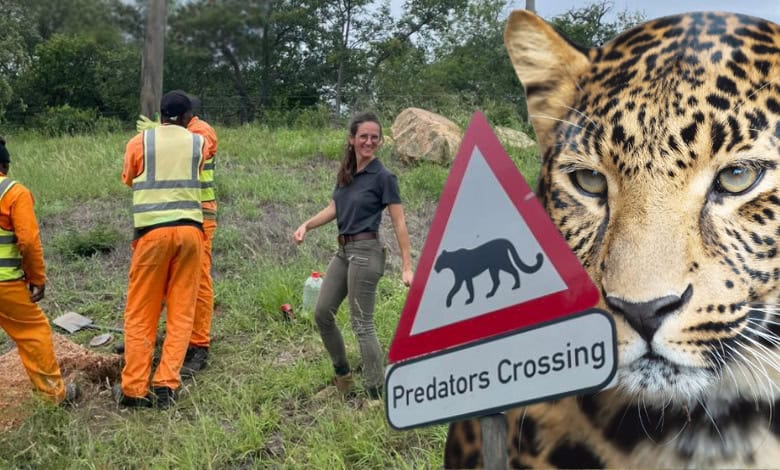
Ingwe Research Programme has installed predator warning signs along the R40 after data showed rising wildlife deaths.
HOEDSPRUIT – Between May 2024 and October 2025, eight leopards were killed on local roads, six of them on the R40, with four of those deaths occurring within a single 15km stretch.
In 2025 alone, 208 animals, including hyenas, African wild dogs, and African wild cats, were killed in vehicle collisions. Of these, 61% were mammals, 26% birds, and 14% reptiles.
“For a long time, these losses were just numbers on a spreadsheet,” said Marine Servonnat, executive director of the Ingwe Research Programme. “But every one of those numbers represents an animal that should still be part of this ecosystem.”
New predator warning signs installed
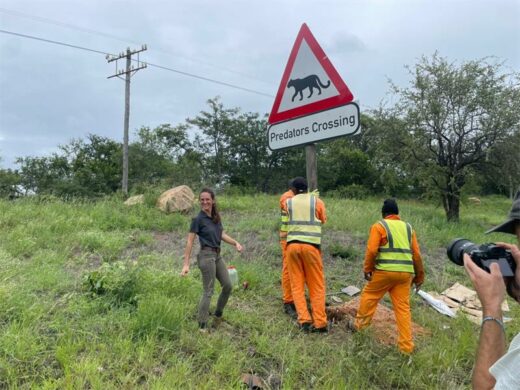
This month, motorists will begin noticing four new “Predators Crossing” warning signs along the R40. Featuring the leopard as a symbolic species, the signs have been installed at locations identified as the highest-density leopard roadkill hotspots and represent the first mitigation measure implemented by Ingwe since the programme’s inception less than two years ago.
“These signs are not just symbolic; they are placed exactly where the data tells us the risk is highest,” said Servonnat. “They are meant to slow drivers down and remind them that they are moving through a living landscape.”
The signage was developed through a collaboration with the South African National Roads Agency (Sanral), which agreed to design the signs specifically for the project.
“Seeing these signs erected just a year after we started collecting data shows what is possible when authorities listen, and communities push for evidence-based solutions,” Servonnat said.
While the signs aim to raise awareness above ground, extensive research continues.
Researchers expand monitoring
In January, Ingwe launched its Wet Season Survey, an intensive roadkill monitoring programme. For 14 consecutive mornings, researchers patrolled the R40, recording detailed information for every animal found. The surveys will be repeated in February and March, totalling 42 days of data collection.
“We are looking at everything, species, location, time, weather conditions, because understanding the patterns is the only way to prevent future deaths,” said Servonnat.
At the same time, long-term mitigation options are being explored below the road surface. Camera traps are currently being redeployed at culverts beneath the R40 to assess how wildlife uses these drainage tunnels as crossing points, following a brief delay caused by flooding.
“Last season, we recorded 17 different species using these culverts, including resident leopards,” Servonnat said. “On average, leopards used the tunnels more than five times a week, which tells us these structures are already part of their natural movement routes.”
This season’s monitoring will include two continuous 45-day sessions per section, with researchers assessing how wet-season factors such as water depth and flow influence animal movement.
Contact marine@ingweresearch-program.org or visit ingweresearchprogram.org.