Dr Ivan Schewitz treats an unidentified condition in a patient at Netcare Waterfall City Hospital
Before the patient consulted the doctor, her 'constant and elusive companion since birth’ was viewed as little more than a cosmetic problem.
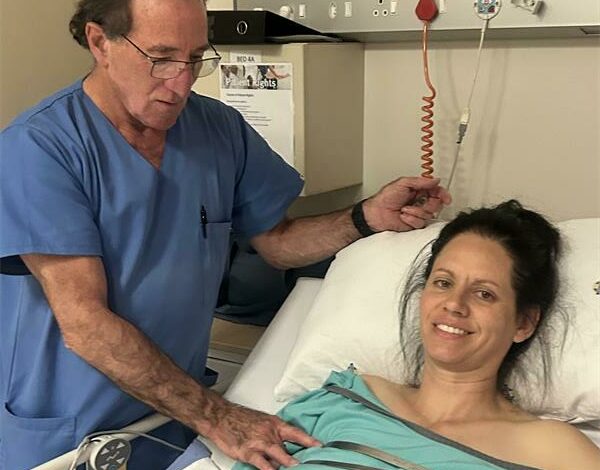
Having sought a healthcare solution for an unnamed condition, Ingrid Dammann turned to Dr Ivan Schewitz – a pioneer in his field – who practises primarily at Netcare Waterfall City Hospital.
It was only at the age of 31, while pregnant with her first baby, that Dammann’s ever-present healthcare condition — a sunken chest with a deeply dented breastbone, was finally identified as a serious concern requiring medical intervention.
Until that moment her ‘constant and elusive companion since birth’ was viewed as little more than a cosmetic problem.
Six years and two pregnancies later, Dammann recalls that even though pectus excavatum (PE), as it was later diagnosed, is the most common chest wall skeletal deformity, it was never something that any medical practitioner had previously paid much attention to or even referred to by name.
“The phrase ‘there’s nothing wrong with you’, uttered during many a medical investigation, became the most unnerving and frustrating verdict. It was, in retrospect, the loneliest road I’d ever walked,” she said.
Dammann, who lives with her husband and three young children, spent the last month of her first pregnancy in bed rest before her baby was born by caesarean section at 36 weeks.
“Prior to being confined to my bed, I could not drive myself to work without pulling over due to dizziness and breathlessness. As an occupational therapist, the active therapy sessions I had with physically and mentally impaired children caused the muscles in my upper and lower extremities to become completely stiff, leaving me gasping for air while fighting light-headedness,” she explained.
“For the first time, the specialists I was consulting took my complaints seriously, but they still could not find clear answers to my problem. After recovering from the caesarean section, the symptoms I experienced during pregnancy did not disappear and my health did not return to what by now was considered ‘normal’ for me. My heart and chest were more problematic than ever, leaving me deeply anxious.”
In search of the solutions
While scouring the internet for a solution, Dammann found an electrophysiologist and a cardiothoracic surgeon and in 2019, at the age of 33, she had a cardiac ablation to treat her abnormal heart rhythm.
Her problems were, however, not behind her as the root cause of her condition had not been resolved.
After ongoing research and reaching out to countless specialists, she finally received a positive response from cardiothoracic surgeon Dr Ivan Schewitz, a pioneer in his field, credited with introducing thoracoscopic surgery and the minimally invasive repair of PE, using the Nuss procedure, to South Africa.
For Dammann, the consultation with Schewitz finally delivered the solution she had desperately been looking for over many years but just after being scheduled for the Nuss procedure, she found out that she was pregnant with her second child.
“Particularly because of the healthcare issues I had faced during my first pregnancy, I decided to proceed with it and I was 16 weeks pregnant at the time I had the Nuss procedure. Though this may be considered controversial, for me it was well worth it even though, at times, it was most uncomfortable and painful – particularly on top of being badly impacted by morning sickness.”
A second and a third pregnancy
Following the procedure, Dammann experienced uncomplicated pregnancies, giving birth to two healthy children with the Nuss bars in place.
“During these two pregnancies, I had no breathing difficulties and was still gardening up until I gave birth. I was not feeling my heart pounding in my chest anymore. By the time our second baby arrived, I had recovered enough from surgery to be able to cope with the post-partum demands.
“When thinking of the lonely road I had walked for so many years I consider myself extremely fortunate that I finally crossed paths with a knowledgeable, capable surgeon. Even now I find it hard to explain how my quality of life has changed for the better.”
PE and the Nuss procedure
PE is a congenital condition in which the breastbone has a distinctive and unusual inverted appearance.
According to Schweitz, this is caused by the overgrowth of the cartilage adjacent to the breastbone which, when growing too fast, pushes the breastbone in – this is called the excavatum.
“In Dammann’s case, her sunken chest pressured her lungs and heart. This was further exacerbated by her pregnancy due to the elevation of her diaphragm which would not only have caused unbearable discomfort but also chest pain and breathing difficulties.”
Schewitz explained that during the Nuss procedure, two small incisions are made on the side of the chest so that a stainless steel bar can be inserted behind the deformed breastbone from where it is attached to the outer edge of the ribs.
“In Dammann’s case, two bars were inserted to correct the problem. It is rather disquieting that for so many years this condition had been considered purely cosmetic. However, a growing interest in the benefits of the minimally invasive Nuss procedure has helped us realise that the condition is so much more than cosmetic.
“Not only does PE cause the chest to have a distinctive and unusual inverted appearance, but it tends to displace the heart to the left of the chest cavity, thereby compressing its right ventricle. It also results in restricted movement of the chest wall.”
Typical symptoms may include shortness of breath, fatigue, chest pain, a rapid heartbeat or heart palpitations, frequent respiratory infections, coughing or wheezing, as well as the psychological effects of living with this condition.
“The stainless steel bars, which remained in place for just over three years to ensure sure that the chest wall correction was stable, were recently removed at Netcare Waterfall City Hospital. Due to her third pregnancy the procedure, which saw her going home after just a day in hospital, was slightly delayed.”