
A water masterclass for Jozi
Civil society and residents engaged with water expert Mike Muller to better understand the water crisis throttling the city.
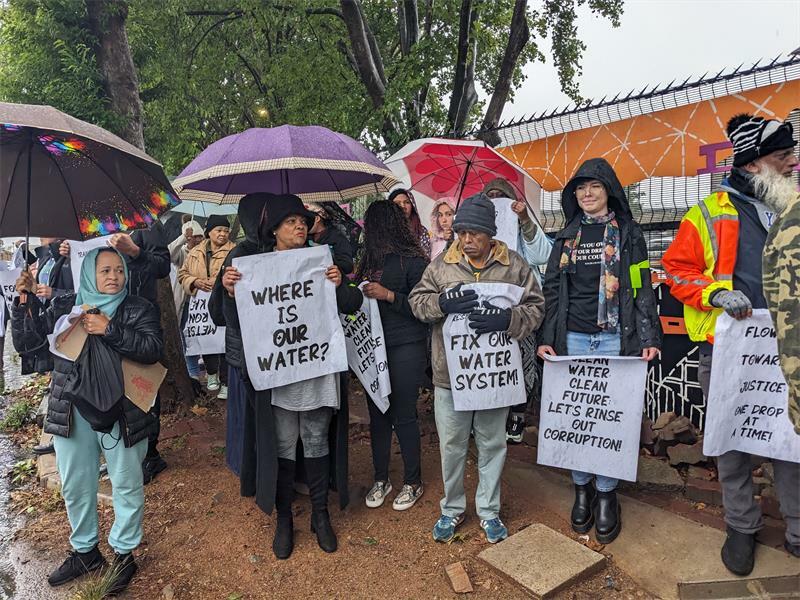
The Water Crisis Committee, a group of deeply concerned residents from across the city, formed a few weeks ago in a bid to tackle the water crisis facing Johannesburg.
They recently held a peaceful picket at the Brixton Multipurpose Centre where they addressed the mayor and handed over a petition that outlines their demands, which the mayor personally received. A follow-up meeting with him is imminent to chart a way forward.
They have also, with Outa’s Water CAN group, arranged for a dialogue at Constitution Hill with both Johannesburg Water and Rand Water to firstly understand how current challenges came about, and to identify a path out of the crisis. This meeting will take place after this edition of the paper goes to print but will be covered in the following edition.
The committee arranged for Mike Muller, a professional civil engineer and water expert, to address several concerns that residents have had and to answer some questions posed by the broader community.
Below is a distillation of the discussion with questions and answers from a large online meeting held by the Water Crisis Committee and the communities they represent.
“South Africa is a water-scarce country, but we shouldn’t run out of water. What we might run out of is time. If we don’t have ingenuity in planning for the future things might get difficult when one looks down the road.”
He says the role of civil society is critically important. Organisations can push for better communication with city entities to communicate localised problems timely so residents can plan better. They can also push for greater accountability from Rand Water and Johannesburg Water, but they cannot involve themselves in maintenance of water systems and infrastructure.
Muller says it is critical that:
- The city gets to grips with water losses in public and private water supply systems
- Residents reduce consumption and check if they have dripping taps or leaks
- Civil society helps residents identify how much they are using to see where cuts can be made, like they did in Cape Town with the Day Zero planning
- New townhouse and other building developments need to instal water-efficient plumbing, smaller geysers and put sensible measures in place for water-wise gardens, and so on.
“Generally, when the weather is warmer and there is no rain, residents are asked to stop watering their gardens during the day nor wash cars, and so on. As soon as there is rainfall or colder weather moves in, the situation normalises. This ebb and flow of managing water supply is normal, cyclical and nothing out of the ordinary.”
He says for many residents a slightly erratic water supply is ‘uncomfortable’ but manageable. “For people living in areas where the particulars of their place in the local water network means they are without water for weeks or months at a time, it is unbearable.

“We are not looking at one set of problems but are dealing with a range of issues across the metro that will take quite a long time to address and not in the short term, unfortunately.”
When looking at the bigger picture, there may be a few things happening:
- Climate change
When temperatures increase people generally consume more water. - Population growth
More people result in a need for greater water supply. We can’t stop migration to the city and we can’t stop reproduction within the city. - Load-shedding
Even though Rand Water is technically exempt from power cuts, the rest of the network is not. When a lack of power impacts the ability of utilities to pump water the knock-on effect can last days. Water is not like electricity when flipping a switch immediately restores supply. Pipes need to be filled, as do reservoirs and so on which can take days to normalise.
- It depends where you live
Depending on what infrastructure is available in a certain area, such as storage reservoirs, capacity in pipes, or the area is high lying. Restoring supply to some areas can take days as the system has to ‘restore’ twice the needed volume in a short space of time. Firstly, to get water into the pipes to start filling reservoirs and water towers, and secondly, into homes and businesses that often start consuming it as it starts to flow, which makes building a reserve time consuming. A good example of this was the recent Rand Water outage of several days to instal larger pipes. Some areas were lightly affected while others suffered a lack of supply for two weeks as the system came back online. - Load-shifting
Water is taken from one water system to another that needs a boost in supply. It is unclear at the moment how this is actually affecting areas the water is taken from. This issue will be one to keep an eye on as we share an already limited supply. - Water leaks
There is much rhetoric around this topic and high numbers flying around. If leaks could be capped at 10 to 15% that would be a reasonably acceptable loss. We are currently losing about 25%.
- Throttling
When supply is lost and reservoirs and towers are empty, it is essential to refill them quickly. Should a second interruption occur, and supply has not been restored, the problems multiply. Therefore, water usage may be restricted to enable reservoirs and towers to be filled before it is made available for consumption. Again, this is an inconvenience for most, but those in some areas may go without water for quite some time after others in that particular water network.
Are boreholes the solution?
Gold miners realised back in 1902 that there was an insufficient underground water supply despite there being a small population at the time. Rand Water was established as a business to bring in water from the Vaal Barrage firstly, and later to build what is now the Vaal Dam in 1938. The Tugela River and other provinces were brought into the mix in the 80s and then other countries when the Lesotho Highlands project was started.
If there was insufficient water back then, nothing has changed except there are more people now consuming it now.
Borehole water generally should not be consumed – especially if it comes from supply under city streets. There are often old and cracked sewerage pipes that can infiltrate the water table the borehole relies on. It is safe for helping to water your garden, wash your car, and so on, but should not be consumed or cooked with as a rule of thumb.
As more and more people install boreholes this will in time deplete the supply.
Can current problems be fixed?
n It is imperative that residents begin using water wisely. A lot of cities across the world are becoming water conscious as this is not a problem unique to South Africa or Johannesburg.
- Leaks and broken infrastructure need to be attended to urgently. Often when supply is restored, the sudden inflow of water can damage pipes causing leaks, and so on.
- When Phase 2 of the Lesotho Highlands Project comes online in about five years that should ease restrictions considerably. But until then the city must cut back on consumption.
This all paints a picture of a water supply network that is functioning at its limit with no clear end in sight.
Related Article: Protesters demand mayor takes action over water crisis