
Former Constitutional Court Justice Sisi Khampepe urges University of Johannesburg graduates to build better communities
Receiving an honorary doctorate from UJ, Justice Sisi Khampepe urged graduates to reject indifference and use their knowledge to create meaningful change.
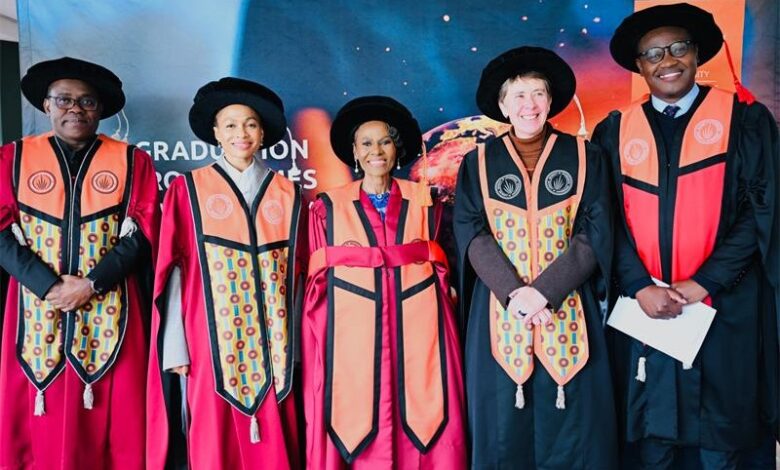
Former Constitutional Court Justice Sisi Khampepe urged new University of Johannesburg (UJ) graduates to use their skills to build better communities during an address on September 30.
Khampepe, an accomplished jurist, spoke moments after receiving an honorary doctorate. Much like her career, which has been dedicated to using the law as a tool for change, she used her acceptance speech to inspire the next generation of leaders. “Graduates, you are not spectators waiting for a better future to arrive,” she said. “You are among its purpose. The future will bear the imprint of what you tolerate, what you create, what you repair, and what you refuse to abandon.”
She reminded graduates that her generation’s task was to help dismantle an unjust political order and lay the foundation of a constitutional democracy. “Your task is not identical to ours. Each generation is called upon to meet the demand of its own time. You may feel the need to fulfil that calling, or you may betray it through indifference, complacency, or silence. Your calling is to make the promise of that democracy real in the daily lives of our people.”
Khampepe forms part of a group of eight eminent individuals across sectors ranging from education, business, and sport on whom the university conferred honorary doctorates for their contributions to society.
Read more: UJ fun run gets Johannesburg moving for a good cause
Born in 1957 in Soweto, Khampepe obtained an LLM from Harvard Law School in 1982, becoming one of the first black South African women to graduate from the institution. She shared that her experience of graduating from a university in a country where democracy was a reality was an important reminder that injustice was not permanent. “What Harvard gave me was exposure to different constitutional ideas of scholars and students from across the world and the intellectual distance from which to see my own country more clearly,” she said. “Apartheid was not natural. It was not inevitable. It was a political system made by human beings, and it could therefore be unmade by human beings.
“I returned home knowing that things could be different, that knowledge mattered. Once you have seen that another identity is possible, it becomes much harder to accept the claim that the present is permanent.”
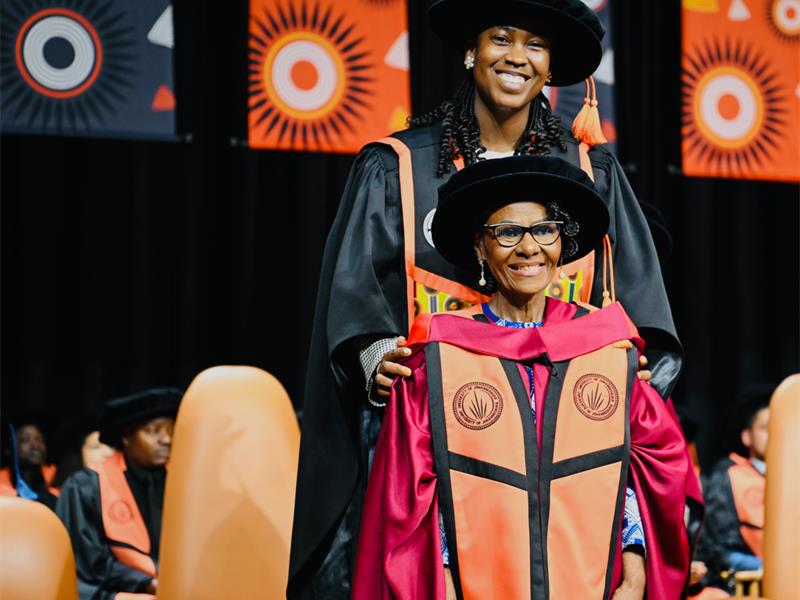
Khampepe’s legal acumen and commitment to justice brought her to national prominence when President Nelson Mandela appointed her as a commissioner of the Truth and Reconciliation Commission in 1995. She was subsequently appointed to serve on the commission’s amnesty committee, where she helped navigate one of the most delicate chapters of South Africa’s democratic transition. Her work in this space required immense integrity, compassion, and legal clarity as the country grappled with the consequences of state violence and systemic oppression.
Khampepe acknowledged that while much had been done to bring South Africa to where it is today, much still needs to be done, noting that these challenges are a stark reality for graduates entering the job market. “You enter a society in which many young people feel anxious about their future,” she said. “They confront high unemployment, systemic inequality, violence, corruption, and climate crisis, whose burdens will be carried long after the present generation of leaders is gone.
Also read: UJ students march on Brixton Police Station to demand increased safety and patrols
“I will not incite you by pretending that optimism alone can solve these problems. Nor will I tell you that every obstacle is merely a failure of personal effort. Structures matter. History matters. Opportunity is still distributed profoundly and differently, along both social, racial, and gender lines, but agency is not the denial of injustice. Agency is the refusal to surrender your ownership to it.”
On receiving the honour, Khampepe said it was something she would forever cherish. “I receive this honorary doctorate with deep gratitude and humility. To be recognised by a university that bears the name and the energy of this great city is deeply meaningful to me.”
UJ vice-chancellor and principal professor Letlhokwa Mpedi praised Khampepe for her contributions to strengthening and deepening democracy in the country. “The values that Justice Sisi Khampepe embodies align with those of the University of Johannesburg, including commitment to justice, integrity, community engagement and ethical leadership. Her legacy is one of quiet courage, rigorous integrity and profound empathy, and her work reflects an unwavering belief in the transformative potential of the law and the necessity of justice for building a dignified and inclusive society.”
Follow us on our Whatsapp channel, Facebook, X, Instagram, and TikTok for the latest updates!