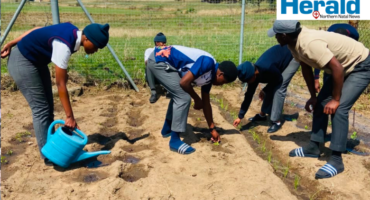
Lack of rain and the heatwave: the prospects are not good for any sign of relief, say the experts
Many regions across the country are experiencing drought conditions and heat waves, with little or no rain expected for the rest of the week.

Meteorologists say the escalating temperatures are expected to continue until the end of the week.
The mercury in Endumeni is expected to rocket up to 36 degrees today and possibly 38 degrees tomorrow.
Many regions across the country are experiencing drought conditions and heat waves, with little or no rain expected for the rest of the week.
Meteorologist, Mduduzi Mthembu, explains why varying levels of hot and dry conditions may even persist until the beginning of autumn next year. It will persist the whole of the summer and even spread towards the beginning of autumn.”
Mthembu adds, “By winter it should be normalising, but going into the winter as well, that is where we are expecting dry weather conditions. You do feel as if it is just a continuation of dry conditions. There is a high pressure system in the north eastern provinces of the country and in the mid-levels of the atmosphere, that results in clear conditions and very warm temperatures due to the air passels subsiding instead of going up and forming the clouds. So it subsides and as it goes down towards the surface it warms up. But on a global scale it is a result of the current El Nino conditions that is being experienced throughout the world.”
The next biggest chance of rain, according to the long term KZN forecast for the area, is November 22 when there is a 77% chance of rain.
According to a document on Long Term Weather Scenarios, prepared by the Department of Environmental Affairs the trend is not unexpected:
“High temperature extremes have increased significantly in frequency, and low temperatures have decreased significantly in frequency annually and in most seasons across the country. Rainfall has shown high inter-annual variability, with rainfall being above average in the 1970s, the late 1980s, and the mid to late 1990s, and below average in the 1960s and in the early 2000s, reverting to mean towards 2010.
“Annual rainfall trends overall over the last five decades are weak and non-significant, but there is a tendency towards a significant decrease in the number of rain days in almost all hydrological zones. This implies a tendency towards an increase in the intensity of rainfall
events and increased dry spell duration.
“Based on comparisons of observed and modelled trends for 1960–2010, some key climatic processes relevant for South Africa appear not to be adequately represented by the GCMs or the downscaling methods currently in use.
Key findings in this regard are that observed temperature trends are more closely matched by modelled simulations than are rainfall trends, a tendency noted in the IPCC fifth Assessment Report. It is also noteworthy that observed temperature trends since 2000 have not increased as steeply as projected by model simulations.
“Overall, there is far less uncertainty in temperature than in rainfall projections over the coming century.
Even under effective international mitigation responses, significant socio-implications are expected for vulnerable groups and communities in South Africa under both wetter and drier climate futures. These implications will largely be felt through impacts on water resources, such as changes in water resource availability and a higher frequency of natural disasters (flooding and drought), with cross-sectoral effects on human settlements, disaster risk management and food security. There is a need to explore the cross-sectoral socio-implications of future climate scenarios on water and food security and to develop adaptation scenarios to inform national and sub-regional response strategies.”
More on the water crisis:
Water crisis deepens as pumps stutter in dwindling Buffalo River …
Farmers, Umzinyathi meet to discuss water crisis