16 Days of Activism Against Women and Child abuse starts tomorrow
What are you going to do help curb this terrible blight on our society?
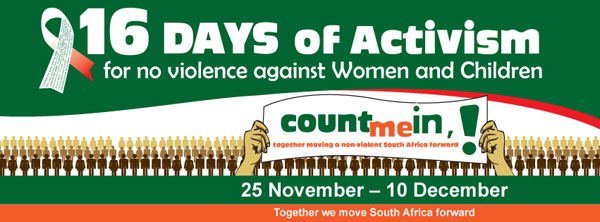
The 16 Days of Activism for No Violence Against Women and Children is an international awareness-raising campaign is to be launched tomorrow November 25 (International Day for the Elimination of Violence Against Women) to December 10 (International Human Rights Day). The period includes Universal Children’s Day and World AIDS Day.
South Africa adopted the campaign in 1998 as one of the intervention strategies towards creating a society free of violence. The campaign continues to raise awareness amongst South Africans about the negative impact of violence against women and children (VAW&C) on all members of the community.
At the launch of the 16 Days Campaign on November 25, 2014, President Jacob Zuma said that activism against gender-based violence should be a year long campaign and not limited to 16 days. The Department of Women heeded the President’s call and launched the “365 Days for No Violence Against Women and Children” (#365Days campaign) and “#CountMeIn.”
President Jacob Zuma will launch the 2015 campaign on November 25 in Naauwpoort, Mahikeng.
Objectives of the campaign
The objectives of the 16 Days Campaign are to:
Attract all South Africans to be active participants in the fight to eradicate VAW&C; hence the theme:
Expand accountability beyond the Justice, Crime Prevention and Security (JCPS) cluster to include all government clusters and provinces.
Combine technology, social media, the arts, journalism, religion, culture and customs, business and activism to draw attention to the many ways VAW&C affects the lives of all people in all communities around the world.
Ensure mass mobilisation of all communities to promote collective responsibility in the fight to eradicate violence against women and children.
Encourage society to acknowledge that violence against women and children is NOT a government or criminal justice system problem, but a societal problem, and that failure to view it as such results in all efforts failing to eradicate this scourge in our communities.
Emphasise the fact that the solution lies with all of us.
What is violence against women and children?
Violence takes many forms, for example:
Physical violence in the form of domestic violence, murder, robbery, rape and assault.
Emotional violence and trauma at many levels caused by many factors. Women and children in their homes, at work, at schools, on our streets, in our communities suffer this form of violence for various reasons.
Another terrible blight of our democracy is the violence of poverty, starvation, humiliation and degradation, especially against women and children. Poverty, inequality and unemployment are conditions under which violence thrives.
What can you do?
Together, let us take actions to support the 16 Days of Activism for No Violence Against Women and Children campaign.
Support the campaign by wearing the white ribbon during the 16-day period: A white ribbon is a symbol of peace and symbolises the commitment of the wearer to never commit or condone violence against women and children.
Participate in the various 16 Days of Activism events and activities.
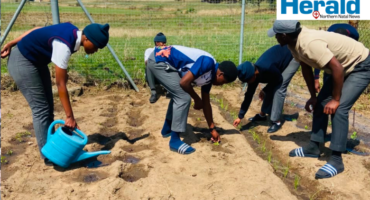
Volunteer in support of NGOs and community groups who support abused women and children: Many organisations need assistance from the public. You can volunteer your time and make a contribution to the work of institutions. Help plant a garden at a shelter, sponsor plastic tables and chairs for kids at a clinic or join an organisation as a counsellor. Use your skills and knowledge to help the victims of abuse.
Speak out against woman and child abuse.
Encourage silent female victims to talk about abuse and ensure that they get help.
Report child abuse to the police.
Encourage children to report bully behaviour to school authorities.
Men and boys are encouraged to talk about abuse and actively discourage abusive behaviour.
Seek help if you are emotionally, physically or sexually abusive to your partner and/or children. Call the Stop Gender Based Violence helpline (0800 150 150).
Talk to friends, relatives and colleagues to take a stand against abuse of women and children.
Try and understand how your own attitudes and actions might perpetuate sexism and violence.
Spread the message on social media using
Join community policing forums (CPFs): The community and the local police stations are active partners in ensuring local safety and security. The goal is to bring about effective crime prevention by launching intelligence-driven crime-prevention projects in partnership with the local community.You may want to also become a reservist, a member of the community who volunteers his/her services and time to support local policing efforts to fight crime. For more information on how to join, contact your local police station.
What is the Government doing?
The Women Empowerment and Gender Equality Bill provides government with the legislative authority to fast-track the empowerment of women and address issues of enforcement and compliance towards the attainment of our target of 50/50 gender parity.
On 6 June 2011, Government launched the Strategy and Guidelines on Children Working and Living in the Streets [PDF]. This Strategy provides guidance on the services and programmes to be rendered to children living and working in the streets.
The Green Paper on Families [PDF] seeks to strengthen and support families as the cornerstone of a well-functioning society.
Since 1994, Government has developed several pieces of legislation to redress the wrongs affecting women and children.
The Prevention and Combating of Trafficking in Persons Act (Act No 7 of 2013) fights trafficking of young girls and women, and also the practice of ukuthwala, a form of abduction that involves kidnapping a girl or a young woman by a man and his friends or peers with the intention of compelling the girl or young woman’s family to agree into marriage.
Where to get help
What if you are abused [PDF]
Service contacts [PDF]
SAPS Crime Stop
08600 10111
Gender-Based Violence Command Centre
0800 428428/0800 GBV GBV
STOP Gender Violence Helpline
0800 150 150/ *120*7867# from any cell phone
Childline- Report child abuse
0800 055 555
Elderly people helpline
0800 003 081
Family and Marriage Society of South Africa – Advice on family relationships
011 975 7107
Thuthuzela Care Centres-
012 8456136
Suicide Crisis Line
0800 567 567
Alcoholics Anonymous SA
0861 435 722 Substance Abuse Helpline 0800 121 314
Narcotics Anonymous SA
0839 00 69 62
Mental Health Information Line
0800 567 567
AIDS Helpline
0800 012 322 / 011 725 6710
National Anti-Corruption Hotline
0800 701 701
Disaster Operations Centre
080 911 4357
Crisis Line
0861 574747
National Crisis Line- Counselling Service
086 132 2322
Human Trafficking
08000 737 283 (08000 rescue) / 082 455 3664
SASSA- Grants enquiries
0800 60 10 11 or CPS 0800 60 01 60
SA National Council for Child Welfare
011 339 5741
Legal Aid
0800 1110 110
Presidential hotline – Unresolved service delivery complaints
17737 (1 PRES)
National Anti-corruption Forum
0800 701 701
Cancer Association of South Africa
0800 22 66 22