VRYHEID KZN: Speed bumps to ensure a safer intersection
That same night, the bumps were removed by the department and not by the local community, as rumours indicated
It is a few months later, but the tragic accident at Lakeside Crossing that claimed 10 lives is still fresh in the minds of many residents. During the investigation that was done by the Road Traffic Management Corporation (RTMC), it was determined that high speed was not a factor in this particular crash. Physical evidence also determined that the car was only ‘overloaded’ by a three-year-old and this wasn’t a contributing factor in this specific crash. RTMC made a few preliminary recommendations, which included stricter law enforcement (for example enforcing the wearing of seatbelts), the amendment of legislation for the transporting of passengers in a commercial vehicle, and the most important one being proper signage, which should’ve occurred a long time ago on these roads leading to this infamous intersection.
During May, a follow-up meeting and site inspection was scheduled between officials from the KwaZulu-Natal Department of Transport, together with investigators from RTMC, when they visited Lakeside Crossing. In this meeting, RTMC concluded that there was not sufficient warning or speed limit signs when motorists approach the intersection, which makes it a hazardous and dangerous crossing. An investigator from RTMC said that ‘geographically, the angle is very high, so there must be measurements implemented to slow down and warn traffic long in advance of this intersection. And it seems like the signage is not there’. Furthermore, it was suggested that the sides of the road be cleared of overgrown vegetation and that stricter law enforcement be implemented during peak times, as well as throughout the day. Even though the recent accident was allegedly due to human error, it is still imperative to rectify and ‘safeguard’ the crossing to avoid further crashes. The officials from the department indicated that a signal light will be erected by the end of this year as an interim measurement. Rumble strips will be upgraded and clearly marked, as well as the clearance of vegetation alongside the road.
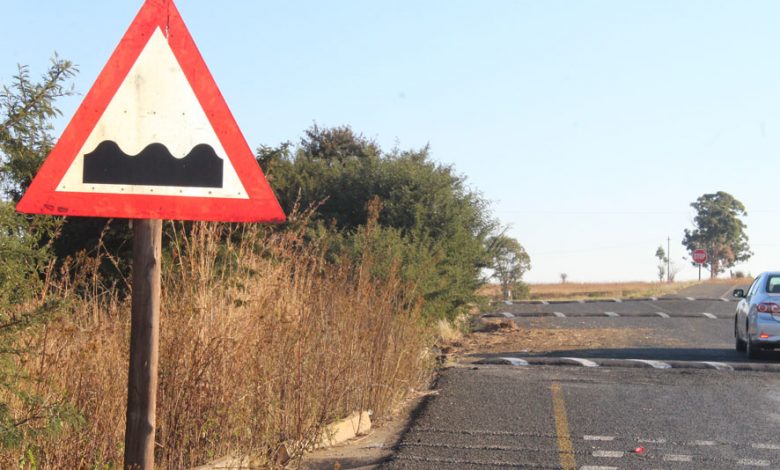
Last week Thursday (June 10), speed bumps were erected on the R69 and R34 leading up to the intersection. At first, these speed bumps seemed hazardous since they were too close together and a few vehicles got stuck on them, while a few other vehicles were severely damaged. There were also no warning signs erected to warn motorists of the speed bumps. Road Traffic Inspectorate (RTI) Principal Provincial Inspector Ndlazi called in officials from the KZN Department of Traffic to indicate to them that the speed bumps were ‘faulty’. That same night, the bumps were removed by the department and not by the local community, as rumours indicated. The following morning (June 11), the department was back on site to clear off the rest of the debris from the previous speed bumps and on Saturday (June 12), the bumps were erected again. This time around, sufficient warning signs were up and the bumps were spaced according to the specifications. Even though some vehicles have a low suspension and might still scrape a bit when driving over the bumps, Inspector Ndlazi said: “Some motorists are happy for the humps, but others are complaining. Road safety is our priority, so let us collectively save lives.” Unfortunately, it was noticed that vehicles are now driving over the island to avoid the speed bumps. Inspector Ndlazi confirmed that they will correct that issue as soon as possible. The Herald drove along the R34 on Sunday (June 13), leading up to the intersection, and the speed bump warning sign is only visible when a driver is already close to the bumps, due to overgrown vegetation. Principal Provincial Inspector Ndlazi (RTI) informed the Herald on Monday (June 14) that immediate clearance of the vegetation will occur. The Department of Transport confirmed that the speed bumps are now according to the Road Traffic Act’s specifications and regulations.
The Road Traffic Act (12.2.7) ‘explains’ speed humps as follows:
“1. Speed humps are an extremely effective means of reducing vehicle speeds. Speed humps are most suitable for local collectors and access roads, and overseas experience shows that they are most commonly used in residential streets with traffic flows of up to 500 vehicles/hour. Both round and flat top (raised plateau) speed humps are acceptable. A major advantage of flat topped road humps is that they can be used as pedestrian crossings. Speed humps must be located along a road such that they are always preceded by a speed reducing feature, such as another speed hump (in a series), and by road markings. A hump may be of any height between 50 mm and 100 mm to suit particular cases. The length of the hump is greater than that of a motor vehicle’s wheelbase, yet it constrains the speed of cars. It is acceptable to use a variety of heights and profiles in a series of speed humps but the length, (the dimension parallel to the road centreline) should be in the order of 3,5 m to 4,0 m.
- The use of speed bumps (i.e. humps of minimal length) is not supported since they can, if not seen by oncoming drivers, result in drivers losing control of their vehicles. There is no restriction on the number of humps in a series but it is recommended that not more than 20 be used.”
ALSO READ: VRYHEID KZN: Coming soon… Infamous crossing to have signal lights
Make sure you follow us on our social media platforms for regular updates