Iris the robot visits Ferdinand Primary School in Weenen
The visit aimed to introduce the school community to the robot and show how it works.
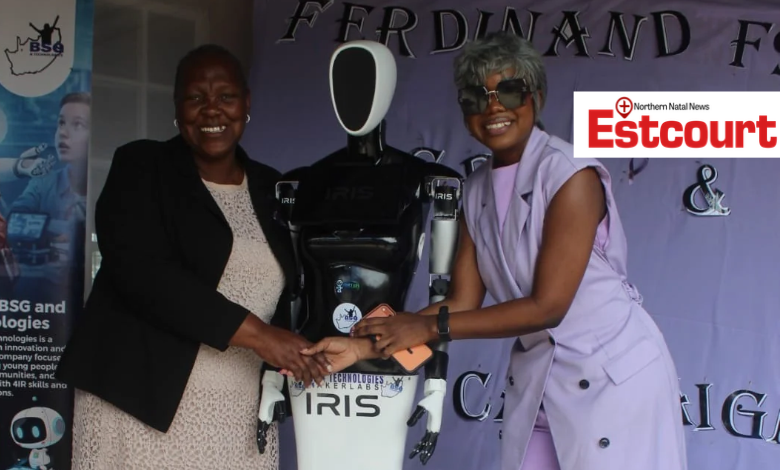
Ferdinand Primary School in Weenen welcomed ‘Iris’ today (October 29). Iris is an innovative educational robot that is part of an initiative to raise awareness about technology among learners, teachers and the wider community. The visit aimed to introduce the school community to the robot and demonstrate how it works and how it can support teaching and learning.
Iris was developed by inventor Ms Thando Gumede, who described the robot as a groundbreaking innovation designed and manufactured in South Africa. According to Gumede, Iris has attracted significant international interest, with more than 2000 units reportedly sold worldwide.
She explained that the robot can help with teaching a wide range of subjects, from Grade R through to university level, and is capable of communicating in more than 7000 languages. This, she said, makes Iris a potentially valuable educational tool for schools looking to embrace technology and improve learning outcomes.
Gumede also shared her experiences participating in international technology competitions. “I have attended competitions in China and Dubai, with support from the MEC, where I competed against other countries in the technology field,” she said, highlighting her experiences on the international stage.
She further revealed that she had been invited by President Cyril Ramaphosa to represent the country in the United States of America.
Schools can win a robot
Recognising that the cost of acquiring Iris may be beyond the reach of many schools, Gumede has introduced the National Iris Lab Campaign, an initiative that gives schools an opportunity to compete to receive the robot.
Through the campaign, participating schools rely on votes from members of the public to improve their chances of being selected to receive an Iris robot.
Ferdinand Primary School was reportedly ranked number three in the voting at the time of the visit. Gumede appealed to the community to continue supporting the school by voting for it, giving learners and teachers a greater opportunity to benefit from the technology.
Supporting teachers, not replacing them
She emphasised that the robot should be viewed as a tool to support educators, rather than a replacement for teachers, addressing concerns that advances in artificial intelligence and robotics could threaten teaching jobs.
“Instead of fighting technology, it is better for us to work with it so we can benefit from it,” Gumede said.
“Iris is like a car; she will always need a teacher to drive her. Teachers have a lot of work to do, including marking papers, classwork, homework and examinations, sometimes even during school holidays. Having Iris means that much of this work can be done within seconds, helping to reduce teachers’ workloads,” she explained.
Her message was that technology, when used effectively, can complement teachers’ efforts, save time and allow educators to focus more on supporting learners and improving the quality of education.
School hosts GBV awareness campaign
In addition to the technology awareness initiative, Ferdinand Primary School also hosted a gender-based violence (GBV) awareness campaign aimed at educating learners, teachers and members of the community about the scourge of gender-based violence.
The campaign brought together various stakeholders, including representatives from the Department of Social Development, the Department of Co-operative Governance & Traditional Affairs (CoGTA), the Department of Health, members of the South African National Defence Force (SANDF) and neighbouring schools.
The participation of these stakeholders highlighted the importance of collaboration between schools, government departments and communities in addressing social challenges and promoting safer environments for children.
Click to receive news links via WhatsApp Channel. Or for the latest news, visit our webpage or follow us on Facebook and Twitter. Join us there!