From bomb shelters to Randburg sunshine
Born in 1936, Dinah Blow grew up in wartime London, surviving bombings, strict rationing and disruption before building a new life in Randburg.
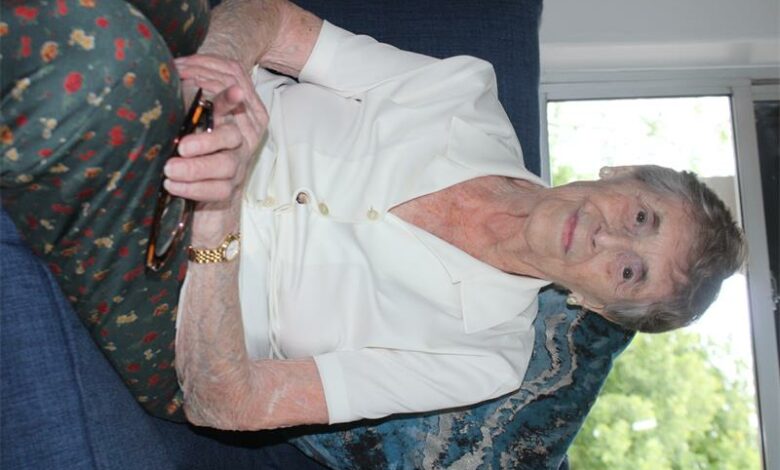
Dinah Blow was not yet three years old when the Second World War began in 1939.
Now approaching 90, she sits with her notes from the night before, a small concession to age, and recalls a childhood that, while shaped by fear and shortage, was simply normal life to a little girl who knew nothing different.
“If there’s nothing you can do about it, then you mustn’t worry about it,” she said with the calm of someone who has carried that lesson for nearly nine decades.
Born in Hampstead, close to the heart of London, Dinah’s early years were quickly uprooted by bombing raids that pounded the city. Her family moved to Harrow on the outskirts, where the bombs still fell, but less frequently. Her two brothers, 11 and 13 years her senior, both went off to fight. Life as she might have known it simply never had a chance to take shape.
Read more: ATM bombing at Honeydew Sasol garage leaves one dead
At school, children were not permitted to leave during an air raid siren. Few families owned cars, so children walked everywhere on their own from a very young age. Blackout curtains were fitted in every home, and wardens patrolled the streets, knocking on doors if even the faintest sliver of light crept through a window. The beaches were lined with barbed wire. Holidays by the sea were out of the question.
Food was rationed strictly, but Dinah speaks of it without bitterness. “Everybody got a little something. Very small portions, just enough to sustain you.” One egg per person per week was the allowance. When rationing on confectionery was briefly lifted after the war, the entire country bought up every sweet in every shop. The government had to reintroduce rationing until people calmed down.
“I think this is why people of my age have reasonable teeth,” she said with a quiet smile.
Once Dinah turned four, her mother was required by law to work in a munitions factory. Dinah reflects on this with admiration. “It was a type of emancipation for women. All of a sudden, they were doing work that men would do. They felt more independent, and they made a heck of a difference.”

One memory stands out with particular clarity. On a visit to central London with her mother, the air raid sirens began to wail. They rushed with a crowd towards the underground station, rode the escalators as deep as they could go, and sat on the staircases waiting for the all-clear. “You were safer underground. If you’re outside and a bomb drops, you can get the blast, the heat, the radiation. All these things were everyday things as far as we were concerned.”
Entertainment was found on the radio. On one programme, she first heard a young girl, about her own age, singing with a voice that left her spellbound. “Why couldn’t I sing like her and be famous?” she laughs. That little girl was Julie Andrews.
Also read: Police respond to bomb scare
When the war ended, Dinah found the aftermath harder than the war itself. “There was freedom, and you had won the war, but there were still shortages. It took a while for people to get everything together.”
Her greatest adventure came in the early 1960s, when her husband came home from work at Kodak with an unusual question: there was a position available in South Africa. Neither had ever met anyone who had gone there. They found the country in an atlas, and Dinah told him simply, “Apply for the job. If we’re meant to go, you’ll get it.” He got it. They came, had three children, and never really looked back.
Now in her late eighties, she ends the conversation with a thought that lingers. Looking at conflicts facing children in the world today, she worries about the long-term effects. “What they see and what they go through now is going to have such an impact on them. We can’t really know what the world is going to be like in 10 or 20 years.”
It is the reflection of a woman who has seen what the world can demand of its youngest people, and what those people can, quietly and without fuss, endure.
Follow us on our Whatsapp channel, Facebook, X, Instagram, and TikTok for the latest updates and inspiration!