Covid-19: Wednesday’s high cases have not affected overall infection downward trend
Natural deaths during the third wave higher than previous waves flagged as a worrying trend for the Gauteng province as the fast decrease in cases do not match slow decrease in deaths.

Although the Gauteng province saw a spike in coronavirus infections on Wednesday, this did not disturb the overall average weekly downward trend in cases, according to experts.
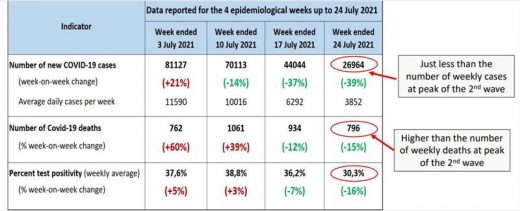
On Wednesday, the province recorded a relatively high infections mounting to 5 204 out of 17 351 cases nationally. This was a jump from an average of under 4 000 infections daily for the past few weeks.
During a press briefing by the Gauteng provincial command council on Friday, the premier’s advisory committee chairperson Dr Mary Kawonga hushed concerns regarding the rise, saying after the uptick cases went back to average and did not disturb the overall decrease in infections.
She said the high cases could be attributed to fluctuations in testing.
“Daily Covid-19 cases are lower than at the peak four weeks ago. The seven-day rolling average of daily cases shows a downward trajectory,” she said.
While the third wave continues, Kawonga said it accounted for more than half of cumulative cases which stood at 855 814 as of Friday.
“The third wave is not yet over, we have not reached the threshold that is expected for it to be over,” she said.
The average positivity rate has been declining for the past three weeks, from 40% during the peak to 23.8%.
“Yesterday, we had a 23% positivity rate but we want to get to 10%, which signifies low level of community transmission. We are not there yet and we need to ensure we get there.”
ALSO READ: Pretoria lung specialist loses battle with Covid-19
In the week that ended on July 24 , the province recorded 796 deaths related to Covid which Kawonga said was concerning as they were higher than during the week of the second wave peak.
Kawonga said an increase in natural deaths during the third wave which was higher than previous waves was worrying.
According to the South African Medical Research Council the province has recorded 47 166 natural deaths between 3 May 2020 and 24 July.
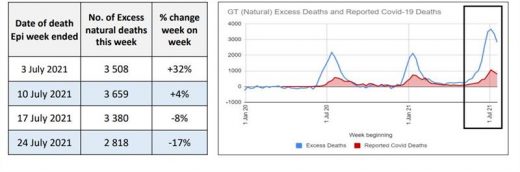
Since the beginning of the month until the week ending July 24, the deaths mounted to 13 365.
“We are seeing a high number of people dying. Even though we are seeing a reduction in deaths lately, this tells us we are not out of the woods yet. The council has previously said there is an underestimation when it comes to Covid-19 deaths and about 85% of those excess deaths are considered to be related to Covid.”
Kawonga said this showed that the province was still at a high risk for possible resurgence for towering infections.

Premier’s advisory committee Professor Bruce Mellado said they were concerned about the slow decrease in deaths while infections were decreasing fast.
He said mobility in the districts including Tshwane dropped.
“Pressure on the hospital system remains very high despite a significant drop in the number of active cases,” he said.
“Two weeks ago, during the looting, Tshwane and Johannesburg had an uptick in the risk index for possible high cases.”
Mellado said they expected in mid-August the active cases to drop to 20 000.
Premier David Makhura said strengthening the vaccination of the public was key to curbing the severe impact of infections.
“Stepping up the vaccination programme will really help us,” he said.
“We had a lot of health workers during the first and second wave that were sick but during the third wave the number was not the same – this shows the impact of vaccination.”
Makhura said the number of hospital admissions was declining compared to the previous week.
“We have a lot of people succumbing to Covid-19 which is really worrying,” he said.
“I want to emphasise, the province is putting a great deal into ensuring people get vaccinated. We have been vaccinating on average 53 000 people a day but we want to push this to 100 000.”

Gauteng health acting CEO Nomusa Mmope said they were seeing slow pace of people aged over 60 and males over 50 going for vaccinations.
“We are concerned about those who are over 60, they are coming but not at a pace that we would like them to. We are also concerned about the males above 50. We are seeing that this group is not coming to vaccinate.”
She pleaded with eligible persons to vaccinate.
* Notice: Coronavirus reporting at Caxton Local Media aims to combat fake news
Dear reader,
As your local news provider, we have the duty of keeping you factually informed on Covid-19 developments.
As you may have noticed, mis- and disinformation (also known as “fake news”) is circulating online.
Caxton Local Media is determined to filter through the masses of information doing the rounds and to separate truth from untruth in order to keep you adequately informed.
Local newsrooms follow a strict pre-publication fact-checking protocol. A national task team has been established to assist in bringing you credible news reports on Covid-19.
Readers with any comments or queries may contact National Group Editor Irma Green (irma@caxton.co.za) or Legal Adviser Helene Eloff (helene@caxton.co.za).
Do you have more information about the story?
Please send us an email to editorial@rekord.co.za or phone us on 083 625 4114.
For free breaking and community news, visit Rekord’s websites: Rekord East
For more news and interesting articles, like Rekord on Facebook, follow us on Twitter or Instagram