Test your dogs for deafness
Congenital deafness has been described in over 80 breeds, but is most commonly diagnosed in Dalmatians, Bull Terriers, Australian Cattle Dogs, English Setters, English Cocker Spaniels and Boston Terriers.
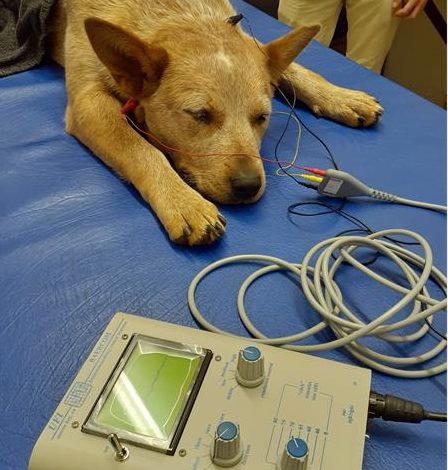
The University of Pretoria’s Onderstepoort Veterinary academic hospital is encouraging pet owners to have their dogs, mostly puppies tested for congenital deafness.
Congenital deafness means that a dog is born deaf and it cannot be cured as there are no implants or operations available in veterinary science to enable dogs to hear.
Onderstepoort’s Dr Paolo Pazzi said deafness can be resolved if it was related to inflammation of the external ear canal or “swimmer’s ear” – if treated early and appropriately.
The veterinary faculty was currently testing up to 30 dogs per month, as it had invested in the latest technology to test deafness.
READ MORE: Explosions as police foil west cash-in-transit heist
“It’s important for dog breeders and people getting a puppy to make sure that there is no congenital deafness in the line, particularly in breeds that are more susceptible to it,” said Pazzi.
He said pet owners were encouraged to have their dogs tested if they were adopted or deaf.
Congenital deafness has been described in over 80 breeds but is most commonly diagnosed in Dalmatians, Bull Terriers, Australian Cattle Dogs, English Setters, English Cocker Spaniels and Boston Terriers.
Pazzi said there was an association between deafness and pigmentation with white dogs being predisposed.
“Even more so if they are white with blue eyes.”
Pazzi said they were using a reliable way to test for deafness, called a Brainstem Auditory Evoked Response (BAER) test, manufactured by the American company UFI Baercom.
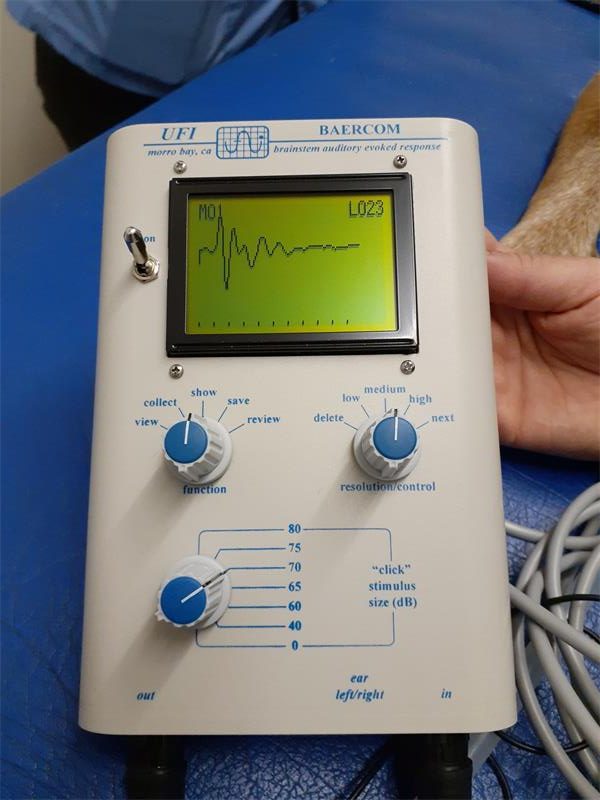
“We had an older, larger, clumsy device before this one as we have been doing deafness testing for some time, but it had become unreliable to the point that we could not do any BAER tests for about two years,” he said.
The BAER test detects electrical activity in the brain.
“The test is painless, and the pup or dog is usually lightly sedated as movement interferes with the results.
“Small electrodes are positioned on the animal’s head and connected to the device, which reads and interprets the brain’s response to a specific clicking noise generated by it.”
Pazzi said each ear was tested individually as the dog could only be deaf in one ear.
“If they can hear in the ear, the machine’s screen will show a recording of ‘waves’ of varying sizes and depths, but if they are deaf then the screen shows a recording of almost flat lines.”
Pazzi said deafness in the dog and or cat population was low overall, but responsible breeders should ensure their puppies can hear and that deafness is not carried in their breeding lines.
“Dogs with congenital deafness can be trained just like a hearing dog, by using hand signals instead of speaking and there are trainers who can assist with this.”
He said if any owner was concerned about a litter or dog, one could test for deafness, by contacting the Onderstepoort Veterinary academic hospital Small Animal Medicine clinic on 012 529 8302 or email referralsam@up.ac.za for more information.
Do you have more information about the story?
Please send us an email to editorial@rekord.co.za or phone us on 083 625 4114.
For free breaking and community news, visit Rekord’s websites: Rekord East
For more news and interesting articles, like Rekord on Facebook, follow us on Twitter or Instagram