Seasoned Botha still has many unfulfilled tennis dreams
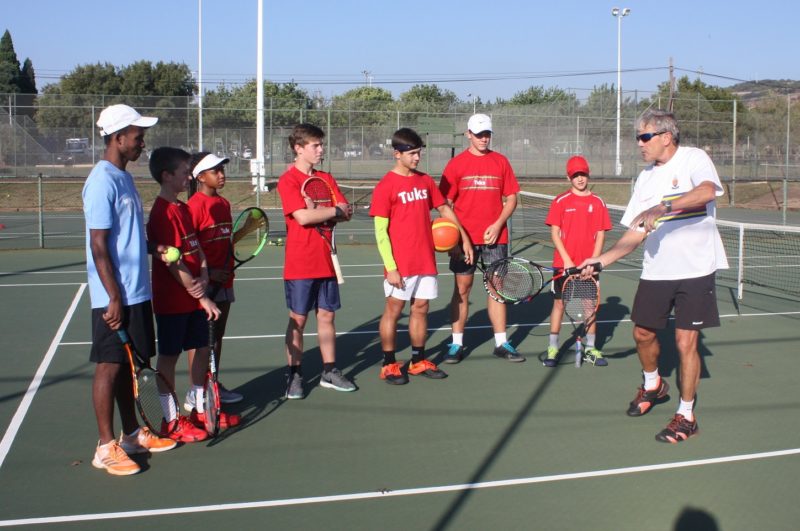
Kobus Botha has been around the block a few times, both as a player and a coach on the tennis courts of the world, yet he still enjoys working with his students every day and he believes that he can still offer much to the sport he loves so much.
South Africa had to wait for more than 20 years to deliver a tennis player who could reach a top ten spot on the world rankings for the first time since the best years of Wayne Ferreira in the mid-1990’s.
Now that Kevin Anderson could follow in the footsteps of Ferreira, tennis bosses will definitely have to look again at the standard of tennis coaching and mentors for youngsters in South African if we want to deliver more top players in future.
In this regard, you do not have to look much further than the Tuks Tennis Club to find one of the country’s most respected coaches.
Kobus Botha of Tuks Tennis is not only one of the country’s most experienced tennis coaches and administrators, but he is also a pioneer in many respects.
Botha had fallen in love with the game as a nine-year-old boy. Today, more than 50 years later, the passion has not yet burned out.
In his second year as a law student at Tuks, he realised he would never be a good lawyer and that he would rather spend his life on the tennis court.
Although he played professional tennis himself, he realised early in his career that coaching is probably more his forte. It is precisely in this regard that he did ground-breaking work when he approached the sport from a scientific perspective in the early 1980’s.
“There were not many resources available in those years,” he told Rekord during a recent interview.
“I had to teach myself by studying books on psychology, nutrition and other related topics.”
Since then, Botha has established himself as legend in the tennis world. His ground-breaking work is almost too much to mention. For example, he was involved in one of the sports coaching programs that would later form part of the foundation of Tuks’s world-renowned High Performance Center.
He is regarded as a brilliant creator of structures within which tennis programs can operate. The integration of aspects such as strategizing a visualization as part of modern tennis coaching programs was also part of his thinking in the modernisation of tennis coaching.
Since joining Tuks Tennis, he succeeded with the development of the tennis careers of dozens of players. At one stage, under his tutelage Tuks won seven consecutive USSA titles and he also did a lot of work to train young coaches.
Botha was also the pioneer who had to facilitate South Africa’s re-entry to the Davis Cup after being appointed the first post-isolation coach of the national team in 1992.
During that time, he coached legends like Wayne Ferreira and Marcus Ondruska and they could celebrate the country’s return with a sounding Davis Cup victory over Côte d’Ivoire.
Ondruska was one of his greatest successes as a coach. Under his guidance, the current South African Davis Cup captain progressed from the180th spot on the world rankings to become the 27th best player in the world – all in less than a year.
Among the other top players, he worked with men such as Neville Goodwin, Grant Stafford and Robbie Koenig. Before them there were also Piet Aldrich, Danie Visser and Pietie Norval.
Aldrich and Visser later became the number one doubles pair in the world.
“I was coached by Kobus Botha for five years and I learnt more than tennis lessons from him,” Godwin said when Rekord asked him about his impressions of Botha.
“He also taught me many valuable life lessons. He was a strict disciplinarian, but always fair and as a player you knew he had your back. Kobus has a deep passion for tennis and for South Africa. I will always think highly of him and remember him as being instrumental in helping me shape my life.”
Discipline as a foundation for a focused approach on tennis is also one of the main features that Koenig remembers of Botha’s mentorship.
“His passion and love for the game also stands out for me and I think it’s a bonus for any player to be coached by someone who really likes what he does,” said Koenig.
Maybe the best testimony comes from Richard Glover, the new CEO of Tennis SA who is doing so well to rebuild and expand South African tennis at all levels.
“Kobus Botha is one of the legends of the local tennis coaching fraternity and cares passionately about the game,” Glover told Rekord.
“He has a proven track-record over many years, but just as importantly still has much to offer our sport. He is actively involved in the Tennis South Africa High Performance Task Force, whose mandate is to look at ways of producing future Grand Slam champions.”
Botha does not think of retirement yet. He still has unfulfilled dreams such as better lighting at the club and the opportunity to host a Davis Cup tournament at Tuks.
His greatest passion and satisfaction, however, is to see talented players develop and progress within the structure he helped create.
He also believes South Africa has enough talent to produce many more top players – men as well as ladies – among the world’s top 50.
For free breaking and community news, visit Rekord’s websites:
For more news and interesting articles, like Rekord on Facebook, follow us on Twitter or Instagram.