Local Taekwondoin believes the sport can change lives
The relatively unknown sport of Taekwondo has changed a Tuks student's outlook on life forever.
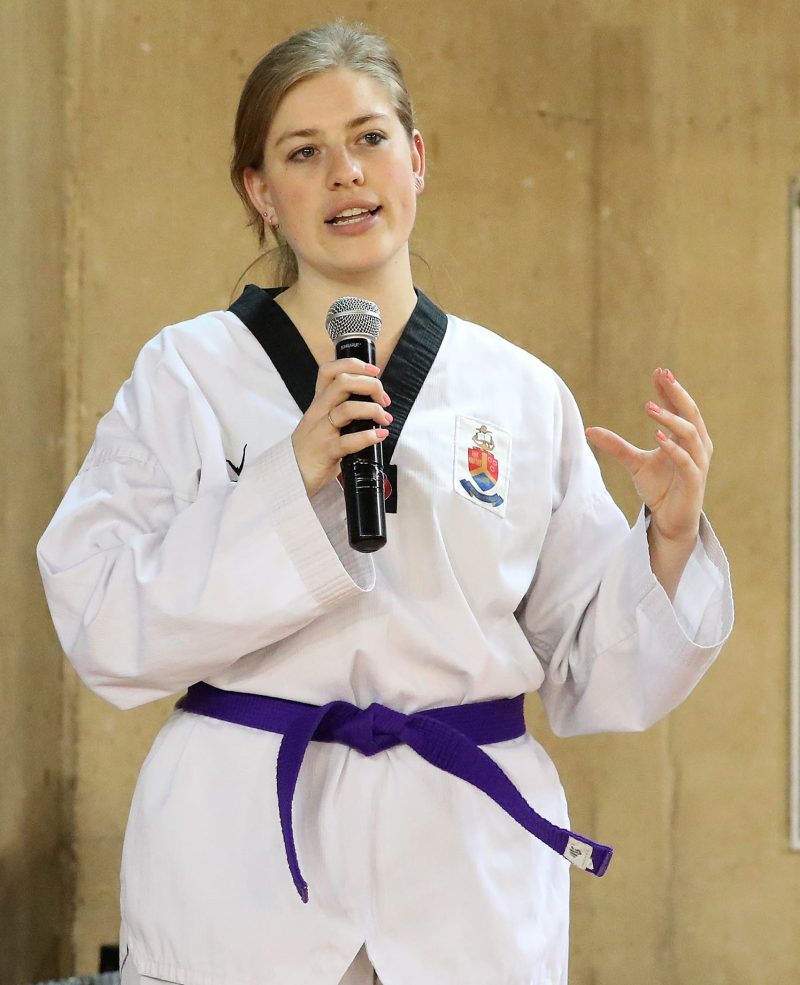
Taekwondo is one of the sports where the unthinkable becomes a reality.
Imagine “flying” through the air while demolishing eight pieces of wood within less than two seconds. It may sound impossible but is not. It happens. Those in doubt should watch videos of South Korea’s Kukkiwon Taekwondo team performing.
But there is more to the sport than breaking pieces of wood or tiles. Taekwondo changed the life of the Tuks postgraduate psychology student Christel Brooks.
Three years ago, she was going through a tough patch in her personal life. She realised she had to do something. Preferable sport as an outlet to vent some of her frustrations. She also felt it would be good to learn some form of self-defence, as in the evenings, a woman on her own is at times at risk.
The Tuks student, however, did not want to be involved in a sport only to make up the numbers. That is why she chose taekwondo. It is a decision she never regretted.
Over the last three years, her self-esteem improved through the heightening of her physical and mental powers. She has got more confidence and has learned to take control of her life.
“Taekwondo has also taught me self-discipline by strengthen mind and body. The sport is also big on respect for yourself and others. You even learn to appreciate your environment,” Brooks said during a recent interview.
Taekwondo was a demonstration sport during the 1988 Seoul Olympic Games. Since 2000 it is one of the official Olympic sporting codes.
Athletes compete according to the rules of World Taekwondo. In an Olympic sparring match, all strikes are full contact, and the clock continues when points are scored. A standard point system works like this: One point for a regular kick, two for a turning behind the kick, three for a back kick, and four for a spinning kick to the head. Athletes wear a chest protector and helmets as well as some other protection.
As expected, one needs to keep one’s wits about when contesting a taekwondo bout. Reflex and a good pregame strategy certainly help. All basically boils down to muscle memory.
“People often might think we just kick for the sake of kicking, but that is not so. In senior competitions, there is a plan with each kick. You want to outwit your opponent,” Brooks explained.
She added that being genuinely competitive boils down to a balance between defence and attack.
Why do athletes break wood in taekwondo?
According to Brooks, it is to show power and accuracy.
“For each belt test, you need to break more boards either by kicking or punching using the techniques you are taught,” she remarked.
As to self-defence, Brooks said what is comforting is that nowadays when she feels threatened it is as if the techniques she has been taught automatically “kicks” in. But she admits there is still a lot to be learned.
Do you have more information about the story? Please send us an email to editorial@rekord.co.za or phone us on 083 625 4114.
For free breaking and community news, visit Rekord’s websites:
For more news and interesting articles, like Rekord on Facebook, follow us on Twitter or Instagram